Google and Constellation Energy have signed a power package covering 3,590 megawatts in the PJM electricity market, but only 890 MW of that total is planned new generating capacity. The distinction matters: one part of the deal will finance upgrades to 11 operating nuclear reactors, while the larger part is a contract for electricity from plants that already exist.
The agreement announced October 6 pairs a 20-year power purchase agreement for 890 MW of reactor uprates with a separate 15-year supply agreement covering 2,700 MW from Constellation’s existing PJM fleet. Constellation plans to invest more than $4.3 billion across six nuclear sites in Illinois, Pennsylvania and New Jersey. The first uprated output is expected in 2028, with the full program targeted before the end of 2032.
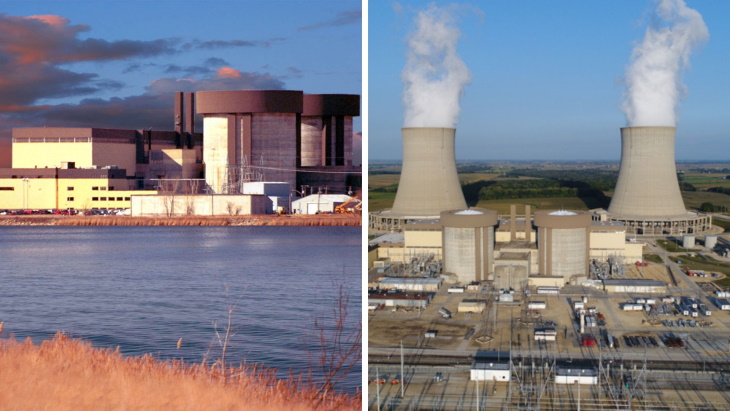
Why 3.59 GW does not mean 3.59 GW of new nuclear power
The two contracts do different jobs. The 890 MW portion is intended to add production through physical and digital upgrades at operating plants. Constellation describes that increase as roughly equivalent to a large conventional reactor, though it will be spread across 11 units rather than built at one site.
The 2,700 MW agreement provides long-term revenue support for electricity and capacity that Constellation’s fleet already supplies to PJM. It may help keep those assets economically viable, but it does not add 2.7 GW to the grid. Headlines that collapse both contracts into a single new-nuclear figure therefore overstate the near-term capacity gain by roughly four times.
The commercial structure also differs from a dedicated wire running from a reactor to a Google data center. The new output will enter the regional grid managed by PJM, which coordinates wholesale electricity across 13 states and the District of Columbia. Google is the anchor buyer financing the uprates and contracting for supply; the electricity joins a shared system serving homes, businesses and other large loads.
What a nuclear uprate changes inside a plant
An uprate increases the licensed output of an existing reactor. Constellation says its program will modernize turbines, steam generators and digital control systems to improve thermal and electrical efficiency. That can unlock more electricity without acquiring a greenfield site or waiting for a completely new plant to move through the interconnection queue.
The work is more substantial than a software optimization. The Nuclear Regulatory Commission divides uprates into three categories. Measurement-uncertainty recapture projects are generally below 2 percent and rely on more precise feedwater measurements. Stretch uprates are typically up to 7 percent and stay within a plant’s existing design capacity. Extended uprates can be larger and may require replacement or modification of high-pressure turbines, pumps, motors, generators and transformers.
Google and Constellation have not published the capacity increase planned for each reactor, identified which unit will deliver the first 2028 increment, or specified the mix of uprate categories. Each project will still need the relevant engineering work, outages and regulatory approvals. The announced dates are a delivery plan, not evidence that the extra power is already available.
The deal answers PJM’s data-center problem with more supply
PJM is trying to plan for loads that arrive faster than large power projects. Its 2026 shortfall analysis says data centers already account for more than 7 percent of energy use in the region and typically draw more than 90 percent of their load continuously. PJM projects its summer peak to rise by about 82 GW over 15 years, to 239 GW.
Against that backdrop, the agreement is designed as a “bring your own power” model. Google is backing incremental generation alongside its growing demand instead of relying only on whatever supply the regional market can procure. The contract also includes load shaping and demand response, allowing non-critical Google consumption to be reduced during stressed grid conditions.
That flexibility could be as important as the added megawatts. Nuclear units run most efficiently at steady output, while data-center operators can move or delay some computing tasks. The announcement does not disclose how much Google load can be curtailed, how quickly it can respond, or which workloads qualify as non-critical. Those details will determine whether the demand-response promise is a meaningful grid resource or a limited contractual safeguard.
Ratepayer protection is a claim that needs a paper trail
Google and Constellation say the private contracts will cover the uprate costs and avoid shifting them to residential customers. They also frame the projects as grid-wide additions rather than behind-the-meter capacity reserved for one company. That is a stronger starting point than asking utilities to socialize the full cost of new generation built around one large customer.
Still, the public announcement does not disclose contract prices, project-by-project cost allocation, performance guarantees or what happens if an uprate is delayed. Regulators and PJM stakeholders will need those details to test the ratepayer-protection claim. The key measures will be how much new capacity actually reaches the grid, whether Google pays for the demand it creates during peak conditions, and who absorbs construction or market risk if costs change.
Gemini is entering nuclear operations, with boundaries still unclear
A separate five-year technology agreement will put Google Cloud and Gemini Enterprise into Constellation workflows. The companies list three initial areas: site selection and power-flow modeling; asset-health, outage and construction planning; and security support for operational-technology networks.
Those are broad categories with very different risk profiles. An AI assistant that organizes permitting documents is not the same as software influencing plant dispatch, maintenance priorities or an air-gapped control environment. The announcement does not say whether Gemini will touch safety-related systems, what decisions require human approval, how model outputs will be validated, or how data will be separated from operational networks.
The 890 MW buildout is the concrete part of the story: upgrades to operating reactors, financed by a long-term customer, with initial output targeted in about two years. The 2,700 MW supply contract gives Constellation additional revenue certainty, and the Gemini program is an operational experiment. Keeping those three pieces separate makes the deal easier to judge as the engineering, licensing and contract details emerge.