Alibaba released Qwen4-Max on Monday, turning last week’s limited preview into a production API model with a one-million-token context window, native image and video input, and list pricing below the Qwen model it replaces at the top of the lineup.
The new model costs $1.50 per million input tokens and $4.50 per million output tokens in Alibaba Cloud’s Singapore region. A cache hit costs $0.075 per million input tokens. Those rates are 25% below the $2/$6 list price for Qwen3.8-Max, but the more consequential claim is that the model needs fewer tokens to finish difficult work.
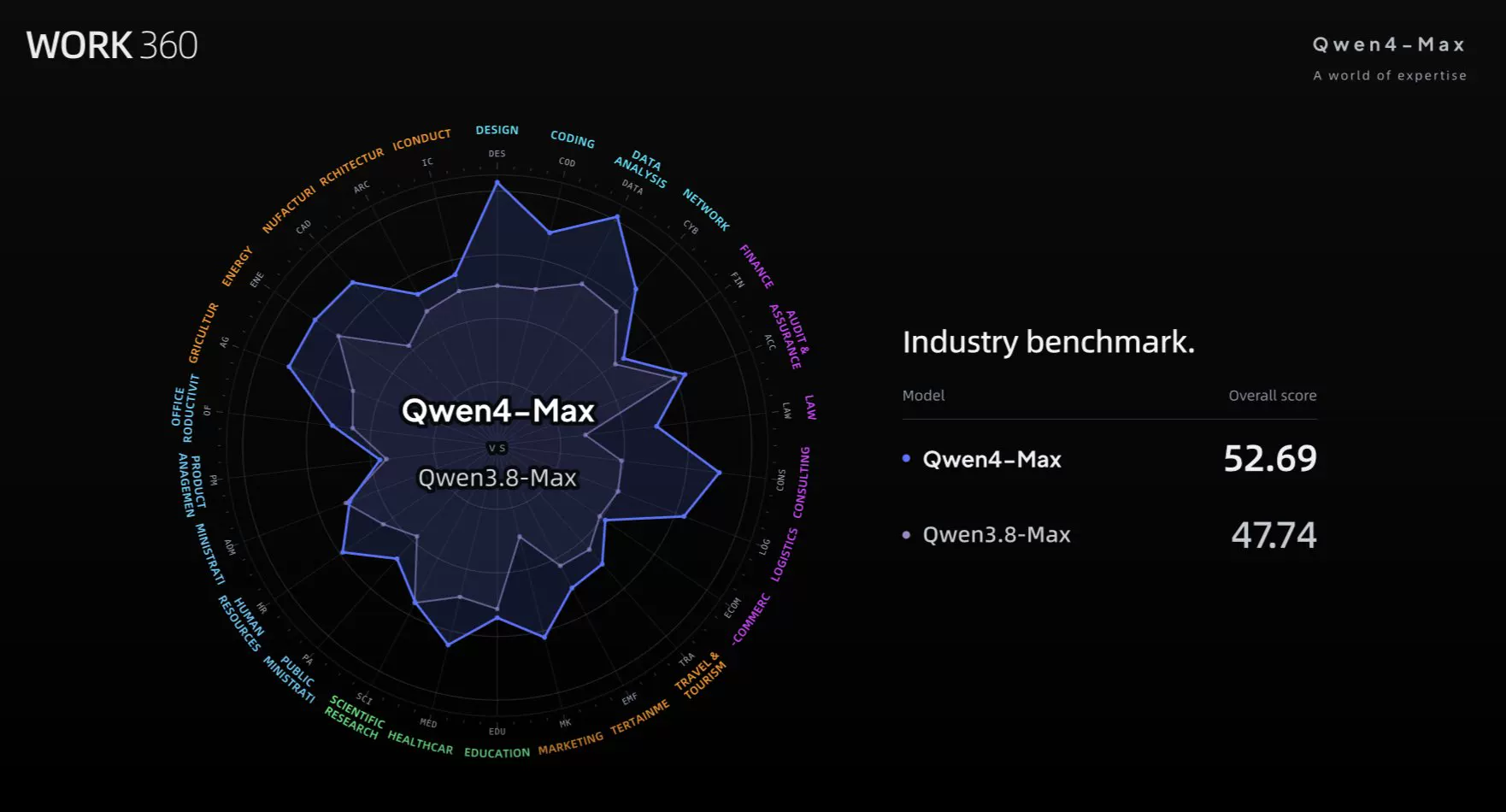
Alibaba’s launch data shows a 35% reduction in token use at its High reasoning setting and roughly 60% lower average cost per task on Work360, its own enterprise-work benchmark. Those figures are useful starting points, not a substitute for testing the prompts, tools and failure costs in a production workload.
What Qwen4-Max actually ships
Qwen4-Max is the first production model in the Qwen4 family. It accepts text, images and video and returns text, with function calling, structured output, web search, PDF processing, code execution and Model Context Protocol support exposed through QwenCloud.
Alibaba describes the architecture as a sparse mixture of experts with 2.4 trillion backbone parameters. Only 71 billion are activated for each token, down from 95 billion active parameters in Qwen3.8-Max. It also uses 328 billion additional n-gram embedding parameters. The design is intended to preserve a very large model’s knowledge while reducing the computation needed for each request.
The model is available through the API under qwen4-max, as well as QwenStudio, QwenWork and Qoder. It is separate from qwen4-max-preview, the time-limited version released on November 11.
Qwen4-Max itself is proprietary. Alibaba plans to release smaller Qwen4 models with open weights, but it has not named their sizes or release dates. Teams that require on-premises deployment, downloadable weights or fine-tuning should not assume the Max model satisfies those requirements.
The benchmark picture is strong but mixed
Alibaba highlights a sixth-place result on Code Arena and reports improvements on coding, agentic-work and visual-reasoning tests. Its published scores include 75.7% on DeepSWE v1.1, 72.5% on an Artificial Analysis run of AutomationBench, 48.5% on Terminal-Bench 4.0 and 54.2% on Chartography.
Those numbers do not establish an across-the-board lead. The comparison chart has Qwen4-Max finishing first on four of 16 tests, while rival models lead the rest. Some results come from public leaderboards or outside evaluators; others were run or selected by Alibaba. Exact tool configurations and evaluation settings are not disclosed for every score.
The cleanest conclusion on launch day is that Qwen4-Max is materially better than Qwen3.8-Max and competitive with current frontier systems, particularly for long, tool-using jobs. It is not evidence that one model now wins every coding, reasoning or visual task.
What a million-token window costs
A one-million-token input followed by a 100,000-token answer would cost about $1.95 at Singapore list rates before caching. A smaller 100,000-token input with a 10,000-token output would cost about $0.195.
That makes the large window economically usable for repository review, document collections and long agent histories. It does not make stuffing every available file into one prompt a good retrieval strategy. Larger contexts increase latency and can bury relevant evidence; teams should compare full-context runs with retrieval, summarization and explicit cache reuse.
The model’s documented limits also need careful reading. Alibaba’s specification table lists up to 131,072 output tokens with thinking disabled. With thinking enabled, the reasoning trace and final answer share a 262,144-token cap. A separate product page displays a 393K maximum, so developers should test the API limit they actually receive rather than plan around the larger marketing figure.
Four checks before moving production traffic
- Replay real jobs. Use anonymized production traces and score task completion, tool errors, retries and human correction time, not just answer quality.
- Measure total task cost. A cheaper token can still produce a more expensive job if the model loops, calls tools unnecessarily or writes longer outputs. Cache-hit rates should be tracked separately.
- Test both reasoning modes. Thinking is enabled by default at the High setting. Compare it with lower effort and non-thinking operation for latency-sensitive work.
- Confirm deployment constraints. Batch inference, fine-tuning and dedicated model deployment are not supported at launch. Data residency and regional pricing also vary.
The production release gives developers a credible lower-cost alternative for multimodal and agentic workloads, with a particularly aggressive cache-read price. The decision to migrate should turn on repeatable task results and operational fit, not the 2.4-trillion-parameter headline.
Sources: Alibaba Cloud launch announcement, The Model Gap specification and pricing record, and Frontier Log benchmark record.