


Browsing Category
Science Tech
10 posts
Science-driven technology coverage, including energy systems, advanced materials, research tools, physics, biotechnology, and commercially relevant scientific breakthroughs.
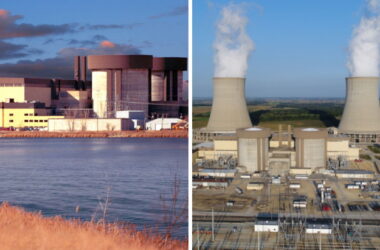
Google’s Constellation Nuclear Deal: What the 3.59 GW Figure Really Means
Google and Constellation signed agreements covering 3.59 GW in PJM, but only 890 MW is planned new nuclear capacity. Here is how the uprates, supply contract and Gemini work differ.


OpenAI Published 722 AI Math Papers. The Proof Audit Starts Now
OpenAI released 722 AI-generated math manuscripts across 372 result families. Here is what Lean can verify, what remains unproven, and why the review will take time.
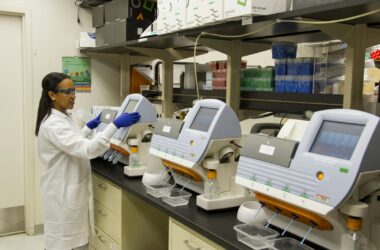
OpenAI GeneBench-Pro Shows Scientific AI Agents Still Need Supervision
OpenAI’s GeneBench-Pro benchmark tests whether AI agents can make messy judgment calls in genomics and translational biology. GPT-5.6 Sol leads the field, but a 31.5% top score shows scientific AI still needs expert supervision before it can be trusted with consequential research decisions.
Claude Science Turns Research AI Into a Lab Workflow Layer
Anthropic’s Claude Science beta gives researchers an AI workbench for literature review, code, compute jobs, scientific figures, and lab-specific agents. The launch matters because it treats AI for science less like a single model race and more like a workflow layer that has to connect databases, HPC systems, NVIDIA BioNeMo tools, and reproducible artifacts.
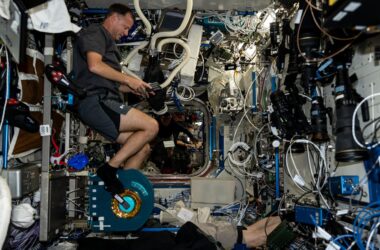
NASA’s Space Medical AI Test Moves Care From Cloud to Edge
NASA researchers are testing the Crew Medical Officer Digital Assistant with Red Hat’s RamaLama so astronaut medical guidance can run locally when a spacecraft cannot depend on Earth or the cloud. The work turns space medicine into a serious edge AI test case.

Google’s AI Talent Losses Put Coding and Science Roadmaps Under Pressure
Google DeepMind lost Noam Shazeer to OpenAI and John Jumper to Anthropic in the same week. The moves matter because AI labs are competing for researchers who can steer coding agents, scientific AI, and frontier model strategy, not just write papers.
SandboxAQ’s $500M CHIPS Award Moves AI Into Chip Materials
The Commerce Department awarded SandboxAQ $500 million to use physics-based AI for semiconductor materials discovery. The target is not a new chip, but the chemicals, magnets, catalysts, and backup-power systems that fabs need to run.
OpenAI o3 Helps Doctors Revisit Rare Disease Cases in NEJM AI Study
Researchers at Boston Children’s, Harvard, and OpenAI used o3 Deep Research to reanalyze 376 previously unsolved rare disease cases. The model surfaced evidence-linked leads that helped specialists confirm 18 diagnoses, but the study is careful about what AI did and did not decide.

OpenAI’s AI Chemist Finds a Lab-Tested Way to Improve Drug Discovery Chemistry
OpenAI and Molecule.one connected GPT-5.4 to an autonomous chemistry platform that ran 10,080 reactions and found a TEMPO-based way to improve a difficult Chan-Lam coupling used in medicinal chemistry. The result is narrow, but it shows AI starting to work inside the experimental loop, not just around it.

Avalanche’s 11 Million Degree Plasma Is a Compact Fusion Milestone, Not a Power Plant
Avalanche Energy says its compact Jyn fusion device reached apparent ion temperatures above 1 keV, roughly 11 million degrees Celsius. That is a meaningful plasma milestone, but it is still a long way from net power.