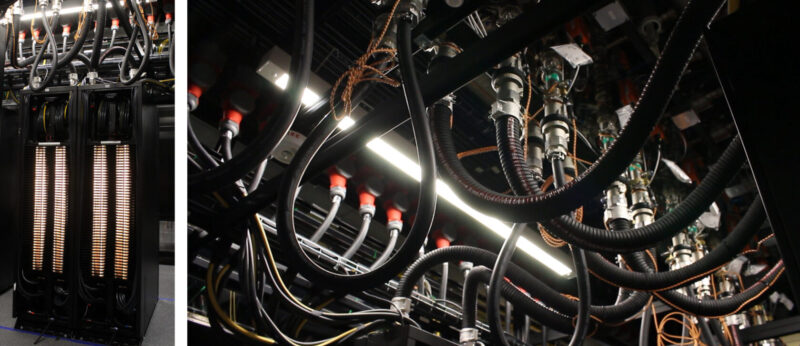
NVIDIA is using its Rubin-generation AI infrastructure to make a sharper claim about the next phase of data center design: the biggest AI systems can run hotter, denser, and with far less water used for on-site cooling.
In a June 21 blog post, NVIDIA described a 100% liquid-cooled AI factory reference design that runs coolant at up to 45 degrees Celsius, or 113 degrees Fahrenheit. That sounds hot by room-temperature data center standards, but it is the point of the design. If the coolant can leave the rack hot enough to reject heat through outdoor dry coolers, operators can avoid much of the mechanical chilling and evaporative cooling that traditional facilities rely on.
The company says that, in favorable climates, the architecture can reduce facility cooling water use from roughly 2.6 million gallons per megawatt per year for conventional cooling-tower systems to near zero. NVIDIA is not saying every data center everywhere will become water-free. It is saying the combination of closed-loop liquid cooling, warmer coolant, and Rubin-class hardware changes what operators have to build around the servers.
Why Rubin Changes the Cooling Math
Most familiar data centers were designed around air. Servers pull cool air across hot components, fans move that air through the rack, and the building uses carefully managed hot aisles, cold aisles, chillers, and sometimes water-intensive evaporative cooling to keep everything inside operating limits.
Rubin points to a different model. NVIDIA says the platform is designed so every chip and networking component is cooled by liquid in a closed loop, with no server fans. Coolant made of 75% water and 25% propylene glycol flows through cold plates attached directly to processors and other high-power components, carrying heat away at the source instead of pushing large volumes of air around the room.
The high temperature target matters because it raises the usefulness of the outside air. A loop that enters the rack at 45 degrees Celsius and exits around 55 degrees Celsius can often reject heat through radiator-like dry coolers without evaporating water. In cooler climates, that can mean no refrigeration equipment for normal operation. In warmer climates, it can still reduce the number of hours when chillers are needed.
NVIDIA also argues that the architecture reduces space and noise. A fully liquid-cooled server can shed perforated bezels, internal fans, and some of the airflow engineering that makes AI data halls loud and mechanically complex. Its blog says higher rack density can let a system that once occupied six rack units fit into two, though the company has not laid out a universal cost comparison against less efficient air-cooled or hybrid designs.
The Timing Is Not Accidental
The cooling push arrives as data center water use is becoming a public fight, not just a facilities engineering problem. Amazon recently disclosed that its global data center footprint withdrew about 2.5 billion gallons of water in 2025, while saying water use at directly owned and operated sites fell 2% from 2024 even as its building count grew. Amazon also says it is about 75% of the way toward its goal of becoming water positive by 2030, partly through projects that return water to local communities.
Those disclosures are now part of a larger AI infrastructure debate. A Guardian analysis this month found that 517 of 809 planned U.S. data centers are in locations that have experienced drought conditions over the past year. The same report cited projections that U.S. data centers could demand as much as 73 billion gallons of water annually by 2028, up from about 17 billion gallons in 2023.
That is the context behind NVIDIA’s emphasis on closed-loop cooling. A design that can avoid cooling towers gives cloud providers and data center developers a stronger answer when local officials ask whether an AI facility will compete with residents, farms, or existing industrial users for water. It also gives NVIDIA’s customers a way to argue that next-generation AI capacity can expand without simply scaling yesterday’s cooling footprint.
What the Claim Does Not Cover
The limitation is that NVIDIA’s most dramatic water claim is about facility cooling. It does not include all of the water tied to AI infrastructure.
Power generation can carry its own water cost, especially when data centers rely on gas, coal, or other thermal power plants that use water for cooling. Chip manufacturing is another part of the footprint. A liquid-cooled data hall that uses little water on site can still sit inside a larger supply chain that depends on water-intensive electricity and semiconductor fabrication.
That distinction is why some outside coverage has treated NVIDIA’s announcement as a real engineering gain but not a complete answer to AI’s environmental pressure. TechCrunch noted that water use outside the data center, especially from electricity generation and chip production, can substantially increase the total footprint. The Verge also pointed out that the design does not settle questions around construction, power sourcing, or the cost of building this kind of facility.
For operators, the practical question is not whether Rubin makes AI data centers harmless. It is whether high-temperature liquid cooling becomes the default for new high-density deployments because the economics, power constraints, noise limits, and local politics all point in the same direction.
What Buyers and Communities Should Watch
The first thing to watch is where Rubin-class systems are actually deployed. NVIDIA says cloud providers and data center operators building for Rubin are moving toward full liquid cooling, but public details about specific sites, climates, costs, and operating data are still limited.
The second is whether providers report water use in a way communities can compare. Facility-level water use, water returned through restoration projects, power-generation water, and chip-supply-chain water are different measures. Blending them together can make an efficient design look like a full environmental solution, while separating them too aggressively can make real engineering improvements look meaningless.
The third is whether liquid cooling changes siting decisions. If a data center can operate without evaporative cooling in the right climate, operators may have more flexibility to build in places where water is politically or physically constrained. But if the same project needs new gas generation, heavy transmission upgrades, or a one-time water fill at large scale, the local debate will not disappear.
NVIDIA’s Rubin cooling design is best read as a significant infrastructure shift, not a blanket sustainability victory. It shows that AI factories do not have to cool tomorrow’s hardware with yesterday’s water-heavy playbook. It also raises the bar for what data center operators will need to disclose as AI demand keeps pushing them into communities where water, power, and trust are already scarce.