XREAL has opened reservations for Aura, a pair of Android XR smart glasses built around Google’s spatial computing platform, Gemini, and Qualcomm’s new Snapdragon Reality Elite chip. The company says the glasses are expected to launch in fall 2026, with a refundable $99 launch-credit reservation and a $299 Founder Priority Pass for earliest-batch delivery.
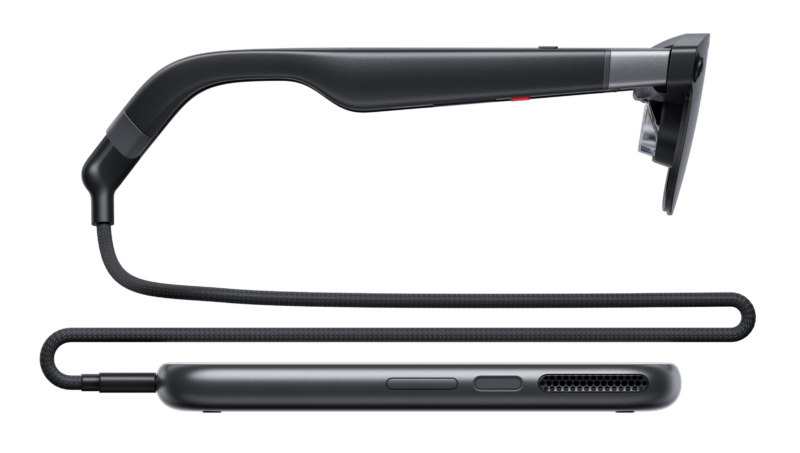
The launch matters because Aura is not being positioned as a simple wearable display. XREAL describes it as a “next-generation Android XR spatial computer” that combines optical see-through glasses with a dedicated compute puck. That makes it one of the clearest early tests of whether Android XR can move beyond headset-style devices and into eyewear people might actually wear for work, entertainment, and AI-assisted tasks.
The official product page lists a final retail price cap of $1,500 before tax, with final pricing and configurations still to come. Current supported launch regions include the United States, United Kingdom, Japan, South Korea, and a group of European Union countries. XREAL also says Best Buy will be its first U.S. brick-and-mortar retail partner, according to AWE’s roundup of major product launches from Augmented World Expo 2026.
Why Aura Is Different From Earlier AR Glasses
Most consumer AR glasses have lived in a narrow lane: they worked as private screens, gaming displays, or phone accessories, but they did not behave like a full computing platform. Aura is more ambitious. XREAL says the glasses support a 70-degree optical see-through display, 6DoF spatial anchoring, hand tracking, world-facing tracking cameras, a high-resolution camera with a privacy LED, electrochromic dimming, a four-microphone array, and Sound by Bose EQ tuning.
The compute puck runs Android XR OS and uses Qualcomm’s Snapdragon Reality Elite platform. XREAL lists two memory and storage options: 12GB with 256GB, and 16GB with 512GB. The puck has a 4,455 mAh battery, USB-C for the glasses, another USB-C port for charging or DisplayPort input, Wi-Fi 6/6E, Bluetooth 5.3, and support for keyboards, mice, and game controllers.
That split-compute design is the central tradeoff. Aura is not trying to put all of the processing, battery, optics, sensors, and thermals into the glasses themselves. The cable and puck make the product less invisible than ordinary eyewear, but they also give XREAL more room to deliver spatial apps, hand tracking, higher display performance, and longer sessions than a tiny self-contained frame could manage today.
Qualcomm Is Supplying the On-Device AI Headroom
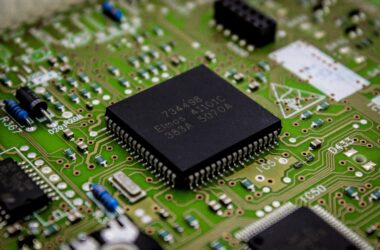
Qualcomm announced Snapdragon Reality Elite at AWE on June 16, describing it as a premium XR platform for mixed reality and spatial computing. The company says the chip delivers up to 48 TOPS of AI processing, can run large language and vision models directly on device, and is designed for experiences such as photorealistic avatars, AI agents, and real-time object generation in a user’s environment.
Compared with Snapdragon XR2+ Gen 2, Qualcomm claims up to 60% higher GPU performance, up to 30% higher CPU performance, up to 160% higher NPU performance, up to 20% longer battery life at the same workload, and operation up to 12 degrees Celsius cooler under load. The platform also supports visuals up to 4.4K per eye at 90 frames per second, though Aura’s listed glasses display is Sony Micro-OLED at 1920 x 1200 pixels per eye with refresh rates up to 120 Hz.
Those numbers matter less as benchmark bragging rights than as clues about the product category. Smart glasses that depend entirely on cloud AI and phone tethering can feel laggy or limited. Qualcomm is trying to make XR hardware capable enough to run more perception, tracking, and AI work locally, which could help with responsiveness, privacy, and offline or low-connectivity use cases.
Google’s Bigger Android XR Bet
For Google, Aura is a developer and ecosystem play as much as a hardware moment. Android XR is meant to extend Android into headsets, wired XR glasses, audio glasses, and display glasses. XREAL says Aura will support millions of Google Play apps on day one, including Google Maps, YouTube, Gemini, Chrome, and Photos, plus more than 100 XR-specific apps.
Gemini is built into Android XR as the assistant layer. With user permission, XREAL says Gemini can understand what the wearer sees, what is on screen, and what is around them, then help open apps, navigate the interface, answer questions, or provide contextual assistance. That is the part of the product that could make Aura more than a floating monitor: the glasses are designed to make AI visual, spatial, and always close to the user’s field of view.
Google is also pushing developers ahead of the consumer launch. The Android XR Developer Catalyst Program offers resources, hardware, and funding for developers building across wired XR glasses such as XREAL’s Project Aura, as well as audio and display glasses. XREAL’s own Aura page says the program gives approved developers a path to build and adapt applications for the Android XR ecosystem before launch.
The Unanswered Questions Before Launch
Aura still has plenty to prove. The final price is not set, and “no more than $1,500” leaves room for a product that is still expensive for mainstream buyers. Battery life, heat, fit, outdoor visibility, prescription-lens handling, app quality, privacy controls, and camera comfort in public spaces will matter more than the reservation page once people can test production hardware.
The app story is also complicated. Play Store support gives Android XR a much stronger starting point than a platform that needs every app rebuilt from scratch, but most phone and tablet apps are not designed for spatial interfaces. The strongest early experiences are likely to be media, virtual screens, maps, games, productivity setups, fitness or health tools, and apps that can use hands, voice, and spatial context without feeling forced.
Still, Aura gives the Android XR ecosystem a more concrete shape. It pairs Google’s platform with XREAL’s glasses hardware and Qualcomm’s new AI-focused XR silicon, then asks developers and early buyers to test whether that combination can make smart glasses useful before fully self-contained AI eyewear is ready. If it works, Android XR gets a wearable foothold. If it does not, Aura may show exactly which gaps still separate smart glasses from everyday computing.
Sources: XREAL Aura product page, Qualcomm Snapdragon Reality Elite announcement, Android XR Developer Catalyst Program, and AWE USA 2026 product-launch roundup.