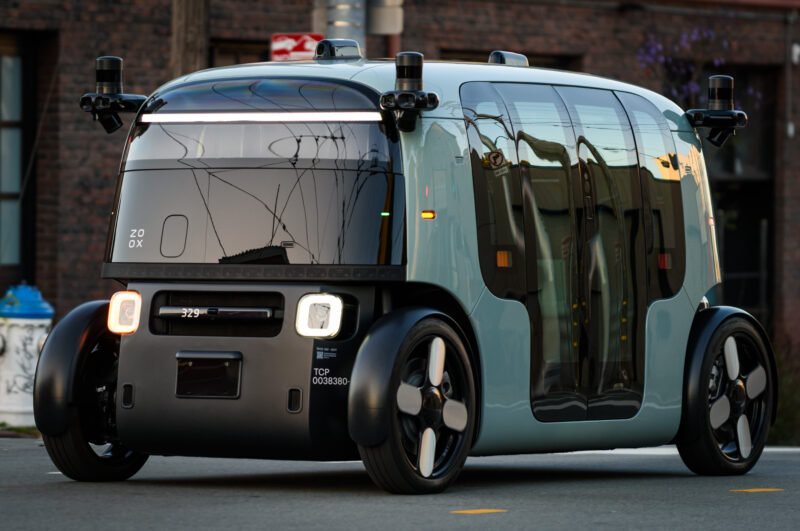
Nevada’s 100-vehicle limit on Zoox’s commercial robotaxi fleet expired on September 25, clearing the Amazon-owned company to expand in Las Vegas. That same morning, a collision involving a Zoox robotaxi and a Nissan Murano on the Las Vegas Strip sent the Murano driver to a hospital.
The timing puts two separate facts into the same public-safety test. Nevada has removed an early deployment ceiling, while investigators have not publicly assigned fault in the crash. The incident does not by itself show that the Zoox system caused the collision, but it highlights how little operating and crash data the state makes public as driverless fleets grow.
KTNV reported that the crash occurred shortly after 9 a.m. near Las Vegas Boulevard and Four Seasons Drive. Four lanes were temporarily closed, and Nevada State Police described the driver’s injuries as minor and affecting the upper body. Public reporting has not established how the vehicles collided, whether the Zoox was carrying passengers or which party was responsible.
What the expired Nevada cap changes
The Nevada Transportation Authority originally limited Zoox to 100 commercial robotaxis in the state. TechCrunch reported, citing an updated permit and confirmations from both the authority and Zoox, that the restriction ended September 25. Zoox said it plans to increase the fleet gradually over the next several months, but it did not disclose a Las Vegas vehicle count or expansion target.
Expiration of the state cap is permission to grow, not an order to put hundreds of vehicles on the road immediately. Fleet production, charging, cleaning, maintenance, remote support, pickup locations and demand all constrain the pace. Zoox currently charges for rides in Las Vegas, where its app serves destinations around the Strip and Harry Reid International Airport. The company lists service hours of 8 a.m. to 1 a.m.
The change also arrives as Las Vegas becomes a genuine multi-operator robotaxi market. Nevada approved commercial permits for Waymo, Tesla and Uber in August. Waymo has since opened service with an initial fleet, while the other operators face their own permit conditions and rollout schedules. A higher authorization number does not equal vehicles in active service, so comparisons should separate permitted capacity from deployed fleet size.
The federal 2,500-vehicle number is not a Las Vegas fleet allowance
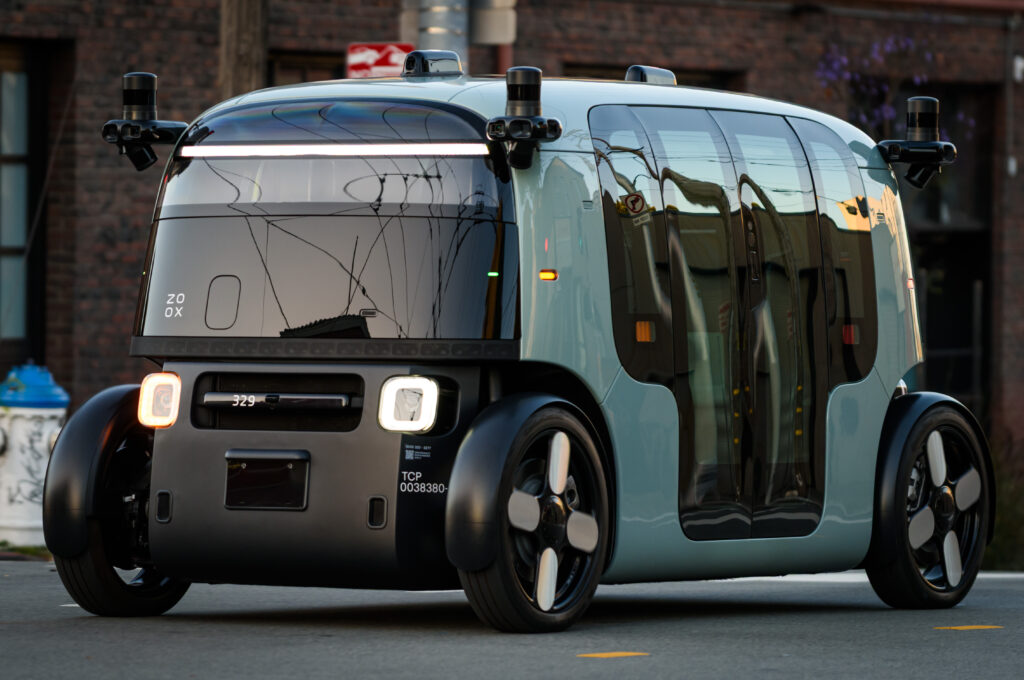
Zoox’s purpose-built vehicle lacks a steering wheel, pedals and conventional mirrors. It therefore needed a federal exemption from several motor-vehicle safety standards written around human-operated cars before it could enter paid service.
NHTSA granted that exemption in July, allowing Zoox to manufacture and commercially deploy up to 2,500 exempt vehicles in a 12-month period for two years. That headline number is easy to misread. It is a federal ceiling on vehicles produced under the exemption, not approval to operate 2,500 robotaxis in Las Vegas.
The Federal Register grant says the number of exempt vehicles operating simultaneously is limited by a separate initial Operational Authorization. NHTSA can revise that authorization as Zoox changes its operating area, technology or use case. State and local permissions still govern where commercial rides can run.
The federal conditions are unusually specific. Zoox must retain operational control of the vehicles rather than selling them, make them available for NHTSA inspection, keep safety-critical remote personnel in the continental United States, and publish maps of operating areas within 14 days of a substantive change. NHTSA can modify, suspend or revoke the exemption if the vehicles or operations present an unreasonable safety risk.
Those conditions provide leverage after deployment. They are not a substitute for an automated-driving performance standard. NHTSA has said it is still developing the first federal performance standards for automated vehicles, leaving today’s exemption process to judge a novel vehicle against an equivalent-level-of-safety case and continuing oversight.
The crash is under investigation, and the missing facts matter
The September 25 collision should not be treated as proof for or against robotaxi safety before investigators release basic facts. The position and motion of each vehicle, the Zoox system’s detected objects and planned path, braking and steering commands, contact point, road conditions and any remote-support interaction would all matter to a technical reconstruction.
None of those details appeared in the initial Nevada State Police account. It identified the two vehicles, the location, the lane closures and the injury. The responsible way to report the event now is therefore narrow: a crash occurred, one driver was taken to a hospital, and the investigation had not established public conclusions about fault.
That restraint cuts both ways. A lack of evidence that the automated system caused the collision is not evidence that it performed correctly. Likewise, the presence of a driverless vehicle in a crash does not mean its software caused it. Useful judgment requires exposure data, consistent incident definitions and enough technical detail to distinguish unavoidable contact from perception, prediction, planning or operational failures.
Nevada tracks crash data but keeps it confidential
The state oversight system has an important transparency limit. At a May 2026 legislative hearing, a Nevada Transportation Authority official said the agency tracks autonomous-vehicle safety. An authority attorney then explained that crash reports, trip data and internal data submitted by autonomous vehicle network companies are confidential under Nevada law and cannot be shared by the agency.
The exchange, recorded in the Nevada Legislature’s hearing transcript, came after a lawmaker asked whether the state knew how many crashes involved autonomous vehicles. The authority could monitor the information internally, but the confidentiality provision prevented it from providing the requested incident data publicly.
That creates a gap precisely when the public needs denominators. A raw collision count says little without vehicle miles, passenger trips, operating hours, road types and severity. Yet keeping trip and crash submissions private makes it difficult for researchers, residents and riders to calculate rates or compare operators on the same basis.
NHTSA’s federal crash-reporting system and its Zoox exemption offer another oversight channel, but they do not make every underlying record public. The exemption notice says some information Zoox submitted was claimed as confidential business information. NHTSA described portions at a higher level while those confidentiality claims were unresolved.
What riders can do inside a Zoox
Passengers cannot take over driving a Zoox robotaxi, so the support path matters. The company’s rider manual lists three ways to contact support: the touchscreen, an overhead Emergency Call Button and the phone number 1-888-477-5055. Zoox recommends saving the number because there can be a brief delay when a call is placed through the vehicle.
For an unexpected stop, unusual vehicle behavior, a close call or contact with an object, the manual tells passengers to contact support immediately. Riders can request that the robotaxi pull over through the touchscreen or support channel; the vehicle will stop at the earliest location it judges safe. For a life-threatening emergency, passengers should call 911. Zoox support can also stop the vehicle and contact emergency services.
Those controls are practical, but they should not be confused with driving controls. Remote personnel provide assistance and guidance; the automated system remains responsible for vehicle motion. NHTSA’s exemption specifically requires Zoox to validate that the location and communications environment for safety-critical remote staff do not introduce unacceptable latency, signal or accountability problems.
The next test is transparent scaling
Zoox now has more room to grow in Las Vegas under both state and federal permissions. Its real deployment test is whether fleet expansion produces a safety record that regulators can evaluate and the public can understand.
Near-term signals include the final findings from the September 25 crash, any NHTSA incident report or defect action, changes to the operational authorization, updated service-area maps, disclosed fleet numbers and comparable mileage-based safety statistics. Without those measures, observers are left with company safety cases, isolated crash reports and permit ceilings that describe legal capacity rather than real-world performance.
The June TechsCurrent explainer on NHTSA’s brake-rule proposal examined how purpose-built robotaxis could fit vehicle standards written for human controls. Zoox’s Las Vegas expansion moves the harder question onto public roads: how a no-controls fleet is supervised, measured and held accountable after deployment.