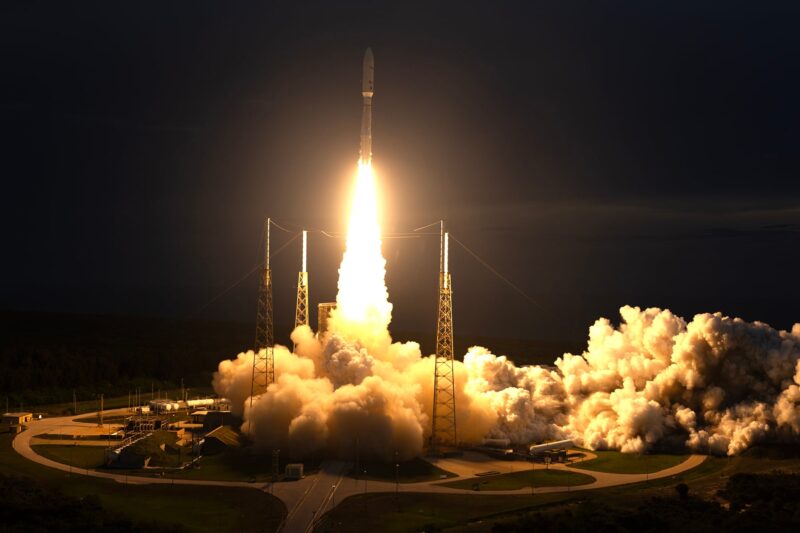
Amazon Leo has crossed the threshold it needs to begin turning its long-delayed satellite broadband network into a real commercial service. United Launch Alliance deployed 29 more Amazon Leo satellites from Cape Canaveral early on July 2, bringing Amazon’s constellation to 396 satellites and ending the Atlas V phase of the launch campaign.
The milestone does not mean Amazon suddenly has a fully formed Starlink rival. It means the company now says it has enough satellites to support continuous connectivity in the initial latitudes where it plans to start service. That is a narrower claim, but an important one: Amazon Leo is moving from deployment story to customer-service test.
Amazon’s mission update says the July 2 LA-08 mission lifted off at 12:30 a.m. EDT on a ULA Atlas V 551 rocket and deployed the satellites at about 465 kilometers above Earth. The satellites will be raised to their assigned operational altitude of 630 kilometers before they are fully commissioned for service.
The launch was Amazon Leo’s 14th mission and the eighth carried by Atlas V. Amazon says Atlas V launched 224 Leo satellites across those eight missions with a 100% success rate. The next ULA launch for the network is expected to use Vulcan, the heavier-lift rocket Amazon is counting on to carry larger Leo payloads and increase deployment cadence.
Why 396 satellites matter
Satellite internet coverage is not just a raw satellite-count race, but the count matters. A low-Earth-orbit broadband network needs enough spacecraft passing overhead, enough ground infrastructure, enough available spectrum, and enough terminal capacity to keep users connected without long gaps. Amazon’s latest launch gives it enough orbital hardware to support an initial service footprint, according to Chris Weber, the Amazon Leo vice president for business and product, as reported by The Verge.
That initial footprint is likely to be constrained. Early Leo customers should expect the kind of staged rollout that is common for satellite broadband: limited geography first, uneven capacity at the edges, and performance that improves as more satellites, gateways, and user terminals come online. Amazon has said it is targeting an initial service rollout later this year, but it has not yet provided public consumer pricing, full availability maps, or a final terminal lineup for everyday households.
The comparison with Starlink is unavoidable because SpaceX already turned low-Earth-orbit broadband into a mass-market service. The Verge notes that Starlink’s early 2020 beta began with nearly 900 satellites and a relatively narrow service band, while today’s Starlink network has more than 10,000 satellites operating across land, maritime, aviation, and enterprise markets. Amazon is entering the market later and with far less orbital capacity, so its first real test will be whether it can deliver reliable service in carefully selected regions rather than whether it can match Starlink globally on day one.
Amazon still has a launch-rate problem to solve
The bigger pressure is scale. Amazon’s first-generation Leo authorization covers 3,236 satellites, and its current 396-satellite constellation is still a small fraction of that planned network. The company has secured more than 100 launches, but those launches depend on a mix of vehicles including ULA’s Vulcan, Arianespace’s Ariane 6, SpaceX’s Falcon 9, and Blue Origin’s New Glenn.
That mixed launch strategy gives Amazon multiple paths to orbit, but it also exposes the program to vehicle readiness, cadence, and payload-size constraints. Atlas V helped Amazon build the early constellation, but it is now giving way to Vulcan for ULA’s Leo work. Blue Origin’s New Glenn is strategically important because it is tied to Amazon founder Jeff Bezos’s broader space ambitions, but Amazon cannot wait for one rocket family alone if it wants the network to mature quickly.
The regulatory clock also still matters. In June, the Federal Communications Commission granted Amazon Leo a limited waiver related to its July 2026 interim deployment milestone. The FCC order said Amazon was originally authorized for a 3,236-satellite Gen1 constellation and still must complete that first-generation deployment by July 30, 2029. The waiver gives Amazon breathing room, but with conditions meant to keep pressure on deployment speed and spectrum use.
For readers, the practical takeaway is simple: Amazon Leo is no longer a distant concept, but it is not yet a broad Starlink substitute. The next few launches will determine whether Amazon can move from a narrow initial footprint into a network with enough density to serve homes, businesses, remote sites, aircraft, ships, and mobile carriers with fewer interruptions and more predictable speeds.
Who should watch the first rollout
The first customers most likely to care are not only rural households. Amazon has already positioned Leo around residential broadband, enterprise connectivity, government use, telecom partnerships, and aviation Wi-Fi. That makes the service relevant to remote businesses, utilities, emergency-response teams, airlines, maritime operators, and mobile carriers that want another low-Earth-orbit option besides Starlink and OneWeb.
Amazon also has one advantage that Starlink did not have at the same stage: AWS. If Leo becomes a reliable network, Amazon can tie satellite connectivity to cloud regions, edge services, private networking, analytics, and AI workloads that already run on AWS. That does not guarantee adoption, but it gives Amazon a sales path for enterprise and government customers that treat satellite service as part of a broader infrastructure stack rather than a standalone internet plan.
The near-term questions are concrete. Amazon needs to show where service will launch first, how much terminals will cost, what speeds and latency users can actually expect, how capacity will hold up in busy regions, and whether the network can maintain service through rain, obstructions, and heavy demand. It also needs to prove that the Vulcan, Ariane 6, Falcon 9, and New Glenn launch pipeline can move fast enough to turn 396 satellites into a dense constellation rather than a promising beta.
For now, Amazon Leo has reached the point where the story changes. The question is no longer whether Amazon can get hundreds of satellites into orbit. It is whether those satellites can support a service good enough for customers to choose when the first coverage zones open.