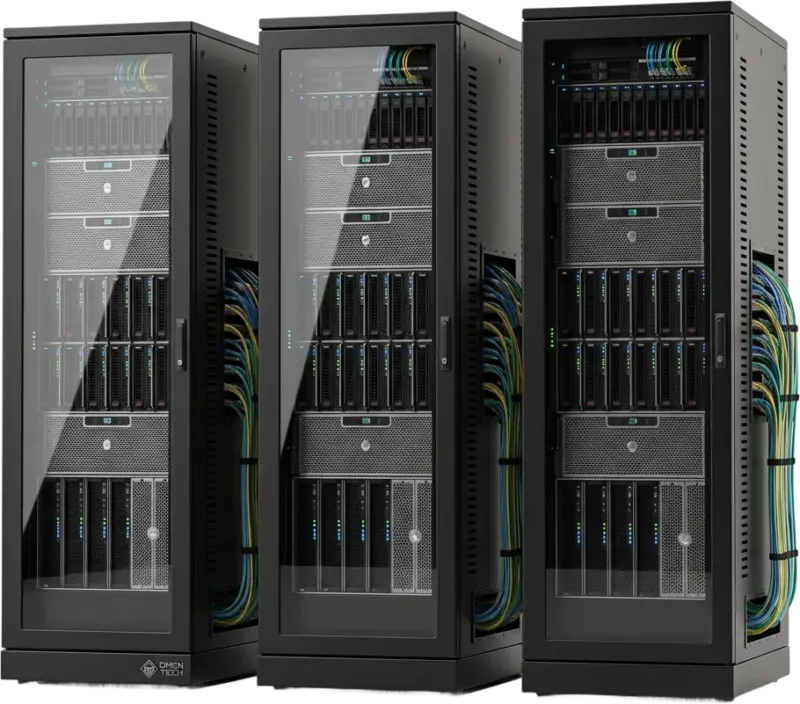
Omen AI has raised $31 million in Series A funding to scale a monitoring system for the liquid running through AI data centers, a small but telling sign of where the next bottleneck in AI infrastructure is moving. The company is not selling another model, chip, or cloud instance. It is trying to catch coolant problems before they force high-density GPU racks offline.
The round, reported Monday by TechCrunch, was led by Nava Ventures with participation from CRV, Vanderbilt University, Mann+Hummel, Starhill Holdings, Hard Launch Capital, and individual investors from companies including Bridgestone, GM, Johnson Controls, and TensorWave. Omen has now raised about $40 million since its 2024 founding.
What makes the story worth watching is the shift underneath the funding. AI data centers are packing more power into each rack, and the industry is moving from air cooling toward direct liquid cooling because dense GPU systems can no longer be treated like ordinary server rooms. Once coolant becomes a core part of the compute stack, fluid health becomes an uptime variable.
Why coolant is becoming an AI infrastructure issue
Omen’s product is a small spectrometer that connects to a machine’s fluid system and analyzes coolant, oil, or water in real time. On its own site, the company says the system can detect bio-contaminants, metal wear, and fluid degradation, including for data center customers operating what it describes as $200 billion worth of facilities.
That matters because the cooling tradeoff is getting more complex. Liquid cooling lets operators move heat away from chips more efficiently than air. But the more data centers optimize the water-and-additive mix for thermal performance, the more they have to manage contamination, corrosion, flow restrictions, pump wear, and biofilm growth inside systems that are supposed to run continuously.
TechCrunch reported that bacterial contamination can clog coolant flow and force operators to flush systems, potentially taking a rack down for five or six hours. In an ordinary IT room, that would be painful. In an AI facility selling scarce GPU time, an unplanned cooling intervention can quickly become a capacity, customer, and revenue problem.
The current alternative is often periodic fluid sampling: pull liquid, ship it to a lab, wait for analysis, then decide whether maintenance is needed. That workflow looks increasingly mismatched with AI clusters that are being sold as always-on production infrastructure. Real-time coolant monitoring gives operators a chance to watch trends rather than discover a failure after thermal alarms or flow problems appear.
Liquid cooling is moving from efficiency claim to operations stack
The timing is not accidental. Nvidia spent the past week making the case that its Rubin-generation AI infrastructure can run on warm liquid cooling at up to 45 degrees Celsius, with chips and networking components cooled through a closed loop. In a June 21 blog post, Nvidia said its DSX AI factory reference design could use dry coolers in favorable climates and reduce facility cooling-water use from roughly 2.6 million gallons per megawatt per year to near zero.
That is a meaningful engineering shift, especially as data center water use becomes a local permitting and public trust issue. But it also makes clear that cooling is no longer a building-services footnote. It is becoming part of the AI factory design, from chips and cold plates to coolant distribution units, pumps, chemistry, maintenance, and monitoring.
Omen is entering that gap. Its origin was in industrial equipment, where fluid analysis can reveal wear patterns in machines before a visible failure. The data center version applies the same basic logic to AI infrastructure: if a cooling loop carries the health signal of the system, watching the fluid continuously can become a form of predictive maintenance.
The company is not alone. Established water-monitoring and industrial-sensor companies are also moving toward coolant analytics for AI facilities. Pyxis Lab, for example, has been marketing smart sensors for cooling distribution units, while broader facility vendors already monitor flow, pressure, temperature, conductivity, and leak detection. Omen’s pitch is that spectroscopy and signal processing can add a more direct view into contamination, metal wear, and chemistry changes.
Biofilm is a reliability problem, not just a health footnote
Cooling systems already have a public-health dimension. The CDC notes that Legionnaires’ disease can spread through improperly maintained cooling towers, and it has used AI-assisted satellite imagery to help identify towers during outbreak investigations. That does not mean Omen is selling a public-health tool or that every liquid-cooled AI rack carries the same risk profile as an evaporative cooling tower. The narrower point is that water systems behave like systems: biology, chemistry, heat, maintenance, and uptime are connected.
For AI operators, biofilm and microbial growth are practical reliability risks even before they become anything else. Biofilm can reduce heat transfer, interfere with flow, increase pressure drop, and create conditions for corrosion. The higher the rack density, the less margin operators have for cooling inefficiency that appears gradually and unevenly across a cluster.
That is why coolant monitoring belongs in the same conversation as power availability, grid interconnection, chip supply, and data center siting. AI infrastructure is being financed and built at a pace that assumes facilities can deliver usable compute, not merely install GPUs. If cooling loops become unpredictable, the constraint shows up as downtime, throttling, expensive maintenance windows, or lower utilization.
What to watch next
The useful test for Omen will be whether real-time coolant data becomes part of routine data center operations rather than a specialty add-on. Operators will want to know how accurately the system detects bio-contaminants, how early it catches degradation, whether alerts map cleanly to maintenance actions, and how the data integrates with existing building management and cluster operations systems.
There is also a buyer question. Hyperscalers and AI cloud providers already have mature facility teams and procurement processes, while newer AI infrastructure companies are still building their operational playbooks. A sensor that reduces surprise rack downtime may be easier to justify in GPU clouds where every hour of unavailable compute has a visible opportunity cost.
Omen’s funding does not prove that coolant analytics will become a standard layer in every AI data center. It does show that investors and operators are starting to treat the plumbing around AI compute as strategic infrastructure. The AI boom is often described in terms of models and chips, but the machines only matter if the facilities around them can keep running. In that world, the water inside the rack is no longer background detail.