The National Highway Traffic Safety Administration has proposed changing federal braking rules so vehicles designed only for automated driving systems would no longer need manual brake pedals, a narrow but important regulatory shift for purpose-built robotaxis.
The proposal, published in the Federal Register on June 26, would amend Federal Motor Vehicle Safety Standard No. 135, the light-vehicle braking standard. Comments are due by July 27, 2026.
NHTSA is not proposing to weaken the basic requirement that vehicles must stop within required distances. Instead, the agency wants to separate those braking-performance requirements from rules that assume a person sitting inside the vehicle will operate a foot pedal or hand control. In vehicles that still include manual driving controls, the existing requirements would continue to apply.
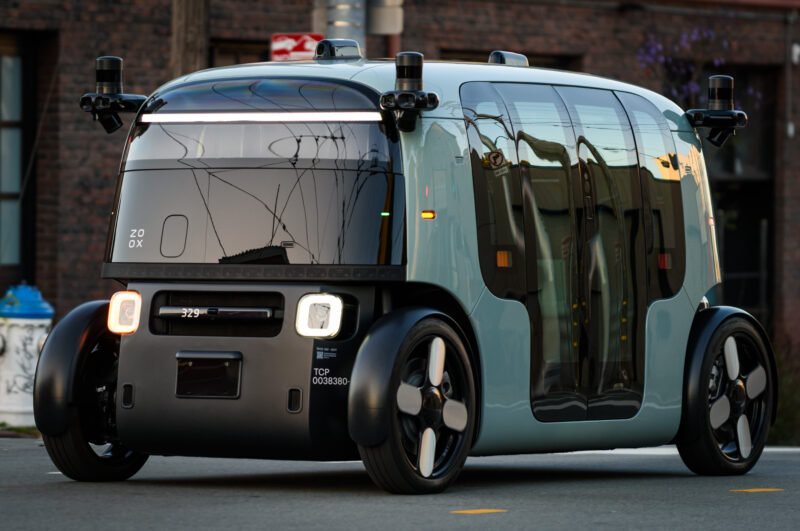
That distinction matters because the next generation of robotaxis is not merely a conventional car with extra sensors bolted on. Companies such as Amazon-owned Zoox and Tesla have shown vehicles designed around the assumption that there is no human driver, no steering wheel, and no pedal box. Under current rules, those designs can run into safety standards written for vehicles that were built around human control.
What NHTSA is actually proposing
FMVSS No. 135 governs light-vehicle brake systems. NHTSA’s proposal would update definitions, telltale requirements, performance requirements, and test procedures so the standard can be applied to vehicles with and without manually operated driving controls.
The agency says it would remove requirements for hand- or foot-operated brake controls only for vehicles designed never to be operated by a human. Vehicles with pedals, steering wheels, or other manual controls would stay under the existing rule structure.
For driverless-only designs, NHTSA says the same stopping-distance performance criteria would remain in place through alternative test procedures. In plain terms, the vehicle would not need a human brake pedal, but it would still need a brake system that can stop the vehicle when commanded.
The agency also makes clear that this rule would not answer every safety question around autonomous driving. Whether a vehicle’s automated driving system chooses the right moment to brake in traffic, at a crosswalk, or around a cyclist is a separate ADS-performance question. NHTSA says it is developing safety performance tests for ADS-equipped vehicles in a separate standard and would continue to use defect investigations and recalls for unsafe ADS behavior.
Why it matters for robotaxi design
The immediate beneficiaries would be companies trying to move beyond retrofitted passenger cars. A standard sedan or SUV can carry sensors, compute hardware, and autonomous software while keeping the familiar human cockpit. That approach has helped Waymo and others deploy services in stages, but it also leaves designers carrying hardware that may never be used in a fully driverless service.
Purpose-built robotaxis take the opposite approach. Zoox’s vehicle uses a symmetrical, carriage-style layout with inward-facing seats and no traditional driver’s position. Tesla’s Cybercab concept is also built around the promise of a vehicle without a steering wheel or pedals. Removing the brake-pedal mandate for ADS-only vehicles would make it easier for such designs to be certified under the braking standard without relying on case-by-case exemptions for equipment that does not fit their architecture.
The proposal is not a blanket approval for robotaxi fleets. It would remove one hardware barrier, not certify any company’s self-driving software as safe. A vehicle without a brake pedal would still need to satisfy applicable federal motor vehicle safety standards, and deployment would still depend on state rules, operational permits, fleet oversight, and NHTSA’s enforcement authority.
The safety tradeoff is narrower than it sounds
The phrase “no brake pedal” can make the proposal sound more radical than the underlying rule change. NHTSA is not saying brakes are optional. It is saying a vehicle that is never meant to be driven by a person should not have to include a specific human interface for braking if the automated system can actuate the brakes and the vehicle meets the same stopping requirements.
There is also a passenger-safety argument running in the other direction. In the agency’s announcement, NHTSA says manual controls in a vehicle operated only by an automated driving system could introduce misuse risk if a passenger intentionally or accidentally interferes with the system. That is a different way to think about vehicle controls: in a no-driver vehicle, a pedal is not necessarily a safety backup if the person near it is not expected to drive.
Still, the harder question is not physical braking hardware. It is how regulators verify that an automated driving system perceives the road correctly, predicts what other road users will do, and applies the brakes at the right time. NHTSA acknowledges that distinction by saying the brake-rule proposal covers whether the vehicle can physically stop when commanded, while ADS performance in real-world driving scenarios will be handled separately.
A broader AV framework is taking shape
The brake-pedal proposal is part of a wider federal effort to modernize rules for vehicles without human drivers. NHTSA says it has also moved on standards involving transmission shifting, windshield defrosting and wiping, and tire placards. The agency’s stated goal is to remove design barriers that make sense for human-driven cars but can become awkward for fully automated vehicles.
That approach could reduce the need for individual exemption petitions, a process that has often moved slowly. For companies building driverless-only vehicles, a clearer rulebook matters because fleet economics depend on repeatable manufacturing and deployment, not small batches of specially exempted vehicles.
The proposal also arrives as robotaxi competition becomes more visible. Waymo continues to expand commercial driverless ride-hailing in U.S. cities, Zoox is preparing a purpose-built service, and Tesla has tied much of its future narrative to robotaxi deployment. A federal brake-pedal update would not decide which company has the safest or most scalable system, but it would make room for vehicle forms that look less like privately owned cars and more like automated transit pods.
What to watch next
The public-comment window will show how automakers, autonomous-vehicle developers, safety advocates, insurers, and state regulators view the tradeoff. Supporters are likely to argue that the rule removes an obsolete hardware mandate while preserving braking performance. Critics may press NHTSA to define the separate ADS-performance standard more clearly before allowing large numbers of vehicles with no manual fallback.
The key test is whether the federal government can modernize vehicle hardware rules without letting the easier question crowd out the harder one. A robotaxi can be engineered without a brake pedal and still need rigorous proof that its automated driving system knows when to brake. NHTSA’s proposal moves the first issue forward. The second is where the real safety standard will have to be earned.