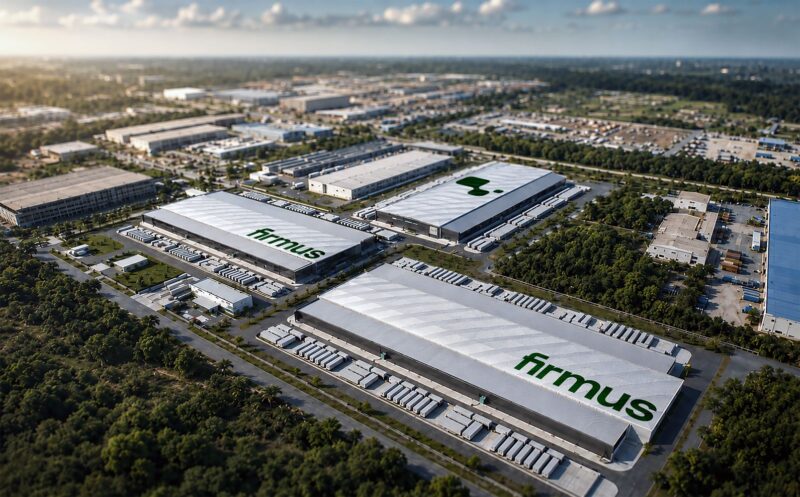
Firmus Technologies has announced a strategic compute partnership with Nvidia that will anchor a 360 MW Nvidia DSX AI factory campus in Batam, Indonesia, putting one of Southeast Asia’s emerging data-center hubs at the center of the next wave of AI infrastructure buildout.
The agreement, announced by Firmus in June 2026, runs through 2034 and covers access to as many as 170,000 Nvidia AI accelerators across Grace Blackwell, Vera Rubin, and Vera platforms through 2027 and 2028. Firmus says it expects US$25 billion to US$30 billion from committed offtake agreements during the first six years of the partnership.
The project is being developed with DayOne, the Singapore-headquartered data-center company whose Asia-Pacific strategy includes a Singapore-Johor-Riau Islands corridor. Batam sits just across the water from Singapore, giving the campus a location close to a major financial and network hub while offering more room for power-hungry infrastructure than Singapore itself can easily provide.
Why the Nvidia structure matters
The notable part of the announcement is not only the size of the campus. It is the way Nvidia is tying chip supply to cloud revenue. Firmus says the arrangement uses a revenue-sharing and credit-support model: Firmus will sell Nvidia-powered cloud services, while Nvidia earns normal product revenue and a share of cloud revenue on supported capacity.
That structure matters because AI infrastructure is increasingly constrained by capital as much as by chips. Training and inference clusters require GPUs, networking, storage, cooling, power contracts, and long-term customer commitments before a single model request is served. Smaller AI-native companies often need large blocks of compute but may not have the balance sheet of a hyperscaler. A supplier-backed arrangement can make that capacity easier to contract, while giving Nvidia a recurring stake in how the hardware is used.
Firmus frames the Batam campus as infrastructure for AI-native companies, enterprises, and independent software vendors rather than a single dedicated hyperscaler build. Co-CEO Tim Rosenfield said in the announcement that AI-native companies need scalable, energy- and cost-efficient compute to compete globally. The practical question is whether the model can deliver that capacity at predictable prices while keeping utilization high enough to justify the scale.
DSX makes the campus a product, not just a building
The Batam project also gives Nvidia’s DSX platform a large, high-profile deployment. Nvidia describes DSX as a common platform for designing, deploying, and operating AI factories, combining reference designs, APIs, software libraries, accelerated computing platforms, and partner technologies.
For a campus this large, that full-stack approach is not marketing trivia. AI clusters are sensitive to power delivery, cooling, networking, storage throughput, scheduling, and hardware failures. A facility that looks efficient on paper can still lose money if GPUs sit idle, inference queues back up, power events interrupt workloads, or operations teams cannot bring new capacity online quickly.
Nvidia’s own DSX materials emphasize lower time to first token, improved tokens per watt, operational resiliency, and integrated security. Firmus says it will integrate DSX with its proprietary HyperCube liquid-cooled AI factory architecture, with the goal of lowering cost per token for the customers served by the campus.
That language points to where AI infrastructure competition is heading. Buyers are not just comparing GPU names. They are comparing how quickly capacity becomes usable, how much output they get per megawatt, how reliable the cluster is under continuous production load, and how cleanly the cloud provider can support fast-changing model architectures.
Batam becomes part of the regional AI buildout
The location is part of the story. DayOne’s public materials describe Batam as part of a regional platform that links Singapore, Johor in Malaysia, and Indonesia’s Riau Islands. For AI infrastructure, that kind of geography is increasingly attractive: close to customers and submarine connectivity, but with more space for large campuses and power infrastructure.
The buildout also shows how AI capacity is spreading beyond the usual U.S. and European data-center markets. Southeast Asia has become a logical target for cloud and AI expansion because of demand from regional startups, enterprises, governments, and global companies that want lower-latency access to users across the region.
Still, the same constraints follow the industry wherever it goes. A 360 MW AI campus requires enormous power planning, grid coordination, cooling design, and customer commitments that hold up through hardware cycles. Nvidia’s platforms are moving quickly, and the agreement spans multiple generations, which means Firmus and DayOne will have to manage both construction risk and technology-refresh risk.
What to watch next
The most important follow-up will be customer disclosure. Firmus has put a large number on expected offtake, but the market will want to know which AI-native companies, enterprises, or software vendors are actually committing to the Batam capacity, and on what terms. Without enough steady usage, even a technically efficient AI factory can become an expensive bet on future demand.
Power sourcing will be another test. AI data centers are now judged not only by chip count but by how they secure electricity, manage water and cooling, and fit into local economic development plans. Batam gives the project a regional advantage, but it also makes the campus part of a broader debate over whether AI infrastructure can scale without crowding out other power needs.
For Nvidia, the deal is a sign that selling chips is becoming only one layer of the AI infrastructure business. The company is pushing deeper into reference designs, factory operations, financing support, and recurring revenue tied to cloud usage. Batam will test whether that model can help smaller AI companies buy compute at hyperscale-like economics, or whether the next AI infrastructure boom remains dominated by the few companies large enough to finance their own campuses.