SpaceX caught a Starship upper stage with the mechanical arms of its launch tower on Saturday, completing the first recovery of the spacecraft after an orbital flight. Ship 42 returned to Starbase in South Texas after about 22.5 hours in space, fired three Raptor engines to swing upright and settled into the tower’s two catch arms.
The catch closed Starship Flight 15, which launched at 4:47 p.m. Central on Friday, November 13. The spacecraft completed 14 orbits, deployed 26 Starlink V3 satellites and survived a full atmospheric reentry before reaching the tower at about 3:20 p.m. Central on Saturday.
It was a substantial step toward the fully reusable launch system SpaceX has promised. It was not a complete demonstration. Super Heavy Booster 22 abandoned its own tower catch shortly after launch when an onboard safety check detected that it was outside the required return corridor. The booster diverted over the Gulf of Mexico and was destroyed near the water.
What Flight 15 proved
The upper-stage recovery tied together several capabilities SpaceX had previously tested separately. Ship 42 reached an orbit roughly 265 to 275 kilometers above Earth, remained there for more than 20 hours, deployed a working payload and then returned to the launch site rather than targeting an ocean splashdown.
SpaceX used ground cameras and cameras aboard some of the newly deployed Starlink satellites to inspect the ship’s heat shield while it was in orbit. Flight controllers also retained contingency options: an earlier return over the Pacific and a later splashdown near Hawaii if the vehicle, tower or landing corridor failed a final check.
Before committing to Starbase, teams polled the condition of the second stage, heat shield, flaps, structure, guidance system and tower. Ship then made a roughly 10-second, single-engine deorbit burn, crossed the Pacific and Mexico, descended through the atmosphere on its side and performed its familiar flip maneuver near the ground. Three engines slowed and aligned the vehicle before the tower arms closed around it.
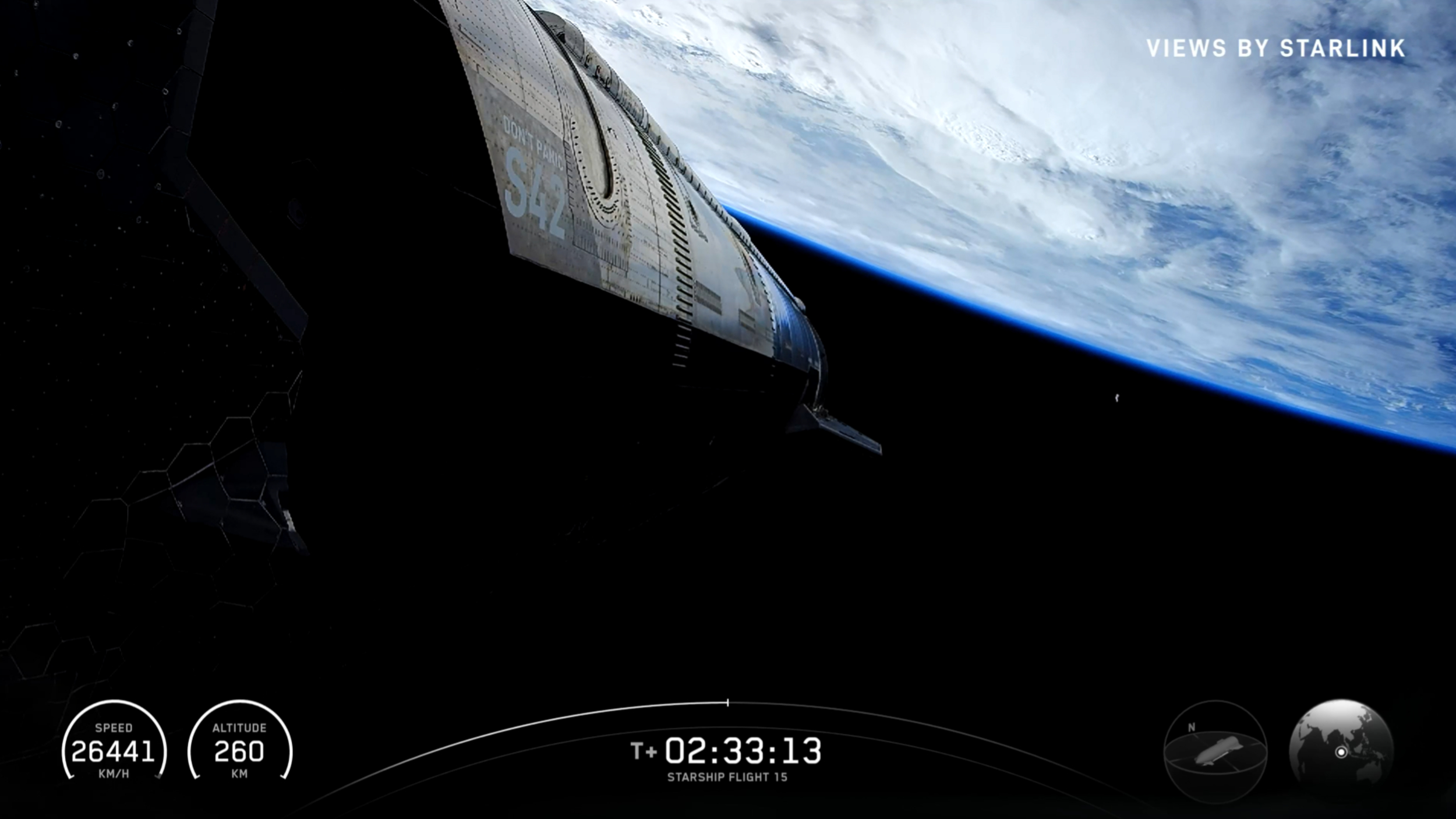
The catch matters because the upper stage faces a harder recovery problem than Super Heavy. It must shed orbital velocity, protect its tanks and engines through prolonged reentry heating, steer across a long descent corridor and arrive within the tower’s narrow capture envelope. SpaceX had already caught Super Heavy on three earlier flights. Flight 15 was the first attempt to catch Ship after orbit.
The mission also gave SpaceX a longer-duration test of the Block 3 vehicle. Flight 14 in September reached orbit for the first time but returned early and ended with an explosion after its Pacific landing. Flight 15 kept Ship in space for 14 laps, exercised the payload bay and allowed hours of thermal, power and communications monitoring before reentry.
Why the booster abort still matters
SpaceX initially described Booster 22’s diversion as a guidance, navigation and control issue. The company later clarified that guidance had performed its safety role correctly. Early data indicated that the boostback burn ended early after a low-fuel-mass alarm, leaving the booster outside the position required for a tower approach.
That distinction is important for evaluating the test. The vehicle did not lose control and head toward the pad. Its software detected that the return conditions were wrong, rejected the catch and sent the booster to an offshore contingency zone. The flight termination system then destroyed it near the surface.
The safety logic worked, but the underlying fuel or propulsion problem remains under investigation. During the return, 32 of the booster’s 33 Raptor engines lit for the boostback burn. SpaceX has not yet disclosed whether the alarm reflected an actual propellant shortfall, a sensor problem or another condition that caused the burn to stop early.
That failure prevented the headline objective SpaceX had set before launch: recovering both stages of an orbital rocket on the same mission. Rapid reuse depends on repeating the entire sequence, not only demonstrating each recovery in isolation. The company still must show that a ship and booster can launch together, return safely, be inspected with limited refurbishment and fly again on a useful schedule.
The engineering milestone is recovery, not yet rapid reuse
Landing hardware intact is necessary for reuse, but it does not prove fast turnaround or lower cost by itself. Engineers will now inspect Ship 42’s roughly 18,000 heat-shield tiles, flaps, plumbing, engines and catch points. The most revealing result will be how much hardware must be replaced before the vehicle can be cleared for another flight.
Heat-shield maintenance is especially consequential. A spacecraft that needs extensive tile inspection or replacement after every return may be recoverable without becoming operationally reusable. SpaceX has repeatedly modified the shield to reduce damage and eliminate labor-intensive refurbishment. Flight 15 provides the first recovered orbital ship the company can examine directly rather than relying on telemetry and images from an ocean landing.
The tower catch also removes landing legs from the ship and transfers structural loads to dedicated catch points. That can reduce vehicle mass, but it makes the pad, tower, guidance corridor and vehicle a single tightly coupled system. A catch must be accurate enough to protect expensive ground infrastructure, while the abort system must reliably send an unhealthy vehicle away from the site. Flight 15 showed both sides of that design: Ship met the criteria and returned; the booster did not and diverted.
What comes next for Starship and Artemis
SpaceX plans to begin Starship launches from Kennedy Space Center in Florida within months, according to reporting from The Associated Press. The company also needs Starship to carry larger Starlink V3 satellites at a cadence that Falcon 9 cannot match.
NASA has committed billions of dollars to lunar versions of Starship for the Artemis program. Those missions add requirements that Flight 15 did not test, including orbital propellant transfer, long-duration cryogenic storage, docking and lunar landing operations. NASA’s current plan calls for an Earth-orbit demonstration involving Orion, Starship and Blue Origin’s Blue Moon before a later crewed lunar landing.
Flight 15 therefore resolves one major question while leaving the program’s hardest operational tests ahead. SpaceX has now brought an orbital Starship back to its launch tower. It still needs to repeat the catch, explain the booster abort, demonstrate both-stage recovery on one flight and show that recovered hardware can fly again with limited work.