Samsung and Google have opened preorders for their first Gemini-powered smart glasses, with Warby Parker models starting at $395 and Gentle Monster versions priced from $449 to $489. The screen-free glasses go on sale December 10 in the United States, while the Gentle Monster collection will also launch in South Korea.
The product, formally called Intelligent Eyewear, combines Samsung hardware, Google’s Android XR software and Gemini assistant with nine core frame designs from the two eyewear brands. It is a more conventional-looking alternative to a headset: the glasses weigh about 41 grams, use a 12-megapixel camera to show Gemini what the wearer sees, and return answers through open-ear speakers. They do not put text, maps or notifications in front of the wearer’s eyes.
That distinction is central to the buying decision. Intelligent Eyewear is closer to a camera-equipped audio assistant than a pair of augmented-reality displays. Its most useful features may be translation, calls, music and hands-free camera access, while the most ambitious Gemini functions still depend on a connected phone, cloud services and the accuracy of an AI model.
What $395 buys, and what it does not
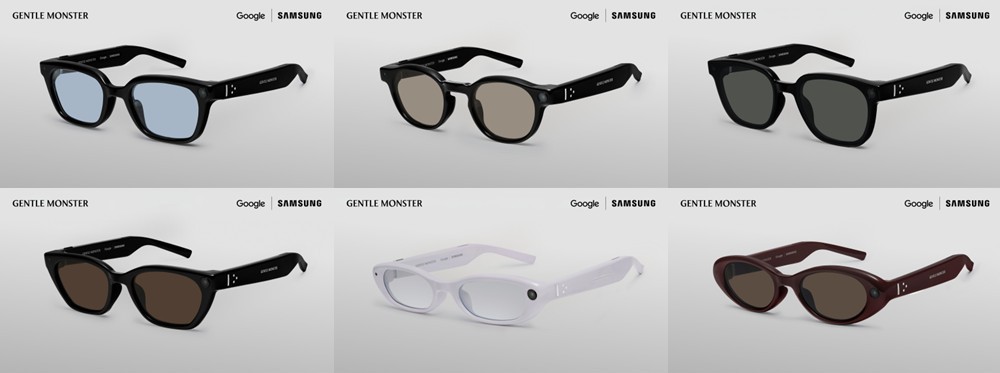
The Warby Parker and Gentle Monster collections use the same hardware and software, according to Samsung’s product information. The price difference pays for the frame design and brand rather than a faster processor, better camera or longer battery life. Warby Parker offers three frame styles in optical and sun versions, while Gentle Monster has six styles and 16 variations. Prescription lenses are available through both retailers, but their cost is separate from the advertised starting price.
| Feature | Intelligent Eyewear specification |
|---|---|
| Display | None; interaction is through voice, touch and open-ear audio |
| Camera | 12MP HDR; 3,024 x 4,032 photos; 3K/30fps video or 2K HDR video |
| Audio | Two open-ear speakers and four microphones |
| Processor | Qualcomm Snapdragon AR1 Gen 1 |
| Memory and storage | 2GB RAM and 64GB storage |
| Battery claim | Up to nine hours mixed use; up to 72 hours with the charged case |
| Connectivity | Wi-Fi 6E and Bluetooth 5.4 |
| Water resistance | IPX4 for the glasses; the charging case is not water-resistant |
| Weight | About 41 grams, varying from 39.6 to 43.9 grams by frame |
The lack of a screen means Google Maps directions arrive by voice rather than appearing as arrows in the wearer’s view. Translated text is also read through the speakers. Anyone expecting a compact version of a mixed-reality headset should wait for a display-equipped product.
Samsung’s nine-hour battery estimate is based on a mixed workload that includes notifications, calls, Gemini conversations, music, photos and video. It is not a promise of nine hours of continuous recording or Gemini Live use. The 72-hour figure assumes repeated charging from a full case, which weighs 166.8 grams for the Warby Parker version or 194.5 grams for the Gentle Monster version.
Phone compatibility is broader than Galaxy, but the experience is not equal
The glasses require a compatible phone and Bluetooth connection. Samsung lists Galaxy S and S FE phones plus Galaxy Z Fold, Flip and Fold Ultra models running One UI 9.0 or later. Google Pixel 7 and newer phones need Android 17 with at least the September 2026 update. Apple support begins with the iPhone 13 family, but Samsung also requires at least 6GB of RAM and iOS 26.6, so buyers should check their exact iPhone rather than relying on the model-year label alone.
Galaxy owners get the fullest integration. Bixby is available only with Galaxy phones, and a Galaxy Watch running Wear OS 7 or later can answer calls or control Gemini through hand gestures after the Glasses Controller app is installed. Photos and videos can be viewed on a paired Galaxy phone. Samsung does not describe equivalent watch controls or the same media workflow for Pixel and iPhone owners.
Activation has another restriction: both the Samsung Account and Google Account must be set to a country where the glasses are officially sold. Samsung says the device can be used elsewhere after activation, although features may be limited. The services are restricted to users 18 and older.
Gemini can see, translate and act, within limits
The 12MP camera gives Gemini a live view when the wearer asks about a landmark, object, sign or menu. Google Translate supports real-time speech and text translation in more than 70 languages, though the Translate app must be installed and availability varies. Google Maps provides spoken turn-by-turn directions. The glasses can also summarize notifications, make calls, dictate messages, play music and capture photos or video.
Samsung’s most concrete productivity example is a meeting whiteboard: the wearer can capture it, ask Gemini for a summary and save the result to Samsung Notes. Other tasks include creating calendar events from information in view and continuing a Gemini conversation without repeating the wake phrase for each follow-up.
A short hands-on test by Tom’s Guide found live English-to-Mandarin translation responsive after an initial conversational delay. The same test found noticeable sound leakage at higher music volume and described the camera output as adequate rather than phone-replacing. Those observations came from a controlled demo, not long-term testing, but they identify two questions a preorder cannot answer: how private the open-ear audio feels in quiet places and how battery life holds up under sustained Gemini use.
Gemini can also make mistakes. The eyewear’s camera does not turn an AI answer into verified identification, medical advice or safe navigation. Google’s Guided Vision feature can provide audio descriptions for blind or low-vision users, but Google explicitly says it is not a medical device, mobility aid, obstacle detector or replacement for a white cane.
The privacy controls are specific, but the camera remains visible technology
Google and Samsung have built several protections around the camera. An outward-facing LED illuminates when a photo or video is captured for the gallery, while the wearer receives an inner-light notification and a sound. Sensors are designed to block capture if the external light is covered or tampered with.
When Gemini uses the live view to answer a question, the glasses are designed to redact bystanders’ faces before sending images for processing. Google says those camera visuals are not saved in Gemini History, used to train AI models or used for ad targeting. Stored data is encrypted, and data sent to a phone or cloud service is encrypted in transit. Apps must request camera access, and the frames have a physical power switch.
There are important boundaries to those assurances. Gemini chat text can be saved in Gemini History, and users must manage whether that text is used to improve Google’s models. A wearer can deliberately ask the glasses to take a photo or video, in which case the file is stored in the gallery. The bystander-facing LED helps signal that capture, but a small indicator on ordinary-looking frames still asks people nearby to notice and understand it.
Google is also using platform rules to deter misuse. Google Play policies prohibit camera apps for social livestreaming or real-time facial identification on the glasses, and apps cannot change the indicator light’s behavior. Google Ads and Shopping policies bar products intended to conceal recording lights. Enforcement will matter as much as the written rules once third-party apps and accessories arrive.
Who should preorder and who should wait
The strongest early case is for a Galaxy owner who already wears glasses or open-ear audio throughout the day and values translation, calls and hands-free capture more than a visual display. Warby Parker’s lower starting price and retail fitting network make its models the practical entry point; Gentle Monster offers the same computing hardware in more fashion-forward frames.
Most other buyers should try the glasses in person after December 10 or wait for independent reviews. Frame comfort is personal, prescription lenses raise the real purchase price, open-ear audio can leak, and Samsung’s mixed-use battery figure needs real-world testing. Pixel and iPhone owners should verify which features carry over from Galaxy before ordering, especially photo handling, notification controls and wearable gestures.
The launch still marks an important shift for smart glasses. Samsung and Google are putting Gemini into eyewear that starts below $400, supports prescription lenses and looks close to an ordinary pair. Whether that becomes a useful everyday device will depend less on headline AI demonstrations than on fit, audio privacy, dependable phone integration and how often the camera-based assistant is genuinely faster than taking out a phone.