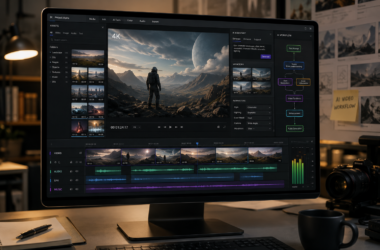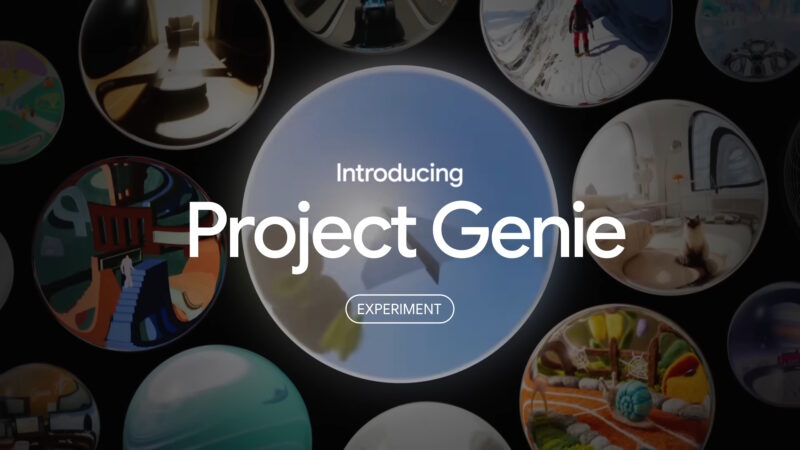
Google DeepMind introduced Genie 4 on Tuesday, October 27, as a research-preview world model that generates interactive scenes in real time, including their visuals, ambient sound, music and responsive dialogue. Access is starting with trusted testers. Google plans to bring the model next to Google AI Ultra subscribers through Project Genie and to selected developers through the Gemini API and Google AI Studio, but it has not given a public rollout date or pricing.
The upgrade is more than a sharper version of AI video. Users can navigate a generated environment with keyboard controls and change it while it is running by entering instructions such as moving the camera, altering the weather or adding a person or object. A Gemini model interprets those interventions and helps keep the scene moving in a coherent direction while Genie renders the next frames.
That loop is the most consequential part of the announcement. It points toward simulations that can be directed and tested as events unfold, rather than clips that must be generated again whenever a prompt changes. It also explains why Google is positioning Genie 4 for robotics and scenario testing alongside games, education and creative pre-visualization.
How Genie 4 combines world generation with Gemini
Google describes Genie 4 as a pixel-level world generator supported by several Gemini systems. The company’s technical overview says Gemini Omni helps anchor a scene in real-world appearance and behavior. Gemini 3.8 Flash acts as a guiding agent: it observes incoming frames, breaks a goal into steps, checks whether each step succeeded and changes the plan when the scene or the user’s instruction changes.
That division of labor matters. Genie supplies the sensory environment, predicting what should appear and sound next. Gemini supplies a more structured planning layer. In one demonstration, Gemini 4 Argon decomposed a task involving Apptronik’s Apollo humanoid playing checkers, then passed steps into Genie 4 as the simulation ran. Another example showed a Universal Robots UR5 arm using a pipette over a lab plate.
These are demonstrations, not evidence that the model can replace a validated robotics simulator. Industrial simulation depends on precise geometry, calibrated dynamics, reproducible results and measurable error bounds. Google has not published benchmarks showing Genie 4 meets those requirements. The demos instead show a possible way to generate many rough scenarios quickly before moving promising cases into conventional simulation or physical testing.
Native audio and live edits change the experience
Genie 4 is DeepMind’s first real-time world model to produce audio natively. A generated environment can include setting-specific ambience, music and speech that reacts to what happens. Characters can converse and respond to a user’s inputs rather than delivering dialogue fixed when the scene was created.
The model also accepts natural-language edits during a session. Google’s examples change camera behavior, introduce objects and alter environmental conditions without restarting the world. The company says the system has improved at aerodynamics, collisions, human motion and characters’ responses to their surroundings, although those claims have not yet been independently tested at scale.
TechCrunch reported that Genie 4 can sustain a scene for up to two minutes, twice the limit associated with the previous generation. Duration alone does not establish consistency: a useful simulation also has to remember where objects are, preserve identities, keep spatial relationships stable and obey the same rules after several edits.
What early testers are doing with it
DeepMind has placed Genie 4 with testers in creative work, journalism, education, gaming and engineering. Filmmakers are using it as a rapid pre-visualization tool, entering a scene and changing lighting, camera angles, dialogue and action to compare rough “takes” before production. Game developers can test a visual style or interaction concept before building assets and systems in an engine.
Other trials turn archival photographs into explorable scenes or visualize short events such as floods and wildfires. Those uses will require unusually clear labeling and sourcing. A plausible simulation derived from a photograph is not a reconstruction of what happened outside the frame, even when it looks documentary-real.
For enterprise teams, the nearer-term value may be fast scenario drafting rather than final simulation. A team could explore how a warehouse layout, training sequence or robot task might unfold, identify missing conditions, and then transfer the useful cases to tools that provide deterministic physics and auditable parameters.
The limits are still fundamental
Google acknowledges that details and object permanence can drift as a session continues, especially after several complex edits or extensive movement through a scene. Complex physical interactions, accurate real-time audio, legible text, spatial precision and long-term consistency remain open problems.
Those gaps separate Genie 4 from a game engine or engineering simulator. A generated door may move, disappear or return with different geometry; a character can lose visual continuity; signage may become unreadable; and an apparently successful robot action may not reflect physically accurate contact or force. Developers evaluating the API will need controls for reproducibility, state inspection and error measurement, none of which Google detailed at launch.
Access details are also incomplete. DeepMind has not announced general API availability, usage limits, output resolution, latency targets, regional eligibility, commercial terms or whether developers will be able to export structured scenes rather than recorded video. Project Genie’s current consumer prototype is limited to eligible Google AI Ultra users, and Genie 4 remains on a waitlist.
World models are becoming a competitive platform
Genie 4 arrives as world-model investment spreads beyond research labs. Runway’s GWM Worlds 2 also generates playable scenes and audio; AMD is acquiring Fei-Fei Li’s World Labs; Rivian has bought Third Dimension for simulation work; and Amazon has reportedly explored a deal for Decart. The common bet is that models able to predict how an environment changes after an action could become infrastructure for robotics, autonomous systems, games and interactive media.
Google’s advantage is the combination of a world generator, the Gemini planning stack and a consumer distribution path through Project Genie. Whether that becomes a useful developer platform will depend less on polished demo clips than on the unannounced details: controllability, repeatability, cost, latency, session length and how reliably state survives intervention.
DeepMind says all Genie 4 video and audio will carry SynthID, its imperceptible watermark for AI-generated media. That provides one disclosure mechanism, but the harder technical test is whether the model can turn short, visually convincing experiments into simulations whose behavior can be trusted. Genie 4 moves that effort forward; its own limitations make clear that the work is not finished.