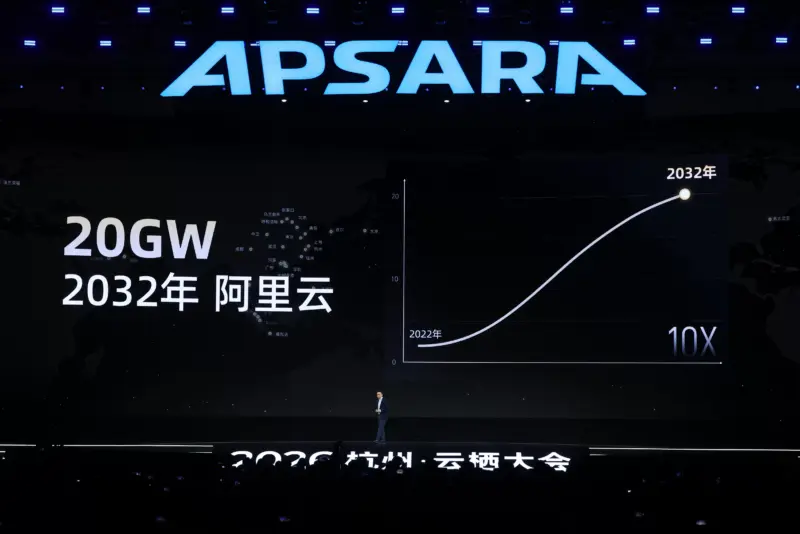
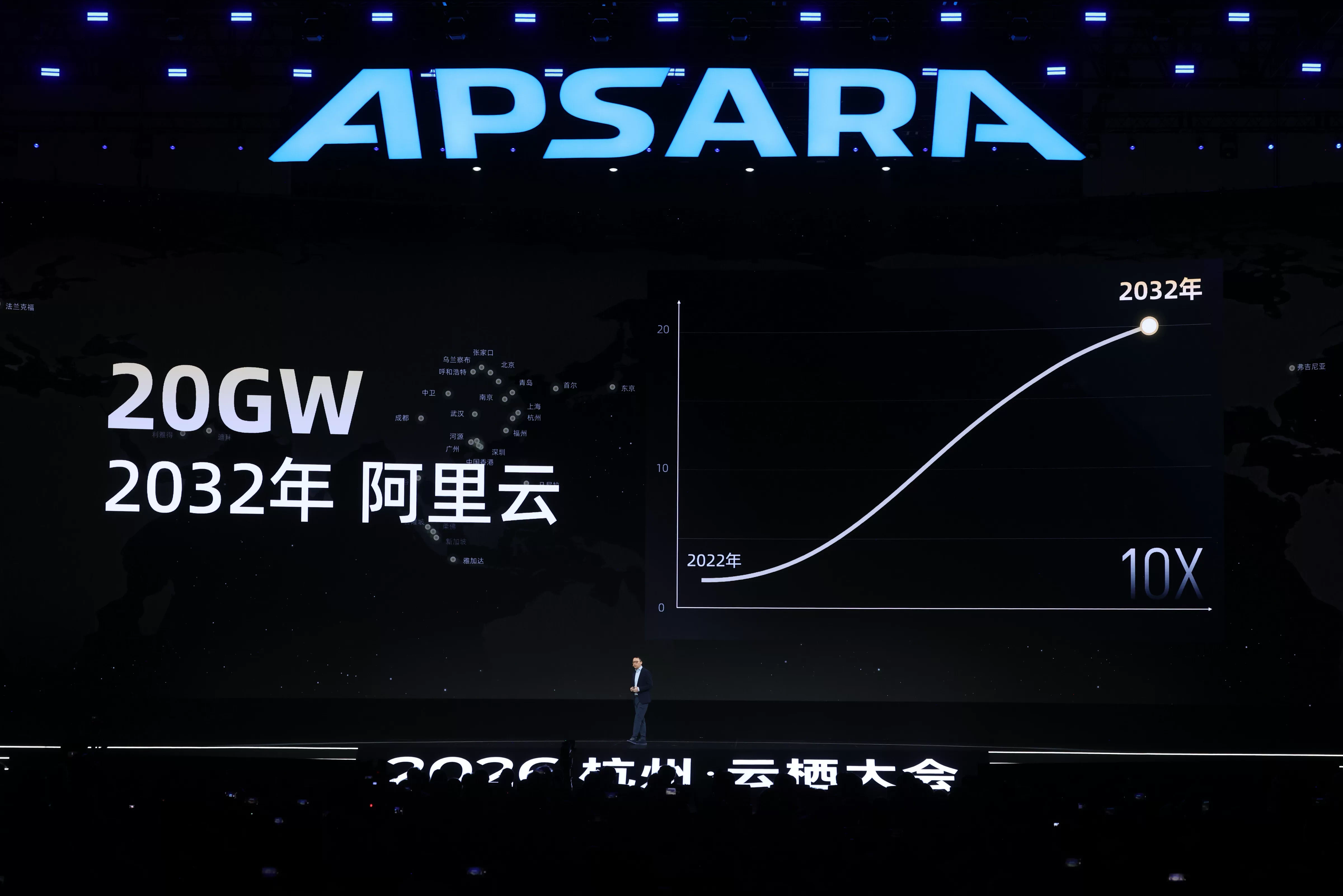
Alibaba has unveiled the Zhenwu V900, a new processor for training and running artificial intelligence models, while confirming that Qwen 4 is in training and laying out plans for models with as many as 10 trillion parameters. The announcements came Tuesday at the company’s Apsara Conference in Hangzhou, where Alibaba also set a target for its global cloud data-center capacity to exceed 20 gigawatts by 2032.
The V900 is the most concrete part of a much larger roadmap. Alibaba says the accelerator has 216 GB of memory, 1,200 GB per second of inter-chip bandwidth, and three times the performance of the Zhenwu M890 introduced in May. It supports FP8 and FP4 numerical formats for lower-precision training and inference, and is scheduled for mass production and commercial availability in the first quarter of 2027.
Taken together, the announcements show Alibaba trying to control more of the AI stack: chips, servers, networking, storage, models, agent software, and the cloud capacity that connects them. That can reduce dependence on outside suppliers and let the company optimize each layer together. It also makes the claims harder to judge from any single benchmark.
What Alibaba announced
The Zhenwu V900 was designed by T-Head, Alibaba’s semiconductor unit. According to the company’s Apsara announcement, the processor can handle both model training and inference and carries 72 GB more memory than the M890’s 144 GB. Inter-chip bandwidth rises from 800 GB/s to 1,200 GB/s.
| Specification | Zhenwu M890 | Zhenwu V900 |
|---|---|---|
| Announced | May 2026 | September 2026 |
| Memory | 144 GB | 216 GB |
| Inter-chip bandwidth | 800 GB/s | 1,200 GB/s |
| Claimed performance change | Baseline | 3x M890 |
| Commercial timing | Available in Alibaba systems | Q1 2027 planned |
Alibaba paired the chip with an upgraded supernode design that combines the V900 with its ICN Switch, Panmai SmartNIC, and Zhenyue SSD controller. The company says the architecture can scale to a cluster of as many as 500,000 accelerators. Its existing Zhenwu line serves more than 650 customers in industries including automotive, finance, energy, manufacturing, embodied AI, and large language models.
There are important gaps in the public specification. Alibaba has not disclosed the V900’s fabrication process, power consumption, software compatibility details, or independently verified training and inference results. The threefold performance claim also needs workload, precision, system size, and power context before it can be compared meaningfully with Nvidia, Huawei, or other accelerators.
Why memory and interconnect matter
The V900’s 216 GB of accelerator memory is significant because large models and long-context workloads can be constrained by memory capacity before raw arithmetic performance becomes the limiting factor. More memory per device can reduce the number of accelerators needed to hold a model, while higher inter-chip bandwidth can reduce the time devices spend waiting to exchange parameters, activations, and intermediate results.
Those advantages depend on the complete system. A cluster’s useful performance is determined by networking, storage throughput, software scheduling, failure recovery, and power delivery as well as the accelerator. Alibaba’s announcement reflects that reality: it presents the V900 as one part of a vertically integrated system rather than as a standalone replacement for a specific Nvidia product.
The company also introduced a 2027 CPU roadmap. The Yitian 720 is intended to improve single-core performance, density, and energy efficiency over the Yitian 710. The Yitian 730 will use T-Head’s own microarchitecture and is claimed to improve SPECint2017 performance per gigahertz by as much as 40 percent over the 710.
Qwen 4 is in training, but the biggest models remain a roadmap
Alibaba confirmed that Qwen 4 is currently being trained. Future Qwen 4.5 and Qwen 5 systems are projected to reach between 5 trillion and 10 trillion parameters, compared with 2.4 trillion for the current Qwen3.8-Max flagship. Reuters reported that the planned models are aimed at more complex, longer-horizon work.
Parameter count is not a reliable scorecard by itself. Mixture-of-experts models may activate only part of their total parameters for each token, and training data, post-training, retrieval, tool use, inference-time computation, and software efficiency can matter more than headline size. The more useful question is whether Alibaba can train and serve the planned systems economically on its own infrastructure.
The company is also promoting what it calls recursive self-improvement based on empirical feedback. In one internal run, Qwen3.8-Max completed 33 automated training-optimization cycles over a month and raised its Artificial Analysis score from 40 to 45. In a separate chip-design experiment, Alibaba says the model made more than 10,000 electronic-design-automation tool calls across 60 hours and produced bus modules that used 42 percent less chip area without sacrificing performance.
Those are vendor-reported results, not independent demonstrations. They are still technically interesting because they describe a measurable workflow: a model proposes changes, invokes design tools, evaluates results, and iterates. For engineering teams, reproducibility, verification coverage, tool permissions, and the treatment of failed runs will matter more than the “self-improvement” label.
The 20 GW target is the real scale claim
Alibaba CEO Eddie Wu said the company wants Alibaba Cloud’s worldwide data-center capacity to exceed 20 GW by 2032. That figure describes an infrastructure ambition, not current installed AI compute. The Associated Press noted that the push comes as Chinese model developers seek domestic alternatives to restricted US chips and chipmaking equipment.
A 20 GW footprint would require far more than accelerators. Alibaba would need power contracts, substations, cooling systems, land, networking, memory, storage, and a dependable supply of packaged chips. Local grid connections and construction schedules can constrain deployment even when demand and capital are available. Wu acknowledged that supply limitations are already slowing expansion, according to Reuters.
The timing also matters. The V900 is not due for commercial release until next year, while the 20 GW goal stretches to 2032 and the 5-to-10-trillion-parameter models sit beyond Qwen 4. The stack exists at different stages: some cloud software was launched at Apsara, Qwen 4 is training, the V900 is approaching production, and the largest infrastructure promise remains six years away.
What cloud customers should verify
Alibaba’s vertical integration could give customers access to a coherent Chinese AI platform when leading US accelerators are difficult or costly to obtain. It could also improve price control and capacity planning inside Alibaba Cloud. Buyers should still demand workload-level evidence.
- Benchmark the actual model and precision. Training, batch inference, low-latency serving, and long-context workloads stress systems differently.
- Measure total system efficiency. Throughput per watt, utilization, network overhead, and failure recovery determine operating cost.
- Check software portability. Framework support, kernel maturity, debugging tools, quantization, and migration effort can outweigh nominal chip performance.
- Separate availability from roadmap. Commercial V900 capacity begins in Q1 2027 if the schedule holds; larger Qwen models and the full data-center buildout come later.
- Ask for independent results. Alibaba’s memory and bandwidth specifications are concrete, but its performance, cost, and automated-design claims need external validation.
The V900 announcement is therefore less a single-chip launch than a test of Alibaba’s ability to operate an end-to-end AI supply chain. The company has supplied enough technical detail to make the plan credible and enough unresolved detail to keep comparisons provisional. The decisive evidence will arrive when customers can run production workloads on commercial V900 clusters next year.