AMD has agreed to buy World Labs, the spatial-intelligence company co-founded by computer-vision researcher Fei-Fei Li, in an all-stock transaction valued at about $8.2 billion. The companies announced the definitive agreement on September 28 and expect it to close by the end of 2026, subject to regulatory approval and other customary conditions.
Li will become an AMD executive vice president and chief scientist, reporting to CEO Lisa Su. World Labs’ researchers will continue model work inside AMD, while co-founders Justin Johnson and Ben Mildenhall remain in leadership roles. Until the deal closes, it is an acquisition plan rather than a completed combination.
The price is striking for a company founded in 2024, but the strategic move is more important than the headline number. AMD is buying a frontier-model team whose experiments can influence the GPUs, networking, software and systems needed for future robotics and simulation workloads. That takes AMD a step beyond supplying accelerators to AI labs and closer to defining the workloads its next hardware must serve.

What World Labs actually builds
World Labs develops models intended to understand and generate persistent three-dimensional environments, not just produce a sequence of attractive frames. Its commercial platform, Marble, turns text, images and video into explorable 3D worlds. The company’s newer research model, Atlas, expands that work into generation, reconstruction and simulation.
World Labs describes Atlas as a multimodal autoregressive diffusion transformer trained from scratch across text, images, video and 3D. It combines those inputs into a shared spatial context so the model can generate new views while attempting to preserve geometry across camera positions.
The announced capabilities include camera-controlled video up to one minute at 1440p, reconstruction of real scenes from one or more images, explicit 3D outputs and “real-to-sim” workflows that convert recorded environments into simulations for robotics. Atlas remains in early access, and company demonstrations do not establish how well it performs across the uncontrolled settings that production robots encounter.
That distinction matters. A model that renders a convincing room is not automatically a physics simulator or a robot planner. It must keep object geometry, motion and cause-and-effect consistent enough for an agent to learn actions that transfer to the physical world. The value to AMD will depend on whether World Labs can turn its research into repeatable workloads and usable products, not simply better 3D media generation.
Why a chip company wants a model lab
AMD’s acquisition announcement says emerging AI models will shape its hardware, software and systems roadmaps. World Labs provides an internal customer with unusual demands: large multimodal training jobs, latency-sensitive generation, geometry-heavy inference, video processing and simulation pipelines that can expose bottlenecks different from those of a text model.
The two companies already had a technical partnership focused on training and inference optimization on AMD GPUs. World Labs says the deal will combine model research with AMD hardware, software, platforms and open models. That existing work reduces some integration risk, but neither announcement supplies benchmarks showing Atlas or Marble performance on AMD Instinct systems, nor a schedule for moving more of the stack onto AMD hardware.
Owning the lab can shorten the feedback loop. Model researchers can identify memory, interconnect, compiler and kernel constraints early; the hardware team can test designs against workloads that may become important several product cycles later. Nvidia has long benefited from a broad software ecosystem and has also released Cosmos world models for physical AI. AMD’s purchase is a more direct attempt to connect frontier research with its compute roadmap.
The deal reaches beyond GPUs
World models are relevant to robot training because real-world data is expensive, slow and risky to collect. A warehouse robot can practice thousands of simulated variations of a task without dropping physical inventory or stopping a production line. Autonomous-vehicle and industrial teams can generate rare scenarios, vary lighting and layouts, and test perception or planning systems before field trials.
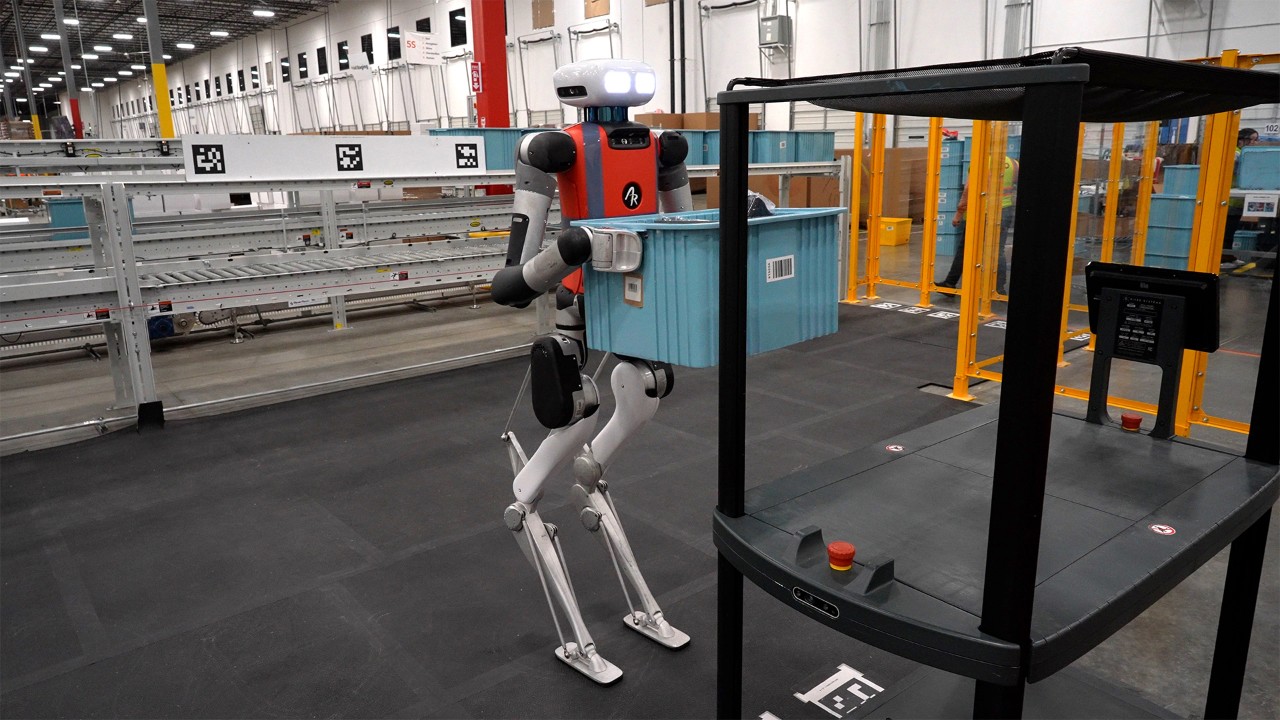
Those workflows also create infrastructure demand across CPUs, GPUs, high-capacity memory, networking and storage. They need rendering and simulation, model training, synthetic-data generation and repeated inference. AMD can potentially sell a broader system around that pipeline, but the announcement does not identify a new chip, customer deployment or revenue target tied to World Labs.
What customers and investors should watch
The first test is integration without narrowing World Labs into a showcase for one vendor’s hardware. AMD and World Labs promise a widely accessible open ecosystem, but they have not defined which model weights, APIs or tools will be open, nor whether existing customers will retain equivalent access across other infrastructure.
The second test is measurable optimization. Useful evidence would include published performance on AMD Instinct GPUs, ROCm support for Atlas components, memory and interconnect requirements, cost per generated or reconstructed scene, and comparisons across training and inference configurations.
The third is product continuity. Atlas is still early access, while Marble is the clearest commercial product. Customers need to know whether those services remain independent products, become reference workloads for AMD, or turn into building blocks for robotics and digital-twin partners.
Finally, regulators still have to review the transaction. The stated year-end timetable may move, and the benefits AMD describes depend on the deal closing and on retaining a scarce research team afterward.
AMD is not buying $8.2 billion of current chip revenue. It is buying a closer view of what a post-language-model workload could require. The acquisition will look prescient if World Labs’ spatial models become useful infrastructure for creators, simulation and robotics, and if that demand improves AMD’s full stack. Without transparent benchmarks and durable products, it risks remaining an expensive research bet.