Broadcom has locked in a longer runway inside Apple’s hardware stack, extending a custom-chip partnership that now runs through 2031. In a Form 8-K filed July 6, Broadcom said the two companies have entered new multi-year agreements for Broadcom to develop and supply “a range of custom ASIC silicon products” for multiple generations of Apple products.
The filing is short and deliberately unspecific. It does not name the iPhone, Mac, Apple Watch, Apple Intelligence, data-center servers, or any individual component. That matters because the deal is already being pulled into the larger AI trade. The safer reading is narrower and still important: Apple is keeping Broadcom deeply involved in custom silicon as on-device AI, wireless performance, power efficiency, and product-specific accelerators become harder to separate.
Reuters reported that Broadcom said it would expand the Apple partnership through 2031, while market coverage from Investor’s Business Daily noted that Broadcom shares rose after the disclosure. Barron’s framed the move around edge AI, arguing that custom ASICs could matter as Apple shifts more artificial-intelligence work onto local devices instead of treating AI only as a cloud service.
Why custom ASICs matter for Apple’s AI plans
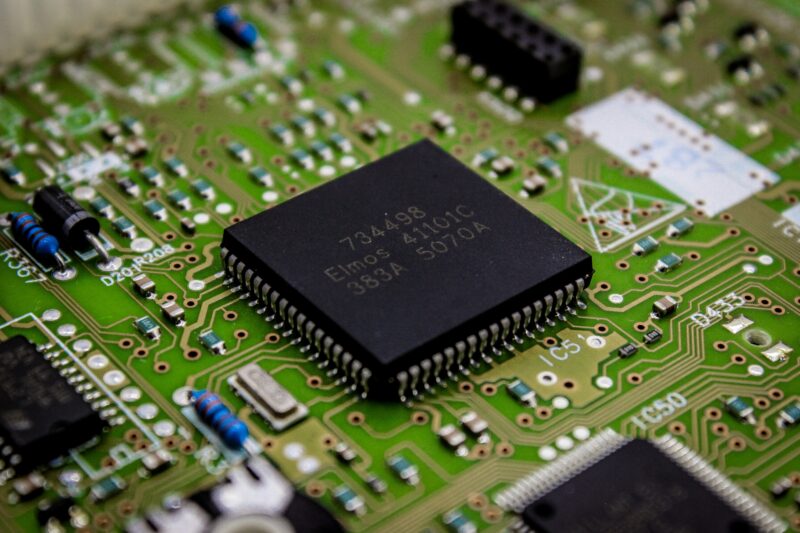
ASICs, or application-specific integrated circuits, are chips designed for a defined job rather than general-purpose computing. In consumer devices, that can mean lower power draw, tighter integration, and performance tuned around repeated workloads. For Apple, the relevance is not just raw AI acceleration. It is the whole device-level equation: battery life, heat, wireless latency, sensor handling, secure processing, and how often a feature can stay on-device instead of reaching for the cloud.
Apple already controls the main processor strategy across the iPhone, iPad, Mac, and Vision product lines through its own Apple Silicon designs. But a modern Apple device is not one chip. It is a package of processors, radios, controllers, sensors, memory, power-management components, and custom support silicon that must behave as one product. Broadcom has long been part of that surrounding layer, especially around wireless and radio-frequency components.
That is why a supply agreement can be strategically meaningful even without a dramatic product announcement. If Apple wants AI features that feel instant, private, and battery-aware, the company needs more than a large model and a neural engine. It needs supporting silicon that keeps connectivity, power, data movement, and product-specific functions from becoming bottlenecks.
This extends a relationship that was already shifting
Apple’s public Broadcom relationship has already moved beyond ordinary component sourcing. In 2023, Apple announced a multi-year, multibillion-dollar agreement under which Broadcom would develop 5G radio-frequency components, including FBAR filters, and wireless connectivity components. Apple said at the time that the work would involve U.S. manufacturing and Broadcom’s Fort Collins, Colorado facility.
The new 2031 agreement is described differently. Instead of naming 5G components or filters, Broadcom’s filing refers to custom ASIC silicon for multiple generations of Apple products. That phrase leaves room for a wider range of device-specific chips, and it arrives at a moment when Broadcom is also gaining attention for custom AI silicon in the data center.
Broadcom’s broader custom-chip business has become one of the clearest ways hyperscalers and large platform companies are trying to reduce dependence on one-size-fits-all AI accelerators. OpenAI and Broadcom recently unveiled the Jalapeño inference chip, and Broadcom has been tied to custom silicon work for other major AI customers. The Apple deal puts Broadcom on both sides of the AI hardware map: large-scale infrastructure and the smaller, power-constrained devices where edge inference has to feel invisible.
The real story is supply certainty, not a confirmed feature list
There is a temptation to turn the filing into a prediction about the next iPhone or a specific Apple Intelligence roadmap. The document does not support that. It confirms an expanded technology collaboration, a 2031 horizon, and custom ASIC supply for multiple generations of Apple products. It does not say which products, what functions the chips will perform, where they will be manufactured, how much Apple will spend, or whether the components are tied directly to AI features.
Even with those limits, the timing is useful. Apple has been under pressure to show that its AI strategy can work across devices people already use, not only through cloud-backed assistant features. The company’s pitch around Apple Intelligence has leaned on privacy, personal context, and tight integration with the operating system. Those promises are easier to make when hardware, software, and specialized components are planned together over several device cycles.
For Broadcom, the agreement reduces a familiar supplier risk. Apple has a long history of bringing more silicon work in-house when it can. A contract through 2031 signals that, at least for a range of custom ASIC products, Apple still sees value in an external partner with deep experience in wireless, networking, and specialized chip design.
What to watch next
The next useful signals will not necessarily come from another filing. Product teardowns, supplier commentary, Apple platform disclosures, and Broadcom earnings calls may reveal whether the new ASIC work is closer to wireless, power management, AI acceleration, device controllers, or server-side infrastructure supporting Apple services. Until then, the deal is best understood as a long-term supply-chain commitment around custom silicon rather than proof of any one future feature.
That distinction is the point. Edge AI will not be won only by releasing bigger models. It will depend on which companies can make AI cheap enough, fast enough, private enough, and efficient enough to run inside everyday hardware. Apple just gave Broadcom a longer seat at that table.