Apple has opened a U.S. research study that lets as many as 200,000 iPhone users ask an AI system health questions and, if they choose, add selected Apple Health data to the conversation.
The Apple Health AI Usage Study, announced November 15 with clinical search company OpenEvidence, is designed to measure whether people trust and understand health answers generated by AI and whether those answers help them prepare for a medical visit. Enrollment is available now through a separate, free iPhone app.
This is a research app, not a new diagnosis feature inside Apple Health. Apple explicitly says it does not provide medical advice, diagnosis, treatment or live monitoring. Its importance lies in what Apple is testing: whether an AI grounded in medical literature can explain health information to ordinary users, then make those explanations more relevant with data from their own devices.
Who can join the Apple Health AI study
Enrollment is limited to people who meet all of these requirements:
- Age 21 or older
- Located in the United States
- An Apple Intelligence-compatible iPhone, meaning an iPhone 15 Pro or later
- iOS 26 or later
- The free Apple Health AI Study App
The App Store lists the app as iPhone-only, 29.9 MB and English-language. Its store age rating is 18+, but the research protocol sets the enrollment threshold at 21. Apple says the app includes an informed-consent process before a user joins.
Those requirements also shape the study population. A sample drawn from adults who own newer premium iPhones, use Apple Intelligence and volunteer for a digital health study will not automatically represent the wider U.S. population. Apple has not publicly identified a recruitment target for different demographic groups.
What the app can do
The conversational system uses OpenEvidence technology, which retrieves information from clinical sources including The New England Journal of Medicine, JAMA and Nature. Responses display links to peer-reviewed sources so participants can see what evidence supports an answer.
Apple gives four broad examples: understanding a symptom or condition, putting personal health measurements in context, preparing for a clinical visit, and building an exercise or meal plan. Participants can rate answers and respond to occasional surveys, giving the researchers a way to compare apparent answer quality with what users actually comprehend and trust.
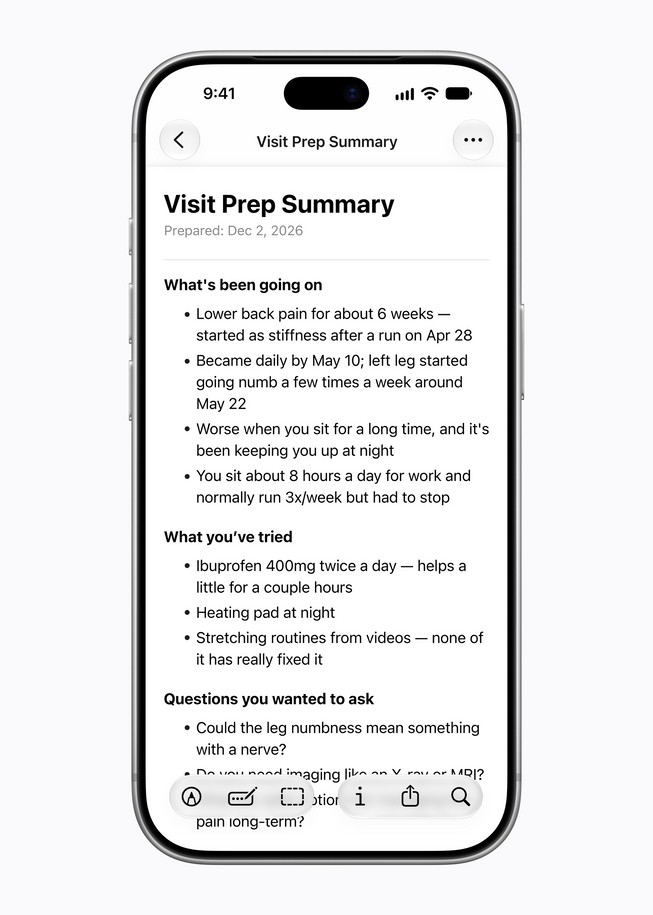
The distinction between a cited answer and a correct decision still matters. Citations can show where information came from, but they do not guarantee that a system selected the right evidence, applied it correctly to one person or communicated uncertainty well. Apple acknowledges that consumer health models can produce incomplete or unclear responses. The study is meant to examine that last mile between technically grounded information and a person’s understanding of it.
The app includes guardrails intended to recognize certain concerning questions and direct a participant to a clinician or another resource. Apple has not published the exact conditions those controls detect, their test results or how often a human reviews an escalation. Anyone with an urgent or potentially serious concern should use appropriate medical services rather than wait for the study app to interpret it.
Which Apple Health data can be shared
HealthKit access is optional. Apple’s examples include resting heart rate, activity, sleep and lab results. The purpose is to test whether adding personal measurements makes an answer more relevant and understandable.
Participants should treat each permission as a separate choice, not as a requirement to open their entire Health record. Before enabling a category, consider whether it is necessary for the questions you intend to ask. Lab results can be considerably more sensitive than step counts, while sleep, heart-rate and activity histories can reveal long-term routines or health changes.
Apple says participants remain in control of whether to share HealthKit metrics and survey responses. The public announcement does not enumerate every HealthKit field the app may request, so the permission screen and consent document are the authoritative places to check the actual scope offered to an individual participant.
What Apple and OpenEvidence say about privacy
Apple states that study data will not be used to train AI models. In additional details provided to ABC News, the company said questions pass through protections that remove identifying information before they reach OpenEvidence. OpenEvidence is expected to delete question-and-response data within 24 hours and not use those queries for model training.
The App Store privacy label covers the app itself. It says a user ID may be collected and linked to the participant for app functionality and analytics, while performance diagnostics may be collected without being linked to an identity. That compact label does not describe the full research dataset, every party that may process it or Apple’s retention schedule for consented study data.
Apple’s announcement says it has security measures for data it maintains, but it does not publicly specify how long that data will be kept, which researchers will receive it, whether a participant can delete previously submitted records, or whether the study has a public registration and named institutional review board. Those details may appear during enrollment. They are worth reading before consenting, particularly for anyone considering sharing lab values or asking about a sensitive condition.
What to check before enrolling
Prospective participants should pause at the consent and HealthKit screens and answer five questions:
- Which data types are requested? Enable only the categories you understand and are comfortable contributing.
- Who receives prompts and health measurements? Check the consent language for Apple, OpenEvidence and any research partners.
- How long does each party keep the data? OpenEvidence’s reported 24-hour deletion applies to its question-and-response copy; Apple may retain research records under a different schedule.
- Can you withdraw and delete earlier submissions? Enrollment withdrawal and deletion of data already used in research are not always the same thing.
- What should never be entered? Avoid names, addresses, medical-record numbers or other identifiers unless the study explicitly requests them through a protected field.
The study arrives as public interest in medical AI is running ahead of confidence in it. A November Pew Research Center briefing found that 80% of U.S. adults want disclosure when AI explains lab results, while only 8% are comfortable with AI doing that without human review. Fifty-one percent expect AI to make the security of personal health information worse.
Apple is therefore studying a real adoption problem, not merely adding a chatbot to another app. The questions are whether people can distinguish evidence from a recommendation, calibrate their trust, understand limitations and arrive at a clinician better prepared. Until Apple publishes results, the study should be judged as an experiment in health communication, not proof that an iPhone can safely interpret a person’s medical situation.