Anduril and Qualcomm unveiled BlueChip on Tuesday, a new line of rugged computers that will begin with a Snapdragon X laptop designed and assembled in the United States. Functional prototypes already exist, circuit-board assembly is planned for Anduril’s Arsenal-1 factory in Ohio, and the companies expect to start taking orders in 2027.
The first machine is aimed at the U.S. military, government agencies, first responders and other buyers that care more about a traceable supply chain and field durability than a thin chassis. It is also an unusually concrete test of whether the United States can rebuild more of the computer supply chain around domestic factories rather than stopping at final assembly.
One number needs careful handling. In the companies’ announcement, components from U.S. and allied-country suppliers represent more than 90% of the prototypes’ component procurement cost. That does not mean 90% of the laptop is made in the United States, nor does it establish what the domestic share will be when BlueChip ships.
What Anduril has confirmed about BlueChip
- Launch window: Orders are planned to open in 2027, but Anduril has not announced a firm shipping date.
- Processor: The laptop will use a Qualcomm Snapdragon X Series chip for CPU, graphics and on-device AI work.
- Manufacturing: U.S. assembly will include circuit boards at Arsenal-1 in Ohio. Anduril is also working on domestic enclosures, battery components and a process for bonding U.S.-made cover glass to the display.
- Target users: The initial rugged model is intended for defense, government, emergency response and public-safety organizations.
- Software: The prototype is expected to support Windows and two Linux distributions that have not yet been named.
- Missing details: There is no final chip SKU, price, weight, battery specification, display specification, durability rating, memory configuration or service plan.

The 90% figure measures cost across the U.S. and its allies
BlueChip’s headline sourcing figure combines American suppliers with suppliers in allied countries, and it measures procurement cost rather than part count, manufacturing steps or domestic value added. A high-value processor can move that percentage much more than dozens of inexpensive connectors, fasteners or passive components.
Anduril founder Palmer Luckey told reporters that the exact domestic content of the 2027 product remains unsettled. The company has identified U.S. sources for items including display cover glass and parts of the enclosure, but the panel behind that glass is among the components still tied to overseas production. Its long-term goal is a fully domestic option, not a claim that the first model has already reached that point.
That distinction also matters for federal purchasing rules. A product assembled in Ohio from U.S. and allied inputs can offer a more auditable and resilient supply chain without automatically satisfying every definition of a domestic end product. Agencies will need the final bill of materials, country-of-origin data and the procurement rules attached to each contract, not the prototype percentage alone.
Snapdragon X links local AI to an Arizona chip plan
Qualcomm CEO Cristiano Amon told reporters that processors for BlueChip are intended to come from TSMC’s Arizona facilities. The announcement itself identifies only the broader Snapdragon X family, so performance, neural-processing capacity and the actual production schedule remain open questions.
The Arm-based platform is a deliberate fit for the product’s pitch. It can run AI models locally, reducing the need to send sensitive prompts, documents or sensor data to an external cloud. Luckey described local inference as important for work that government and defense users are not permitted to upload. For disconnected or bandwidth-constrained deployments, that can be an operational requirement rather than a convenience.
Arm also creates a compatibility test. TechCrunch reported that Anduril is working on Windows applications, government Linux environments and older agency software. Emulation can cover many conventional Windows programs, but buyers with kernel drivers, hardware tokens, specialist peripherals or old x86-only tools will need validation on the final machine.
The first BlueChip is field equipment, not a Dell replacement
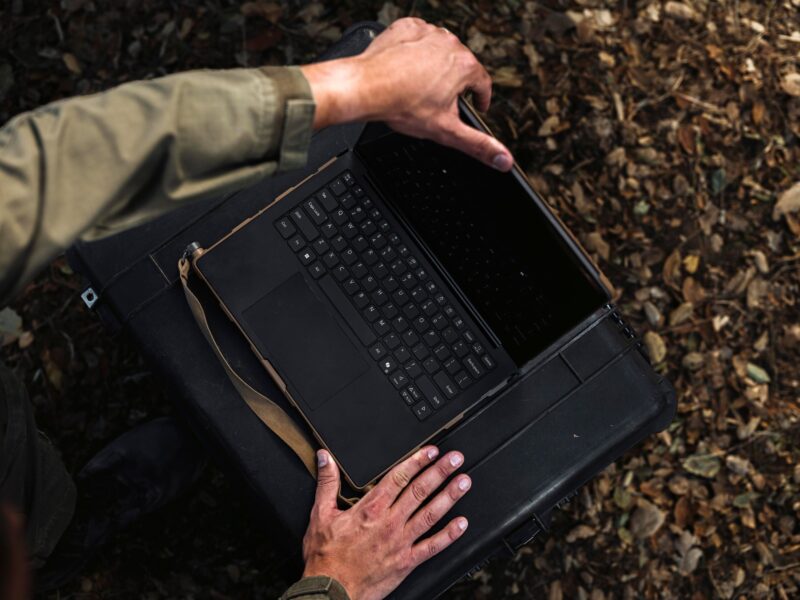
Images of the prototype show a thick tan chassis and an integrated carrying handle. The rugged design is meant to tolerate rain, dust and rough handling, which is likely to increase weight and limit battery life compared with mainstream premium laptops. No MIL-STD test results or ingress-protection rating have been published.
Pricing is not final either. Luckey estimated that BlueChip could cost about 20% more than a typical high-end PC and acknowledged that an ordinary consumer seeking value would probably be better served by an established laptop brand. That candor helps define the initial product: BlueChip is selling supply-chain visibility, local control and ruggedization before it is selling broad consumer appeal.
The first customer base may also make low-volume production economically possible. Government and defense contracts can absorb higher unit costs when security documentation, long support windows, replaceable parts and controlled sourcing are part of the requirement. Anduril has described consumer laptops as a later step, after defense, government and public-safety deployments.
What buyers should watch before 2027 orders open
BlueChip will become much easier to judge when Anduril publishes a final configuration. The most important disclosures are not cosmetic:
- the exact Snapdragon X processor, memory ceiling, storage options and measured performance;
- battery capacity, replaceability, runtime and charging behavior under field workloads;
- weight, port selection, repair documentation, spare-part availability and warranty terms;
- tested dust, water, shock, vibration and temperature ratings;
- Windows-on-Arm and Linux compatibility for agency software, drivers and security tools;
- secure-boot, firmware-update, device-attestation and software-bill-of-materials practices;
- the final domestic-content calculation, the countries behind major components and whether the Arizona-made processor is available at launch; and
- price, minimum order size, production capacity and delivery lead times from Arsenal-1.
BlueChip is more substantial than a concept render: prototypes are running, a processor partner is named and an Ohio assembly site is identified. But its most ambitious promise is still a manufacturing roadmap. The 2027 product will show whether Anduril can turn a rugged government laptop into a repeatable U.S. computer supply chain, and how much buyers are willing to pay for that traceability.
Sources: Qualcomm and Anduril announcement; Reuters reporting; TechCrunch; The Verge.