Google, NVIDIA and Emerald AI launched a coalition Wednesday to press utilities and regulators to treat flexible AI data centers as grid resources rather than uninterruptible power customers. The AI Energy Management Alliance, or AEMA, brings together 20 technology and energy organizations around a direct bargain: data centers that can reliably reduce electricity use during grid stress should get faster connections and credit for avoiding some infrastructure costs.
The founding group is a relaunch of the Advanced Energy Management Alliance, a demand-response trade association created in 2014. Its new roster includes Anthropic, National Grid, AES, Constellation Energy, NRG and RWE alongside Google, NVIDIA and Emerald AI, according to Axios. AEMA plans to advocate before federal and state regulators, grid operators and utilities for rules based on measured performance, including how quickly a facility can cut demand, how long it can sustain the reduction and how predictable that response is.
The coalition arrives as the grid-connection fight moves from theory into tariff design. In June, the Federal Energy Regulatory Commission ordered major regional grid operators to revisit how they connect large loads, including possible new services for facilities that accept curtailment. TechsCurrent covered those orders in its guide to FERC’s large-load proceeding. AEMA is now organizing the companies that want flexible computing written into the resulting rules.
What a flexible AI data center actually changes
Electric grids are planned around the hours when demand is highest, even though those peaks may occur only during a small part of the year. A conventional data center is generally modeled as a firm load: planners assume it may require its full contracted power during those difficult hours. That can trigger new substations, transmission upgrades or generation before the site is allowed to connect.
A flexible facility accepts a different operating model. When a utility or grid operator sends a dispatch signal, software can pause batch jobs, lower GPU power limits, delay training work or route some inference traffic to another region. Batteries and on-site generation can reduce the building’s draw as well. Interactive services and other high-priority jobs stay protected, while work with looser deadlines yields for a defined period.
Google says it has integrated 1 gigawatt of demand flexibility into utility agreements around the United States. AEMA’s policy proposal is technology-neutral: a data center should be judged by verified speed, duration and predictability, whether the response comes from computing controls, storage or generation. In return, the alliance wants expedited interconnection and compensation or tariff treatment that reflects the grid value of controllable demand.
The strongest evidence is in the workload controls
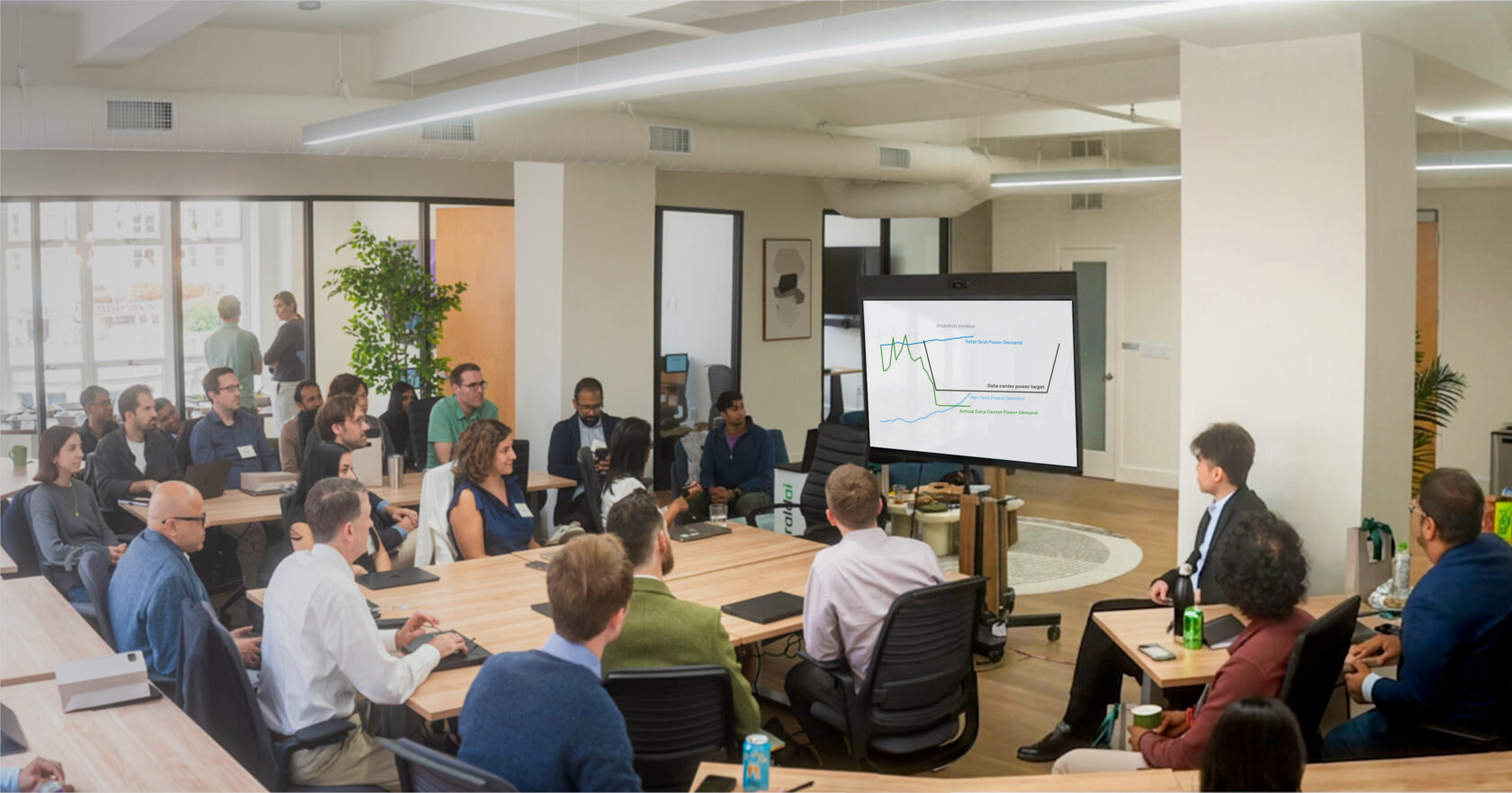
The coalition is selling a policy idea, but its members now have production and field-test data behind it. In an August event described by NVIDIA, Silicon Valley Power sent a demand signal to an AI facility running thousands of NVIDIA GPUs. Emerald AI’s Conductor software followed a predefined job hierarchy, reduced the site’s draw from four megawatts to three and kept high-priority inference running. The utility has since sent more than 200 signals to the facility, NVIDIA reported, with the system responding each time.
A separate five-day trial at a Nebius facility near London used a 96-GPU Blackwell Ultra cluster. According to NVIDIA’s case study, the system met more than 200 simulated reduction requests, cut demand by as much as 40% in under a minute and sustained curtailment for as long as 10 hours. One emergency scenario shed roughly 30% of load in about 30 seconds.
The technical paper behind that work explains how priority metadata determines which jobs absorb the reduction. During extended tests, lower-priority work was delayed or power-capped while the highest-priority jobs retained nearly full throughput. In a separate geographic-shifting experiment, GPUs in Ashburn, Virginia, were capped at 375 watts and an Envoy load balancer redirected inference requests to Chicago. Average time to first token in Ashburn increased by about 30 milliseconds while Chicago absorbed the extra traffic, according to the researchers’ preprint.
Those details matter because “flexible” can otherwise mean little more than a promise to cooperate. Grid operators need telemetry, dispatch interfaces, workload priorities and penalties strong enough to make the reduction dependable during an actual emergency. A training run that can pause for an hour is different from a customer-facing inference service with a latency target, and a battery with a fixed discharge window is different from compute that can move across regions.
Faster connections are the incentive
AEMA says new AI facilities can wait five to 10 years for grid connections in constrained markets. Its larger claim is that moderate flexibility could unlock 100 GW of capacity already present on the U.S. grid. That figure comes from research arguing that existing infrastructure has room outside a relatively small number of peak hours. It is a modeled opportunity, not 100 GW of guaranteed projects.
The commercial incentive is easier to see. If a utility can study a data center as a controllable or non-firm load, it may be able to connect the site before every upgrade required for full, uninterrupted peak service is complete. Developers get earlier access to power; utilities get a load they can call during stressed conditions; and other customers may avoid part of the cost of infrastructure built for rare peaks.
Independent research is more cautious about the size of the benefit. A University of Alberta modeling study found that temporal and geographic flexibility could reduce grid investment and operating costs by 3% to 21%, depending on location, congestion and how much work could move. It also found diminishing returns from longer deferral windows and warned that flexibility does not automatically eliminate the need for new generation.
The rules will decide whether households benefit
AEMA frames flexible computing as a way to protect electricity affordability, but lower bills do not follow automatically from lower peak demand. Regulators still have to decide who pays for dedicated substations and transmission upgrades, whether a data center receives a discounted rate, how often it can be curtailed and what happens if it fails to respond. They also need to prevent a flexible-service contract from becoming a shortcut that shifts reliability or infrastructure costs to households.
The political pressure is substantial. A new AP-NORC and University of Chicago Energy Policy Institute poll cited by Axios found that 84% of Americans are concerned about data centers’ effect on local electricity prices. Roughly four in five Democrats and Republicans supported requiring developers to pay for the grid upgrades their facilities need.
The alliance therefore has two jobs. It must prove that AI workloads can respond reliably at commercial scale, and it must persuade regulators that faster connections will not become preferential treatment for the largest power users. The Santa Clara and London tests show that GPUs can move quickly enough to help. The next test is whether contracts, tariffs and public reporting make those reductions enforceable when the grid is under real strain.