Google opened SynthID Detector to the public worldwide in English on October 7, turning what had been a limited tool for journalists, researchers and media professionals into a general-purpose verification site. The portal checks images, video and audio for invisible SynthID watermarks from Google and participating AI companies, including OpenAI, NVIDIA and Kakao. Apple support is due later.
The important limitation is built into that description: SynthID Detector is a watermark checker, not a universal test for artificial intelligence. A positive result can show that a supported system created or edited the media. A “not detected” result does not prove that a person made it, that it is authentic or that AI played no role.
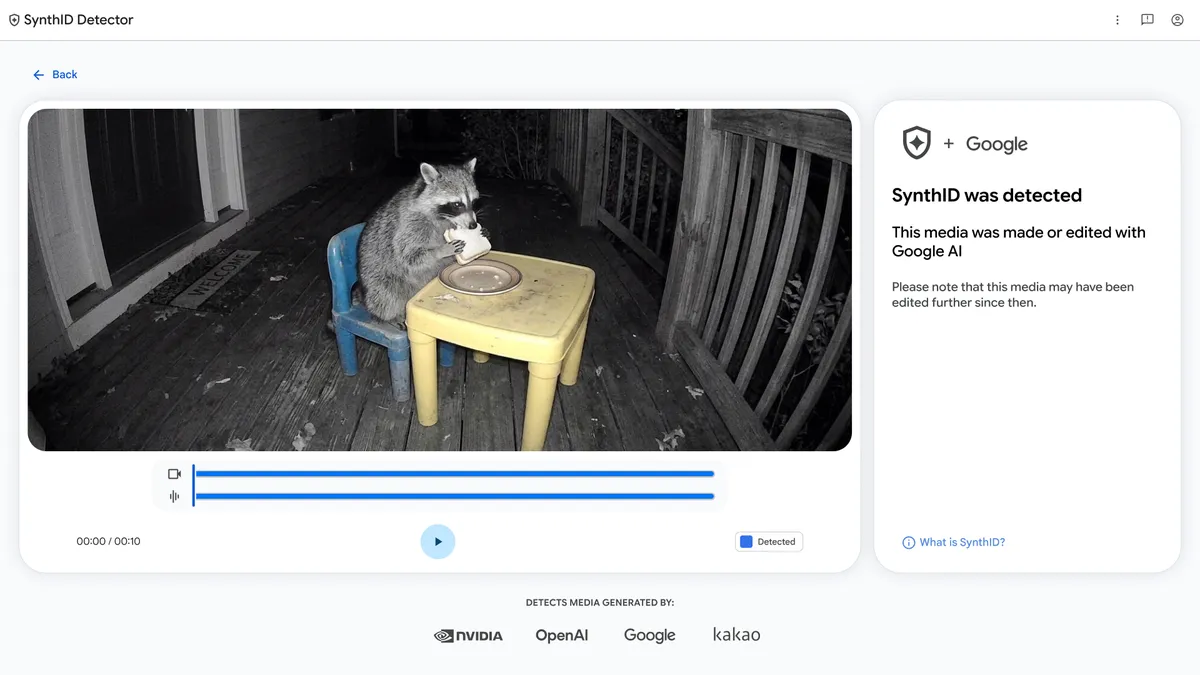
How to use Google SynthID Detector
Go to synthid.com, sign in, upload a file and run the check. The site accepts Google, OpenAI and Apple accounts for sign-in, according to Ars Technica’s review of the launch.
The supported formats cover most files people are likely to receive or download:
- Images: JPG, JPEG, PNG, BMP, WebP, AVIF, HEIC, HEIF, TIFF, TIF and GIF.
- Video: MP4, MOV and WebM.
- Audio: WAV, MP3, OGG, FLAC, AAC and M4A.
The public portal does not currently advertise text-file checks, even though Google also uses SynthID to watermark text produced through Gemini. For text, media and product-specific checks, Google continues to expose verification through Gemini, Search and Chrome.
Access is also rate-limited. Google gives users an approximate quota of 10 image, video or audio checks per day, Ars reported. Repeatedly testing very similar files may exhaust access sooner. The restriction is intended to make it harder to use the detector as an oracle while tuning a watermark-removal method.
What a detected watermark tells you
SynthID places an imperceptible signal inside generated media rather than relying on a visible badge or ordinary file metadata. For an image or video, the signal is embedded in pixels or frames. For audio, it is woven into the waveform. Google says it is designed to survive common handling such as cropping, filters, frame-rate changes, added audio noise and lossy compression.
When the portal finds a supported watermark, the useful conclusion is narrow: a participating AI system was involved in creating or editing the checked media. The result is stronger evidence of origin than a detector that merely judges visual or linguistic patterns associated with AI output.
It is not necessarily evidence that the entire file was generated from scratch. Google describes SynthID as identifying content that was “made with AI,” and its own product documentation covers both generated and altered media. A real photograph edited with a supported generative tool can therefore carry the same kind of signal as a wholly generated image.
The public tool also returns less forensic detail than Google’s earlier internal interface. It reports whether a supported SynthID watermark was found, but does not show the image regions where the signal appeared. For video or audio investigations, users should preserve the original file and document the portal result rather than treating a screenshot of the verdict as a complete analysis.
What “not detected” does not tell you
A negative result has several possible explanations. The file may be human-made. It may have come from an AI model whose provider does not use SynthID. It may have been created with a local open-weight model. It may carry a different provenance system, or editing may have weakened the signal beyond the detector’s threshold.
Meta and Microsoft, for example, have used their own labeling or provenance approaches. Thousands of open models and applications can generate media without adding Google’s watermark. Even within participating companies, coverage depends on which product and generation path produced the file.
That means SynthID Detector should not be used to clear a suspicious file as “real.” It is better understood as a positive-evidence tool: finding a mark answers a provenance question, while failing to find one leaves the question open.
Google does not claim the watermark is invulnerable. Its technical overview says the image and video signal is designed to withstand everyday transformations, and the company’s earlier image research reported resilience to color changes, brightness adjustments, filters and JPEG compression. Deliberate adversarial processing, regeneration or substantial reconstruction remains a different problem.
Why cross-provider checks matter
The launch removes an awkward fragmentation problem. Before this update, a file made with an OpenAI product could contain a SynthID-based watermark but fail to register in Google’s consumer-facing verifier. The new portal checks the distinct implementations used by Google, OpenAI, NVIDIA and Kakao in one place. Apple has committed to join, but its support was not live at announcement time.
Google says SynthID has already been applied to more than 180 billion images and videos and 240,000 years of audio. Verification features in Search, Gemini and Chrome now handle more than one million requests a day, according to the company’s launch announcement.
Those figures show the scale of the system, not its coverage of all synthetic media on the internet. The value of the new portal is that several large providers now share a place where their marks can be checked. Its blind spots remain every provider, product and workflow outside that group.
A better verification workflow
For a low-stakes curiosity, uploading the file and reading the result may be enough. For journalism, fraud review, school discipline, elections or workplace investigations, a single detector should be one part of a broader process:
- Keep the original. Do not begin with a screenshot, social-media preview or messaging-app copy if the source file is available. Re-encoding can discard useful metadata and other provenance signals.
- Check SynthID, then record the exact result. Note the file checked, date and account context. A detected mark supports AI involvement; a negative result remains inconclusive.
- Inspect Content Credentials and metadata. C2PA Content Credentials can record the device, application and edit history when participating tools preserve them. Missing credentials are not proof of manipulation either.
- Trace the source. Find the earliest upload, compare the publisher’s other accounts, reverse-search key frames or images, and look for the original photographer, recording or event.
- Seek corroboration before acting. High-stakes decisions should use source records, witnesses, device evidence or expert media analysis rather than one automated verdict.
This distinction matters because the public portal makes AI provenance easier to check, but it does not make authenticity binary. SynthID Detector can establish that a participating system left its mark. It cannot certify everything that did not.