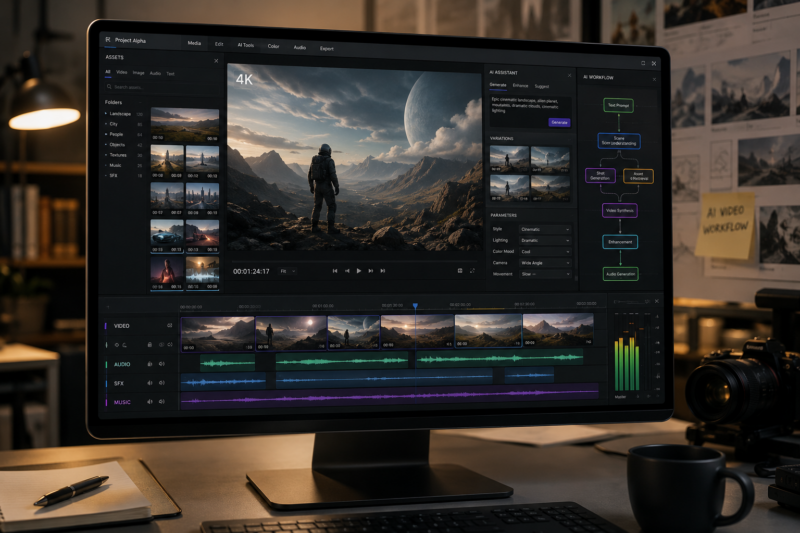
ByteDance has unveiled Seedance 2.5, a new AI video generation model that moves the company’s creative AI push closer to production-style workflows rather than short novelty clips. The model was introduced at Volcano Engine’s FORCE conference in Beijing on June 23 and is expected to launch publicly in early July after an enterprise beta, according to reports from The Next Web and The Decoder.
The headline numbers are built for attention: native 30-second video generation, 4K output, and as many as 50 multimodal reference inputs. Those inputs can include images, audio, video, style references, and 3D white-box material, giving creators more control over characters, motion, composition, and scene continuity than a text prompt alone can usually provide.
That reference limit is the most important part of the announcement. AI video tools have improved quickly at producing impressive individual shots, but production work depends on repeatability: the same character across angles, the same visual language across cuts, the same product or set design across versions, and fewer expensive retries when a generated clip misses the brief. A 30-second clip is useful only if the model can hold style, motion, and intent together long enough to be edited into real work.
What Seedance 2.5 Adds
Seedance 2.5 is described as generating a single 30-second clip without post-stitching, including scene changes and tempo shifts. That matters because many AI video workflows still rely on chaining shorter clips, then hiding continuity breaks in editing. Longer native generation does not eliminate editing, but it can reduce the number of seams a creator has to manage.
The model’s reference capacity expands the same idea. Instead of asking a prompt to carry every detail, a team could feed the system a product photo, a style frame, a motion reference, a storyboard element, and audio direction. Reports from the conference describe support for up to 50 full-modal references, compared with 12 in the prior generation. In practice, that could make Seedance more useful for advertising variants, creator templates, e-commerce demos, and short narrative formats where consistency is more valuable than a single spectacular shot.
ByteDance’s existing Seedance 2.0 materials already frame the model family around unified multimodal audio-video generation, with text, image, audio, and video inputs used to guide performance, lighting, camera movement, and editing. The new version appears to extend that direction rather than simply raising resolution.
There are also practical production details in the update. Seedance 2.0 is being upgraded with native 4K and 10-bit color depth, while Seedance 2.5 is expected to support native 4K output. The distinction between native output and upscaling matters for studios, agencies, and brand teams that need cleaner gradients, better post-production color work, and less visible artifacting after compression.
Why This Is More Than a Model Demo
ByteDance has an unusual advantage in AI video because it controls not only models, but also creator and distribution surfaces. CapCut, TikTok, Doubao, Dreamina/Jimeng, and Volcano Engine give the company a route from generation to editing to publishing that many standalone model labs do not have.
That makes Seedance 2.5 a platform story as much as a model story. If the model’s reference system works reliably, a creator may be able to move from brand assets to testable video creative inside ByteDance’s own editing and sharing ecosystem. For agencies, the appeal is faster iteration. For creator platforms, it is more supply. For ByteDance, it is a way to turn AI video into infrastructure for everyday content production rather than a separate experimental app.
The company also introduced other models at the same event, including Doubao 2.1 Pro, Seedream 5.0 Pro, and Seed-Audio 1.0, according to The Decoder. That broader lineup shows ByteDance treating generated media as a stack: language, image, video, audio, editing, and cloud access. The valuable products will likely be the ones that combine those pieces into repeatable workflows, not the ones that win a single leaderboard or viral comparison clip.
Copyright Remains the Hard Part
The launch also arrives with unresolved copyright pressure around AI video. Earlier Seedance 2.0 coverage drew attention because AI-generated clips based on recognizable movie and character styles circulated widely, and Hollywood studios raised objections. The Next Web reported that ByteDance added watermarking, face-blocking filters, C2PA-style provenance measures, and copyrighted-character detection after legal pressure around the earlier rollout.
Seedance 2.5’s most useful capabilities also raise the stakes. More reference inputs can help legitimate teams preserve product, actor, set, and style consistency. The same control layer could also increase concern from studios, performers, and rights holders if users can steer generated footage too closely toward protected works or likenesses.
ByteDance appears to be pairing the model push with a rights-management strategy. Chinese reports from the FORCE conference describe an AI copyright commercialization platform and authorized templates tied to classic Stephen Chow film material. If that model expands, it could point toward a licensing path for AI video: not unrestricted imitation, but official templates, approved assets, and revenue-sharing structures that let studios participate rather than merely object.
What To Watch Next
The immediate question is availability. Seedance 2.5 is expected in early July, but public pricing, country access, API terms, U.S. availability, and platform integrations are not yet fully settled. Those details will determine whether the model becomes a mainstream creator tool, an enterprise media service, or mainly a China-first showcase for ByteDance’s AI stack.
Performance also needs proof beyond controlled demos. The meaningful tests are not whether Seedance 2.5 can produce one impressive cinematic clip, but whether it can preserve identity and style across many generations, respect rights controls, handle editing without visual drift, and produce usable results at a cost that makes sense for commercial teams.
For now, Seedance 2.5 is one of the clearest signs that AI video competition is shifting from prompt-to-clip spectacle toward workflow depth. The next phase will be judged by control, licensing, cost, and integration. Those are less flashy than a 30-second 4K demo, but they are what decide whether AI video becomes a production tool people can trust.