


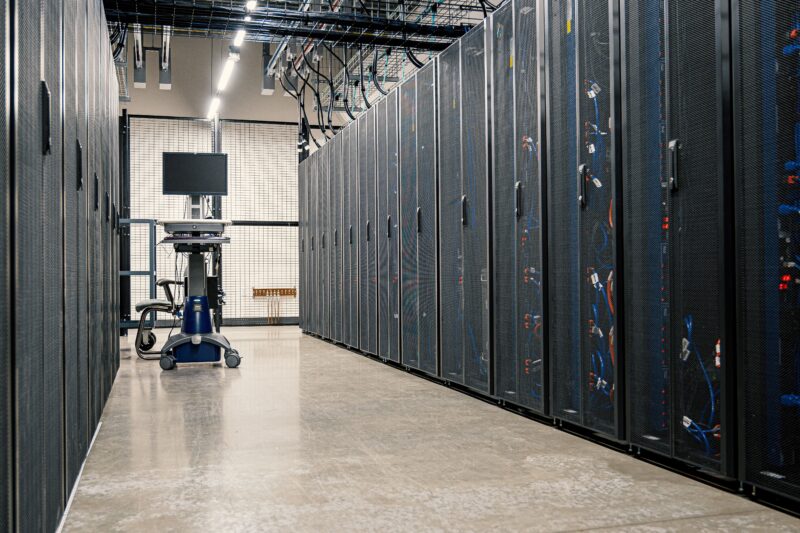
The Federal Energy Regulatory Commission moved Thursday to force the country’s major regional grid operators to confront one of the AI boom’s most practical bottlenecks: how quickly massive data centers can connect to the transmission system, and who pays when they do.
In orders issued June 18, FERC directed the six regional transmission organizations and independent system operators under its jurisdiction to either defend their existing tariffs or propose changes for data centers, manufacturing facilities, and other large electricity users. The agency gave them 60 days to address large-load connection rules, and 30 days to report how they plan to ensure enough generation is available for existing and future large loads.
The action does not build new power plants, solve transformer shortages, or erase local opposition to data center projects. But it does put a federal clock on the grid rules that increasingly determine where AI infrastructure can be built, how fast projects can get electricity, and whether ordinary customers end up subsidizing upgrades for some of the largest power users in the country.
What FERC Ordered
FERC used show-cause orders under Section 206 of the Federal Power Act, a mechanism that requires regulated entities to explain why their current rules remain just and reasonable or file revisions. The orders apply to PJM, MISO, SPP, CAISO, ISO New England, NYISO, and their transmission owners.
The FERC fact sheet lays out five reform areas: faster transmission service application and study processes, clearer transmission-cost transparency, rules for co-location and behind-the-meter generation, new transmission services for flexible large loads, and study processes for generation serving nearby or co-located loads.
That language matters because many AI campuses are no longer ordinary commercial power customers. Large data centers can ask for hundreds of megawatts of capacity, look for sites near power plants or substations, and negotiate complex arrangements involving on-site generation, curtailed demand, or grid upgrades. Existing interconnection processes were built around more familiar power-sector categories, not a wave of compute campuses racing each other for high-voltage access.
FERC is not imposing one national tariff template. The agency said the six regional grid operators have different market designs, transmission-service models, and large-load processes, so each region can respond within its own structure. SPP, for example, already has expedited assessment processes for high-impact large loads, while CAISO does not use the same traditional transmission-service model as some other regions.
The Cost Question Is the Hard Part
The politically sensitive part of the order is not just speed. It is cost shifting. FERC’s release frames the action as a way to deliver “speed-to-power” for the innovation economy while protecting ratepayers. Its fact sheet says the orders are meant to guard against cost shifting among transmission customers, while leaving states responsible for preventing cost shifting among retail customers.
That distinction will matter in practice. A new data center may require network upgrades, new transmission studies, substation work, flexible operating requirements, or dedicated generation arrangements. If those costs are not clearly assigned, the economic promise of faster AI infrastructure can turn into higher bills or reliability risk for households and businesses that did not create the new demand.
FERC also made a point of preserving state authority over siting, permitting, and retail electricity rates. That is a notable limit. State regulators, local governments, utilities, and community groups are already wrestling with data center projects that can strain water use, land use, noise rules, local emissions plans, and household power bills. FERC is pushing transmission operators to modernize connection rules, but it is not taking over the entire approval chain for data centers.
The Associated Press reported that commissioners approved the move unanimously, while utilities, states, and regional grid operators had been concerned about losing authority over the process. The same report noted that FERC’s order does little by itself to fix tightening electricity supplies in regions where new demand is arriving faster than power plants, transmission equipment, and skilled labor can be added.
Why AI Infrastructure Changed the Grid Debate
Data centers have always needed reliable power, but AI has changed both the scale and urgency of that demand. Training clusters, inference farms, and cloud regions built around accelerator hardware require large, dense, and dependable electricity service. The resulting search for power is now shaping real estate decisions, cloud strategy, nuclear and gas generation deals, transmission planning, and local politics.
The Electric Power Research Institute’s Powering Intelligence work has estimated that data centers account for roughly 5% of U.S. electricity demand today and could consume far more by 2035 depending on AI adoption, chip efficiency, cooling systems, and where facilities are built. That uncertainty is exactly why grid operators are being asked to look beyond ordinary queues and study how flexible loads, co-located generation, and regional resource adequacy will work together.
Flexible large-load service could become one of the most important pieces. If a data center can reduce demand during grid stress, run some workloads at different times, use on-site or nearby generation, or accept curtailment under defined conditions, it may be easier to connect without forcing the same level of network upgrades. But that only works if contracts are explicit, telemetry is reliable, and operators can count on the load response when the system is tight.
Co-location is another pressure point. Developers increasingly want to put compute near power generation or behind the meter, reducing some transmission needs while raising questions about how much grid service they are actually using, how reliability obligations apply, and whether other customers are affected when a large private load changes the economics of a power plant or local grid node.
What Comes Next
The next useful signal will come from the 30-day generation-adequacy reports and the 60-day tariff responses. Those filings should show which regions think their current rules can handle large-load growth, which ones will propose new study processes, and how explicitly they plan to assign network upgrade costs.
For AI companies and cloud providers, the order may make power access a more transparent part of infrastructure planning. Faster studies and clearer tariff rules could help developers compare regions, design more realistic project timelines, and decide whether flexible operations or co-located generation are worth the complexity.
For utilities and regulators, the filing deadlines create a test of whether AI-era load growth can be integrated without repeating familiar grid fights in a faster, larger form. The order gives data centers a more urgent path into transmission planning. It also makes the price of that urgency harder to hide.



1 comment