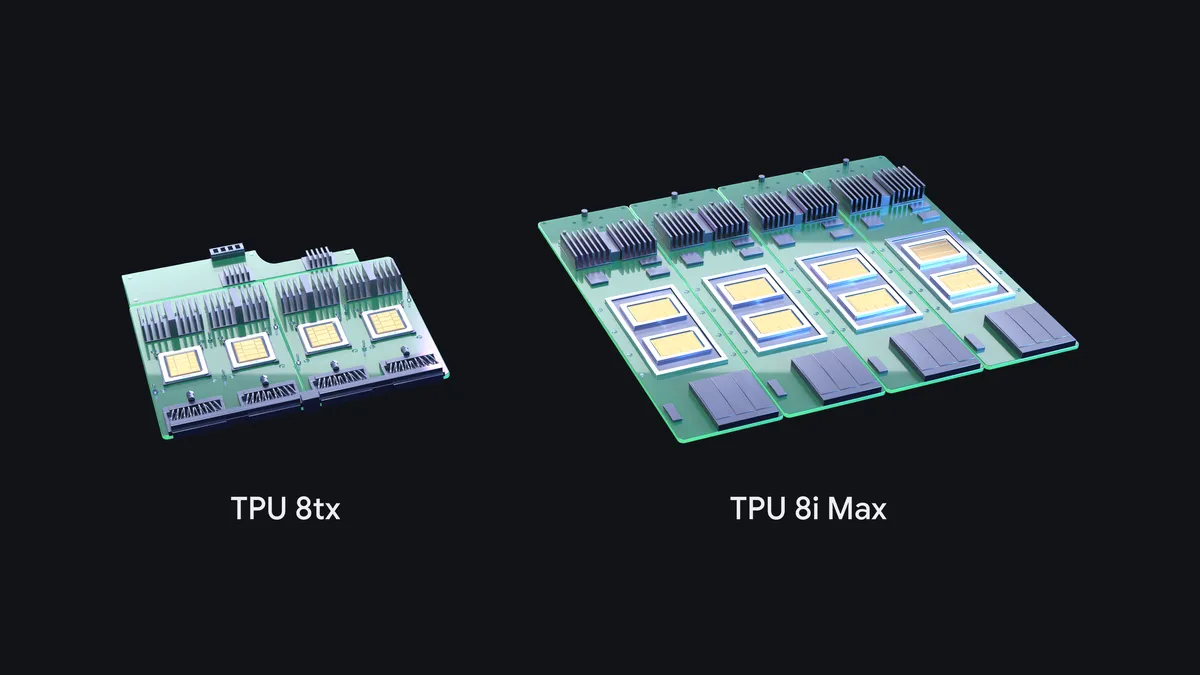
Google introduced two additions to its eighth-generation Tensor Processing Unit lineup on Monday: TPU 8tx, a system designed to protect data and model weights while they are being processed, and TPU 8i Max, a dual-chip package built for workloads that run into memory-bandwidth limits.
The distinction matters: these are new TPU systems, not two newly fabricated processor designs. TPU 8tx uses the same silicon as the training-focused TPU 8t, while TPU 8i Max combines two existing TPU 8i chips in one package. Google is changing the CPUs, networking, memory and packaging around its accelerators faster than it could design a fresh chip.
That gives Google four eighth-generation configurations in one year: 8t for large-scale training, 8i for low-latency inference, 8tx for confidential computing and 8i Max for high-context, memory-intensive work. The company has not disclosed pricing, cloud regions, reservation options or a customer availability date for the two new systems.
TPU 8tx protects data while it is in use
TPU 8tx targets a familiar weakness in cloud security. Storage encryption protects data at rest, and transport encryption protects it on the network, but model weights and prompts normally have to be exposed in memory during computation. Google says 8tx adds hardware isolation across that active processing path.
The system pairs TPU 8t silicon with fifth-generation AMD EPYC host processors. Google describes the design as protecting sensitive data and model weights even while they are in use, making it relevant to private fine-tuning, model distillation, reinforcement learning and agent execution in regulated environments. It also adopts the low-latency Boardfly network used by TPU 8i; Google claims up to two times lower latency than TPU 8t with a near-zero performance penalty.
Those claims need careful evaluation. Confidential computing can reduce the trust placed in a cloud operator or neighboring tenant, but it does not make an AI application safe by itself. A compromised identity, over-permissive service account, malicious tool call, vulnerable inference server or prompt-injection path can still expose data through the application’s authorized interfaces. Buyers will need documentation for attestation, key management, trusted firmware, audit evidence and the exact boundary between the EPYC host and TPU before mapping 8tx to a compliance requirement.
TPU 8i Max attacks the memory wall
TPU 8i Max addresses a different bottleneck. Long-context models, multi-agent coding systems and video workloads can spend more time moving model state and attention data than performing arithmetic. Google has placed two TPU 8i chips in one package, doubling compute, SRAM and high-bandwidth-memory throughput while keeping the existing rack footprint.
At a media briefing, Google Cloud executives gave more detail: TPU 8i Max has 384 GB of HBM, 17.2 TB per second of memory bandwidth and 768 MB of on-chip SRAM, according to ChosunBiz. The doubled bandwidth should help when many concurrent requests or agents are reading large working sets. It does not automatically make a single request twice as fast; throughput depends on whether the workload is limited by memory, computation, networking or software overhead.
The packaging also raises compute density without demanding twice as much rack space. That is useful in data centers constrained by floor area and network topology, although Google has not published full power figures or independent performance-per-watt results for the system.
The software changes may matter as much as the packages
Google is coupling the hardware launch with work intended to make TPUs less dependent on a Google-specific development stack. Its open-source TorchTPU backend now lets developers run standard PyTorch workloads through familiar APIs, while vLLM, SGLang, Hugging Face, Ray and llm-d integrations cover serving and orchestration. A preview TPU agent suite can help coding tools diagnose and tune workloads.
Google also made dynamic TPU slicing generally available on Google Kubernetes Engine. Instead of dedicating a fixed node pool to one TPU topology, platform teams can assemble or partition TPU “cubes” as jobs arrive. Google reports up to five times faster workload startup and 4.5 times faster recovery, with a failed cube replaceable in one to two minutes. The feature requires pre-provisioned capacity in 16-VM node pools and is limited to TPU All Capacity reservation mode, so it is an operational tool for committed fleets rather than an on-demand shortcut.
For agent workloads that pause while waiting for a tool or user, TPU Sync can move key-value cache and model weights away from the accelerator and return them later. That creates an opportunity to assign otherwise idle TPU capacity to another job, but production savings will depend on pause duration, cache size, transfer speed and the cost of restoring state.
What infrastructure teams should ask Google
Teams considering the new systems should avoid choosing from the product labels alone. A useful evaluation should include:
- Availability: regions, lead times, minimum reservations and whether 8tx or 8i Max will be offered through partners such as Oracle Cloud.
- Economics: hourly or reservation pricing, host-CPU charges, networking, storage and measured cost per useful token for the team’s own model.
- Security: attestation flow, key ownership, firmware update policy, operator access boundary and evidence accepted by auditors.
- Portability: operator coverage and numerical parity for the exact PyTorch model, plus fallback behavior on GPUs.
- Performance: time to first token, inter-token latency, concurrent throughput, cache hit rate and recovery behavior under a real context-length distribution.
- Power: rack power, cooling requirements and performance per watt, none of which Google quantified in Monday’s announcement.
The launch broadens Google’s answer to Nvidia without requiring a new chip for every workload. TPU 8tx packages existing silicon around a stronger trust boundary; TPU 8i Max packages it around more memory traffic and density. The architectural idea is clear. Procurement decisions will have to wait for the commercial details and workload-specific evidence that Google has not yet published.