The UK government is creating an independent AI Biosecurity Lab with £100 million in public funding and as much as £200 million in model and compute credits from OpenAI and Anthropic. Announced on October 24, the lab will use frontier AI to detect biological threats earlier and shorten the path from an emerging risk to vaccines, treatments and other countermeasures.
The lab, known as AIBL, is the centrepiece of a new £165 million National AI Biosecurity Initiative. The remaining £65 million is earmarked for biological surveillance and countermeasures against priority pathogens. It also sits inside a broader package of more than £600 million for AI security, domestic capability and adoption that the government outlined before its next Budget.
The headline total needs some unpacking. AIBL itself receives £100 million from the government. OpenAI will supply £100 million in compute and model credits, while Anthropic will provide up to £100 million in model credits, trusted access and technical support. Those contributions give researchers access to expensive systems, but they are not cash that the nonprofit can spend on laboratory staff, secure facilities, datasets or independent evaluation.
What the AI Biosecurity Lab will work on
The Cabinet Office set two initial priorities: improving early detection of biological threats and accelerating medical countermeasures. That could include outbreak modelling, analysis of genomic and epidemiological data, candidate screening, protocol support and connecting computational predictions with laboratory testing.
OpenAI’s contribution will run through its Rosalind Biodefense programme. The company describes GPT-Rosalind as a life-sciences reasoning model available to vetted developers and selected government partners. Existing work under the programme includes epidemiological modelling, DNA-synthesis screening, diagnostics, outbreak planning and protein-engineering workflows, according to OpenAI’s May launch document.
Anthropic has committed model credits, access to relevant systems and dedicated technical support. Google DeepMind is expected to contribute research collaboration and potentially trusted access to Gemini and specialised science models. London-based Basecamp Research will provide AI-biology models and technical expertise.
This makes AIBL a multi-model institution rather than a lab tied to one supplier. That matters in biology, where performance can vary sharply by task. A system that is useful for literature synthesis may not be reliable at sequence analysis, experimental design or predicting whether a candidate will survive laboratory validation. Comparing systems against the same controlled datasets and wet-lab outcomes should be more informative than accepting vendor benchmarks at face value.
The public agencies give the project an operational path
AIBL will operate as an independent nonprofit, modelled in part on the UK’s AI Security Institute. Its public partners will include the UK Health Security Agency, the Animal and Plant Health Agency and the Defence Science and Technology Laboratory. The Medicines and Healthcare products Regulatory Agency will work with the lab on emergency preparedness and the regulation of AI-designed medicines.
That structure could help promising research move into public-health systems. UKHSA already handles disease surveillance and outbreak response; APHA covers animal and plant threats; Dstl brings national-security research; and MHRA governs the route by which medicines and medical products reach use. A shared programme can test whether an AI-generated lead survives the steps between a model output, laboratory evidence and a decision that affects patients or national preparedness.
The government has not yet named AIBL’s director, location or scientific advisory committee. It also has not published a start date, a timetable for spending the £100 million, rules for selecting projects, or detailed arrangements for handling sensitive biological data. Those are not administrative footnotes. A lab working with frontier models and biosecurity data will need clear controls over access, logging, model outputs, external publication and the point at which computational work can proceed to physical experiments.
Why credits are useful, but not the same as funding
Model credits can remove a real barrier for public-interest research. Large-scale inference, agentic workflows and repeated scientific evaluation can be costly, particularly when teams need access to the most capable models rather than standard commercial tiers. Trusted access may also include systems or capabilities that are not generally available.
But the value of credits depends on the terms attached to them: which models qualify, how usage is priced, how long credits last, whether providers can change access, what data-retention rules apply and whether researchers can reproduce work on another platform. AIBL will need enough independent technical capacity to avoid turning donated access into long-term dependence on any one vendor.
The distinction is especially important because the project must evaluate dual-use systems. The same biological reasoning that can improve pathogen detection or vaccine design may lower barriers for harmful work. OpenAI says its trusted-access approach includes vetted partners and additional safeguards. The UK announcement, however, does not yet explain how AIBL will independently test those safeguards, audit provider controls or report serious failures.
The lab is one part of a larger UK AI-security buildout
The government’s wider package includes another £120 million for the AI Security Institute, £60 million for a National Cyber Shield using agentic AI, and £70 million for a National Exposure and Real-Time Vulnerability Centre. The Cyber Shield allocation includes a £25 million challenge fund and work on a regulatory sandbox for agentic cyber-defence systems.
That places AIBL in a broader effort to build state capacity around powerful AI rather than leaving testing and incident response entirely to model developers. Earlier in October, the government reported that two public-sector pilots used frontier models to identify and address 1,352 vulnerabilities across 548 code repositories in 18 departments. The new funding extends that approach into national cyber exposure, biological risk and independent model evaluation.
What would show the lab is working
AIBL’s first useful evidence will not be the number of models it can access. Better measures would include how much earlier a surveillance system identifies a threat, how many model-generated candidates survive laboratory validation, whether screening tools catch risky sequences without overwhelming legitimate research, and how quickly public-health teams can turn evidence into an operational response.
Independent replication will matter too. Results should separate improvements produced by a model from gains caused by better data, more compute or additional expert labour. Where security permits, the lab should publish evaluation methods, failure rates and comparisons across providers. Its advisory committee will also need expertise beyond AI companies, including biosafety, public health, laboratory science, medicine, civil society and research security.
The UK has supplied a concrete mission, named the participating agencies and secured substantial model access. The next test is institutional: whether AIBL can turn donated frontier-AI capacity into independently evaluated tools that public-health and biosecurity teams can trust.
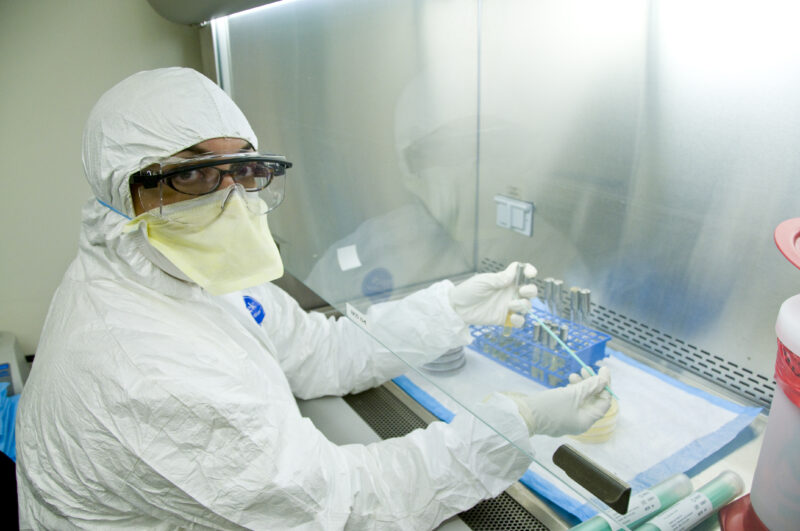
Featured image: A U.S. Food and Drug Administration microbiologist works with samples in a biosafety laboratory. Public-domain photograph via Wikimedia Commons.