NEURA Robotics has raised up to $1.4 billion in Series C financing to expand its physical AI platform, giving Europe one of its most visible bids in the race to turn humanoid robots from trade-show demos into deployable industrial systems.
The Metzingen, Germany-based company announced the round on June 10, naming Tether, Qualcomm Technologies, Amazon, NVIDIA, imec.xpand, Bosch, Schaeffler, the European Investment Bank, Lingotto Horizon, InterAlpen Partners, and others among its backers. NEURA says the capital will support serial production at multi-million-unit scale by 2030, expansion of its Neuraverse robotics platform, and the rollout of NEURA Gyms, real-world training environments for robots.
The size and investor mix matter because humanoid robotics is no longer being funded as a narrow hardware category. NVIDIA wants more embodied AI workloads for accelerated computing and simulation. Qualcomm is positioning edge AI and connectivity as core robot infrastructure. Amazon brings cloud, AI tooling, and logistics experience. Bosch and Schaeffler add the manufacturing, sensing, actuation, and industrial-deployment knowledge that robot companies need if they want machines to work safely around people rather than only in controlled demos.
What NEURA Is Actually Building
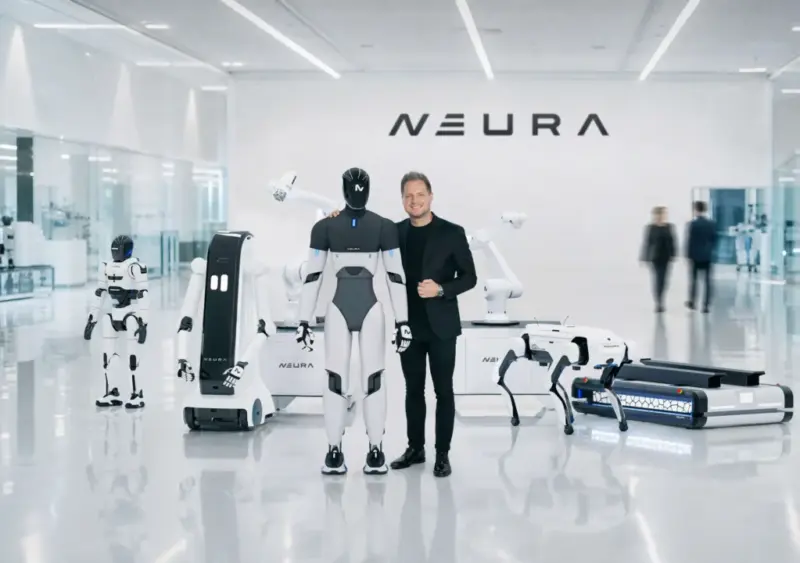
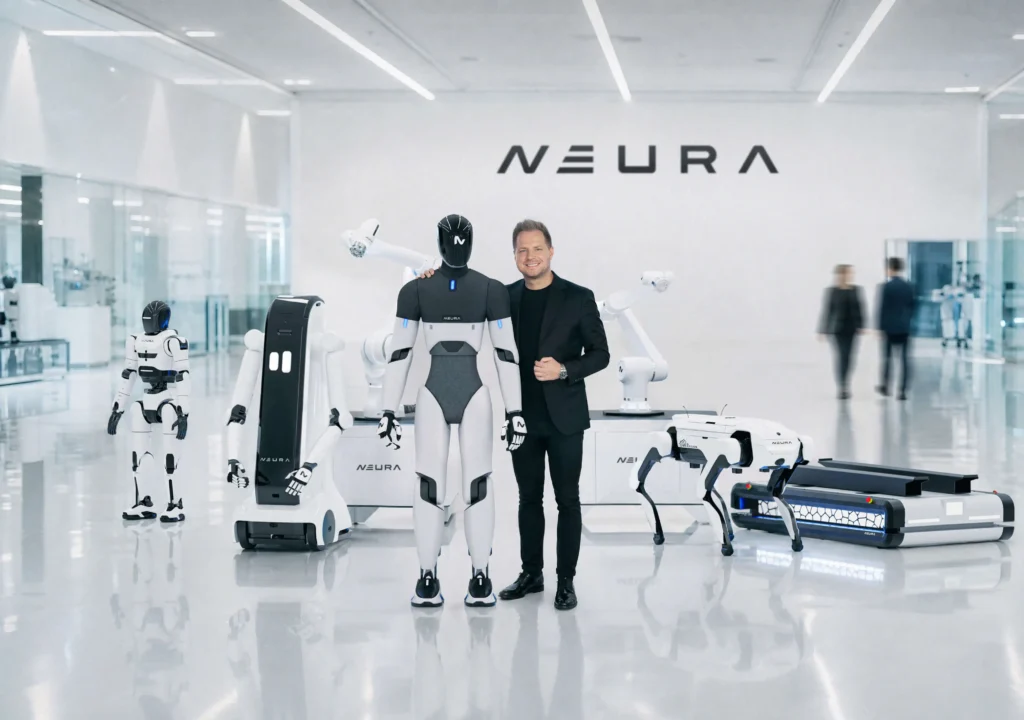
NEURA describes its approach as “Physical AI,” a term that can sound loose until it is tied to specific systems. In NEURA’s case, the stack includes humanoid robots, collaborative arms, mobile robots, sensors, edge compute, robot training spaces, and shared learning software. The company’s pitch is that robots should learn and exchange skills through the Neuraverse rather than remain isolated machines programmed for one narrow workflow.
That is why the NEURA Gyms are central to the story. The company is not only trying to manufacture robot bodies. It is trying to build the training pipeline that teaches those bodies how to handle physical tasks, gather sensor data, and transfer learned capabilities across deployments. For industrial buyers, the difficult part of robotics is often not buying a machine; it is adapting the machine to a messy workflow without months of bespoke integration.
NEURA says its existing orderbook and strategic deployment pipeline exceed $1 billion. That does not prove mass adoption is here, but it does suggest customers are at least willing to reserve capacity around humanoids, cognitive robots, and automation systems before the market has settled on a dominant platform.
4NE1 Makes the Ambition Concrete
The most visible product in NEURA’s lineup is 4NE1 Gen 3.5, a full-size cognitive humanoid that the company is taking reservations for ahead of expected availability at the end of 2026. NEURA lists the robot with high-dexterity hands, Wi-Fi 6, Ethernet, Python and C++ SDK support, a ROS 2 interface, digital-twin access, teleoperation, and readiness for NEURA Gym training.
The pricing also makes the commercial question sharper. NEURA lists 4NE1 Gen 3.5 at an estimated 98,000 euros per unit for one to 19 units, excluding taxes and shipping, and 60,000 euros per unit for orders of 20 or more. A refundable 100 euro reservation fee secures a place in the delivery queue. That places the robot in a category where early buyers will need a credible labor, safety, uptime, or throughput case rather than novelty value.
The official datasheet lists 4NE1 at 180 cm, or 5 feet 11 inches, with an 80 kg body weight, 12 degrees of freedom in its own hands, 360-degree perception and computer vision, optional human-detection sensor skin, exchangeable forearms, and application-dependent payload capacity from 10 kg to 100 kg. Those numbers are useful, but they are not enough by themselves. The open questions are reliability, manipulation accuracy, battery logistics, safety certification, maintenance cost, and how quickly customers can teach the system a task that is valuable in production.
Why Big Tech and Industrial Investors Are Crowding In
Humanoid robots sit at the intersection of several expensive technology bets. They need perception models, low-latency inference, simulation, sensors, batteries, actuators, safety systems, fleet management, developer tools, and manufacturing scale. That makes the category attractive to infrastructure companies even before humanoids become common in factories, warehouses, hospitals, or homes.
NVIDIA’s role fits its broader push into robot simulation and embodied AI. Qualcomm’s participation points to on-device reasoning, wireless connectivity, and edge AI. Amazon’s backing is a natural extension of cloud, logistics, automation, and AI infrastructure. Bosch and Schaeffler are especially important because humanoid robots will depend on parts, precision engineering, and industrial relationships that consumer AI startups usually do not have.
Tether’s presence adds a different strand. In NEURA’s announcement, Tether CEO Paolo Ardoino framed autonomous machines as systems that may eventually need local decision-making and a secure financial layer. That idea is still early, and it should be treated as strategic positioning rather than a near-term requirement for most robot deployments. The more immediate issue is whether robots can perceive, decide, and act safely without shipping every decision to the cloud.
The Real Test Is Deployment, Not Demos
The funding round lands as the robotics market is being pulled in two directions. One side is the spectacle of humanoid demos: walking, carrying, sorting, greeting, and performing staged tasks. The other side is the slower enterprise work of deployment: proving that a robot can perform useful work for many hours, recover from edge cases, avoid hurting people, integrate with existing systems, and justify its cost.
NEURA’s challenge is to turn its platform language into measurable progress. Buyers will care about cycle times, task-change overhead, safety approvals, maintenance intervals, spare parts, remote operations, and the ability to update robot skills without creating new risks. A humanoid that can move through human spaces is compelling; a humanoid that can be managed like reliable industrial equipment is much harder.
The company’s European positioning is also part of the appeal. U.S. and Chinese companies dominate much of the visible AI and robotics conversation, while Europe has deep industrial supply chains but fewer global consumer-platform winners. A credible European physical-AI company would give manufacturers, policymakers, and infrastructure investors a local champion in a field tied directly to labor shortages, factory automation, logistics, and strategic autonomy.
What to Watch Next
The next useful signals will not be more promotional videos. They will be customer deployments, production numbers, safety documentation, third-party testing, and evidence that NEURA Gyms can shorten the time it takes to teach robots new tasks. Pricing and availability will also matter: the gap between a 100 euro reservation and a delivered, supported robot is where many robotics companies struggle.
NEURA’s round shows that investors now see humanoids as part of the AI infrastructure race. The company still has to prove that its robots can work reliably at scale, but the funding gives it the capital, partners, and visibility to test that claim in the real world. For readers tracking where AI goes after chatbots and coding agents, physical deployment is becoming one of the next serious battlegrounds.