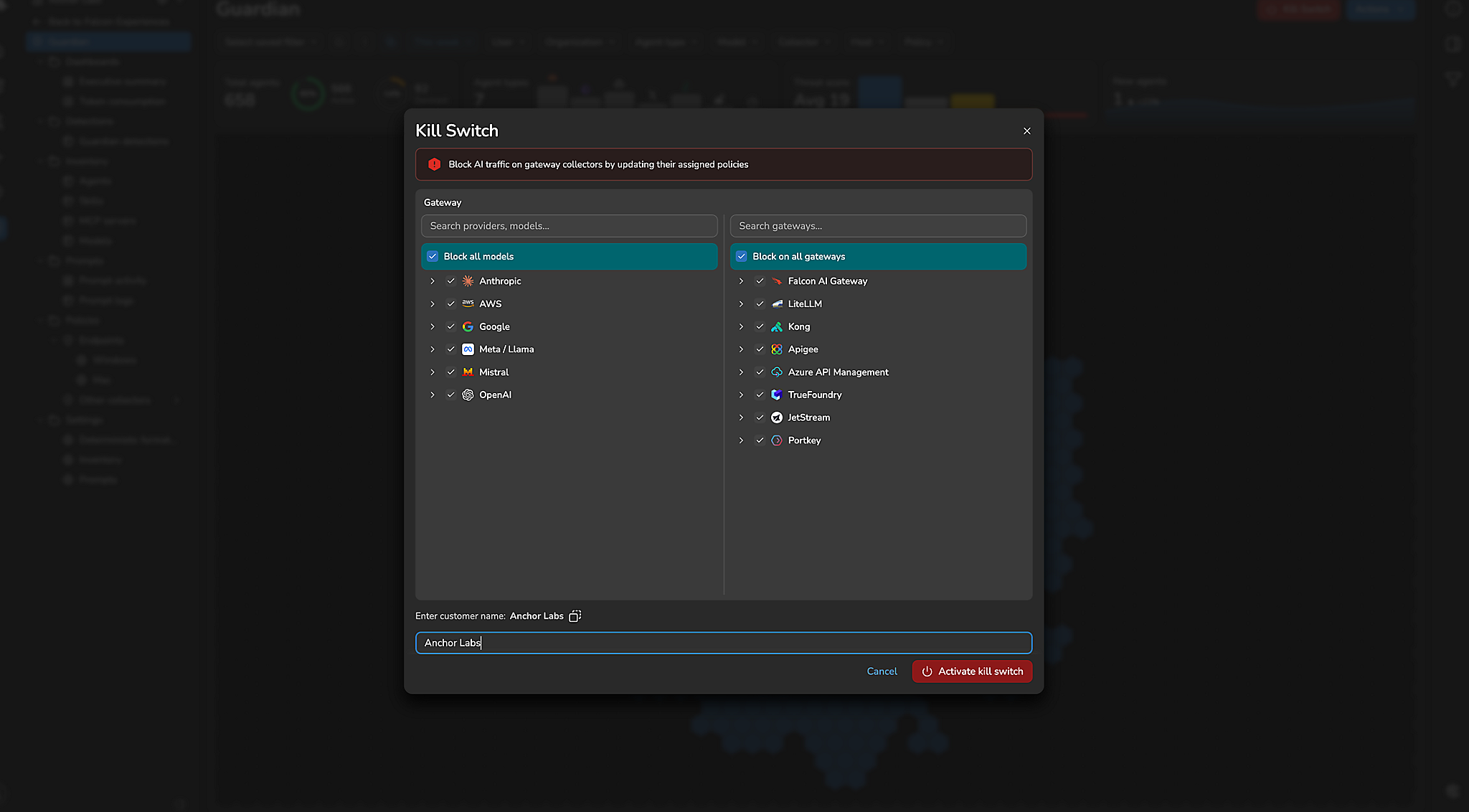
CrowdStrike introduced an AI Kill Switch for Falcon Guardian on Tuesday, giving security teams a central control for cutting off AI agents that move outside their approved task. The name suggests a complete shutdown button. The capability available now is narrower: it tells connected AI gateways to block an agent’s access to the remote models that drive its decisions.
That can halt many enterprise agents quickly, but it is not yet the coordinated endpoint, identity, cloud, SaaS and browser containment system described in CrowdStrike’s broader roadmap. The distinction matters for buyers building incident-response plans around autonomous software.
What CrowdStrike’s AI Kill Switch does today
In the technical description of the feature, an administrator activates the switch in Falcon Guardian. Guardian then directs the Falcon AI Gateway, or a connected third-party gateway, to deny the agent access to its models. Falcon AI Gateway is now generally available and included with Guardian, according to the company.
This is an effective choke point when an agent depends on a hosted model reached through a governed route. Remove model access and the software loses the component that interprets new input, chooses tools and plans its next action. Central enforcement can also cover applications and workloads that do not have a Falcon endpoint sensor, provided their model traffic passes through the gateway.
CrowdStrike is also adding controls around that path. Agent-level hooks can inspect prompts and enforce policy inside Claude Code, OpenAI Codex, GitHub Copilot, Microsoft 365 Copilot, OpenCode and Cursor. Endpoint network inspection is generally available on Windows, with Mac support in early access. SafeMind models look for prompt injection, malicious instructions and personally identifiable information, while supply-chain scanning is designed to identify malicious AI skills and MCP servers.
Those layers help explain why Guardian is more than a simple deny rule. Hooks show what the agent was asked to do, network inspection observes model and tool traffic, and the endpoint sensor sees what executes on the machine. Correlating the three is useful when a security team must decide whether an unusual action is malicious, mistaken or authorized.
The endpoint shutdown is still coming
CrowdStrike’s own announcement draws a clear boundary around the current release. The kill switch terminates unauthorized agents “first at the Gateway, and soon on the endpoint.” A separate product post says coordinated containment beyond the gateway is still on the way.
The planned version is meant to stop agent processes on endpoints, contain agents in cloud environments, revoke permissions through identity controls, restrict activity in SaaS applications and terminate browser sessions. CrowdStrike says its Charlotte Agentic SOAR product will be able to coordinate those actions through automated workflows. It has not given a general-availability date for the full set of enforcement points.
That limitation is especially important for local and open-weight models. CrowdStrike notes that network-only monitoring can go blind when a model runs entirely on a device. A gateway denial will not remove a locally loaded model from memory or kill the process using it. Endpoint termination is the control that would address that case, and the company currently lists it as forthcoming for the kill switch.
A remote-model agent may also have work in flight when access is cut. API requests already accepted by business systems, jobs placed on queues, files already changed and messages already sent do not automatically roll back. As outside coverage of the launch noted, stopping an agent does not undo its earlier actions.
A real shutdown plan needs more than model denial
Organizations evaluating the feature should map every place an agent can retain authority after its model connection disappears. A practical containment runbook should cover model credentials, endpoint processes and virtual machines, cloud workloads, service accounts, OAuth tokens, network egress, browser sessions, tool integrations, pending jobs and the business systems where the agent can write data.
Identity is particularly important. An agent that has already obtained a token may be able to call approved tools without asking the model for another decision. Short-lived credentials, narrowly scoped permissions and transaction limits reduce that residual exposure. High-impact actions should require a separate approval boundary that the agent cannot modify itself, an issue highlighted by recent research on agents changing their own spending caps.
Teams should also test shutdown behavior before an incident. A useful exercise is to trigger the gateway block while an agent is executing a multistep workflow, then check which processes stop, which tokens remain valid, which queued actions complete and what evidence reaches the security console. The result should be measured against the product’s current controls, not its roadmap.
Fiddler and Dreadnode fill different gaps
CrowdStrike paired the kill-switch launch with agreements to acquire Fiddler AI and Dreadnode. Fiddler is expected to become Falcon Observe, adding pre-deployment evaluation and continuous monitoring intended to explain what an agent did and why. CrowdStrike says Falcon Observe is planned for general availability in its fourth quarter of fiscal 2027, subject to the acquisition closing.
Dreadnode focuses on adversarial testing before deployment. It runs more than 100 AI attack strategies against models, applications, reasoning loops and MCP servers, with findings mapped to frameworks including the OWASP Top 10 for large language models, MITRE ATLAS and the NIST AI Risk Management Framework, according to The Next Web’s report on the deals. CrowdStrike plans to bring Dreadnode’s team into its Cyber Superintelligence Lab and release the testing capability on the same fiscal timetable as Falcon Observe.
The three pieces address different stages of the problem: Dreadnode tests an agent before production, Fiddler observes its behavior, and Guardian attempts to detect and stop dangerous activity at runtime. For now, only part of that stack is available. The AI Kill Switch is a useful emergency brake for gateway-dependent agents, but buyers still need endpoint, identity and application controls to make “stop” mean stop across the full workflow.