Etched, the AI chip startup building hardware specifically for model inference, came out of stealth on June 30 with a larger claim than a normal funding update: the company says it has raised $800 million, started production of its first racks, and lined up more than $1 billion in customer contracts for systems built around its Sohu chip.
The announcement puts Etched in the center of a fast-forming market for AI inference hardware, where the cost of serving prompts, long-context requests, and agentic workloads is becoming as strategically important as the cost of training frontier models. TechCrunch reported that Etched’s most recent unannounced $500 million round closed in December at a $5 billion post-money valuation, with investors including Stripes, Jane Street, VentureTech Alliance, Hudson River Trading, Two Sigma, Ribbit Capital, and Peter Thiel.
Etched is not pitching Sohu as another general-purpose GPU. The company’s argument is narrower and riskier: if transformer-based models remain the dominant architecture for high-value AI workloads, a chip designed around that workload can deliver better economics than hardware built to handle many kinds of computation.
What Etched says it has built
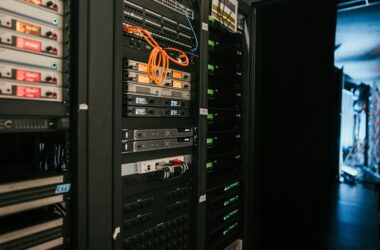
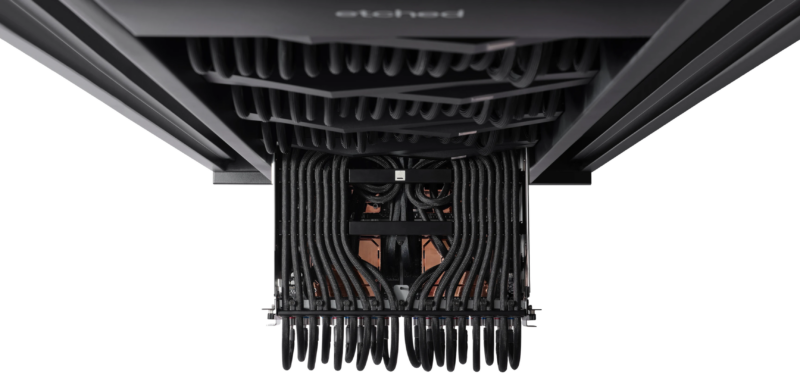
On its public company site, Etched describes its product as “frontier inference clusters,” meaning racks that combine custom chips, packages, boards, cooling, interconnects, software, and manufacturing methods rather than a chip sold in isolation. The company says its first racks ship this summer and that production has begun to fulfill the reported customer demand.
The technical pitch centers on two named approaches. Low-Voltage Inference is Etched’s answer to thermal throttling: the company says it runs chip math blocks at less than half the voltage of most AI chips, allowing higher sustained FLOPs density and keeping trillion-parameter sparse mixture-of-experts workloads above 80% of peak FLOPs without the same throttling pattern. Cluster-Scale Memory is meant to reduce decode latency by using a lower-latency shared memory pool across chips, backed by a proprietary interconnect and a hybrid HBM/SRAM design.
Those details matter because inference performance is not one number. For a model-serving business, throughput, latency, prefill speed, decode speed, power draw, rack density, and software support all shape the actual cost per useful response. A system that looks fast on a single benchmark can still fail in production if it struggles with mixed workloads, memory pressure, scheduling, model updates, or customer integration.
The Nvidia comparison is the hook, but not the whole story
Etched’s obvious foil is Nvidia, whose GPUs dominate AI training and inference deployments. The startup has previously claimed that an eight-chip Sohu server can generate more than 500,000 tokens per second on Llama 70B and replace far more H100-class capacity for that kind of transformer inference workload. That claim is attention-grabbing, but the more important question for customers is whether Etched can reproduce meaningful gains across the models, batch sizes, context lengths, traffic patterns, and uptime requirements that real AI services face.
Unlike Nvidia’s GPUs, Sohu’s specialization is also its tradeoff. A transformer-focused ASIC can remove hardware flexibility that makes GPUs useful across training, image generation, scientific workloads, simulation, recommendation systems, and models that do not map cleanly to the same architecture. The bet works best if customers know enough about their future workloads to accept a narrower hardware target in exchange for better inference economics.
That is why the customer-contract figure is more interesting than the valuation. AI labs, cloud providers, and large application companies are under pressure to reduce the cost of serving models as usage climbs. If Etched’s first racks perform as advertised, buyers could use specialized inference systems to reserve GPUs for training, multimodal workloads, or tasks where flexibility still wins.
Why inference hardware is becoming urgent
Training once absorbed most of the attention in AI infrastructure because bigger models required enormous compute clusters before they could launch. But as AI products move into search, coding, office software, customer support, security operations, media tools, and autonomous agent workflows, the recurring cost is often inference: every prompt, tool call, code review, image request, voice interaction, and background agent step has to run somewhere.
Long-context models and agentic workflows make that pressure worse. A coding agent may read large repositories, call tools repeatedly, revise its plan, and generate multiple patches. An enterprise assistant may search documents, summarize evidence, and produce a governed answer. A consumer AI app may need low-latency responses while millions of users interact at once. These workloads reward systems that can keep latency down without burning through power, rack space, and scarce accelerators.
Etched is entering a market where the largest buyers are already trying to diversify. Amazon, Google, Microsoft, and other hyperscalers build or buy custom AI silicon; Groq, Cerebras, SambaNova, d-Matrix, and other startups are chasing inference and accelerator niches; and OpenAI’s own chip ambitions have made custom inference hardware a board-level issue rather than an obscure procurement topic. Etched’s specific opening is transformer inference at rack scale.
What still has to be proven
The next test is not whether Etched can draw attention. It is whether customers can operate Sohu racks in production and see the promised gains after accounting for model support, developer tooling, reliability, support contracts, supply chain execution, and the pace at which model architectures change.
Independent benchmarks are still limited, and Etched’s strongest performance claims remain company claims until customers or outside evaluators can compare systems under transparent conditions. Hardware startups also face a difficult ramp: successful A0 silicon and early customer tests are meaningful milestones, but broad deployment depends on yields, manufacturing cadence, software maturity, system integration, and the ability to support customers whose workloads rarely stay still.
Even with those caveats, Etched’s emergence changes the inference conversation. The company is no longer just an ambitious chip story with a bold Sohu pitch. With $800 million raised, public production plans, a 400-plus-person team, and more than $1 billion in customer contracts, Etched has become a live test of whether AI infrastructure buyers are ready to trade GPU flexibility for specialized serving economics.
If that trade works, the next phase of AI hardware competition will not be defined only by who can train the biggest model. It will also be defined by who can serve the most useful intelligence, at the lowest latency and cost, for the millions of requests that arrive after the model is already built.