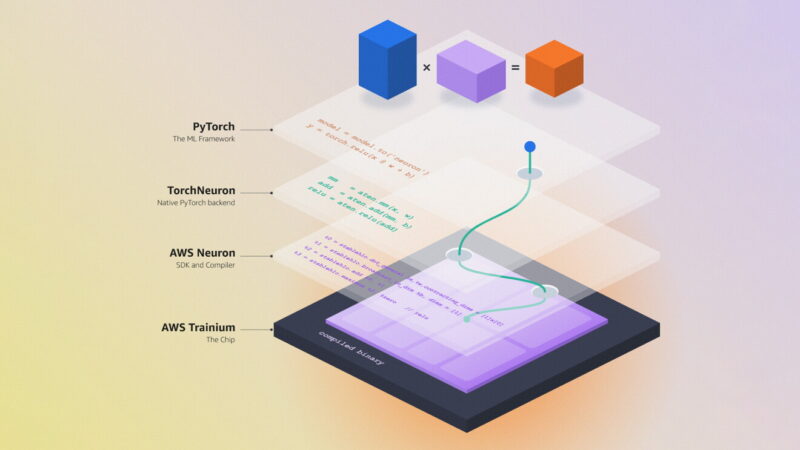
Amazon is opening TorchNeuron, a native PyTorch backend for its AWS Trainium accelerators, in public beta. The project lets developers move supported models and tensors to Trainium with .to("neuron"), use familiar distributed APIs and compile production graphs through torch.compile. Amazon announced the software on October 19 and scheduled its Apache 2.0 open-source release for October 20 at PyTorch Conference North America.
The release targets one of Nvidia’s strongest advantages: developers have spent years building models, kernels and operating practices around PyTorch and CUDA. Trainium may offer attractive economics for some workloads, but cheaper silicon is not useful if a team must rewrite its stack to reach it. TorchNeuron reduces that porting burden by registering Trainium through PyTorch’s official PrivateUse1 extension point, according to the PyTorch launch documentation.
The important qualification is “supported.” This first beta is not a universal drop-in replacement for CUDA. Dynamic shapes, sparse tensors and several PyTorch APIs are missing; unsupported operations can fall back to the CPU; and peak performance still depends on compilation, profiling and sometimes custom kernels. Teams should treat the release as a reason to run a controlled portability test, not as proof that every PyTorch workload can move unchanged.
What TorchNeuron changes
Previous Trainium workflows often required Neuron-specific interfaces or adaptations. TorchNeuron instead presents neuron as a standard PyTorch device. A basic training loop can keep its existing optimizer, autograd and module code while changing device placement:
model = MyModel().to("neuron")
inputs = inputs.to("neuron")
output = model(inputs)
Code already written against the device-neutral torch.accelerator API may detect Trainium without that edit. For production graphs, developers can select the Neuron backend once and use torch.compile(model), or pass backend="neuron" on an individual compile call.
Underneath that familiar surface, TorchDynamo captures the model as an FX graph, AOTAutograd builds the backward graph, Torch-MLIR lowers it to StableHLO, and the Neuron compiler produces a Neuron Executable File Format file for the hardware. Eager mode compiles and dispatches operations individually, preserving Python control flow, print statements and breakpoints for development. An experimental adaptive eager mode can fuse eligible operations to reduce launch overhead.
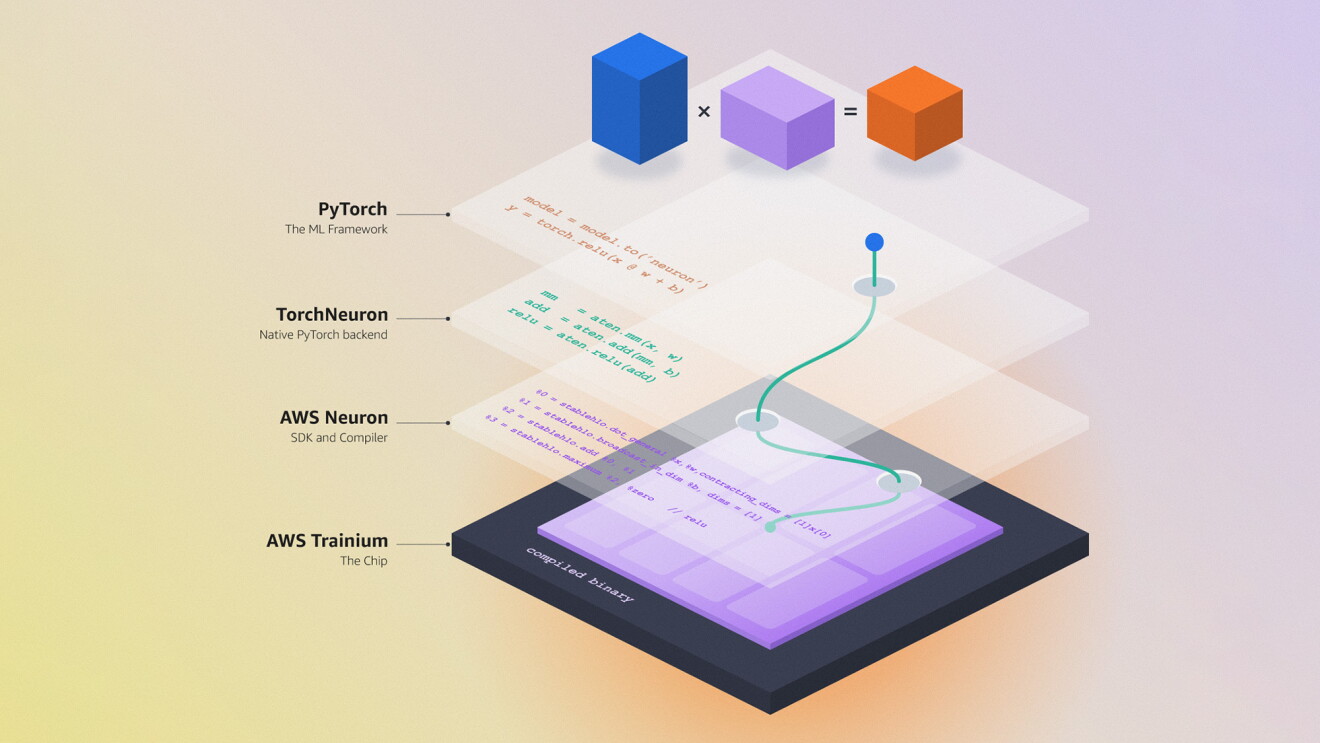
The beta supports Trainium2 and Trainium3, not the original Trainium generation. AWS’s current support matrix lists Linux x86-64 environments on Ubuntu 24.04 or 26.04, PyTorch 2.13 or 2.14, and Python 3.12 through 3.14. Teams must install the torch-neuronx package family that matches their PyTorch version. Those boundaries matter for existing containers, managed notebooks and build pipelines.
The one-line migration claim has real limits
A device-name change is enough to begin testing, but it does not guarantee that the whole workload stays on Trainium or performs well. AWS’s Neuron 2.33 release notes list several gaps:
- Dynamic shapes:
torch.compilecurrently requiresdynamic=False. A new input shape can trigger another compilation, so variable sequence lengths and batch sizes may need padding or bucketing. - CPU fallback: Unsupported operations can run on the host CPU. That helps a model start, but repeated device transfers or host-side bottlenecks can overwhelm any accelerator savings.
- Unsupported APIs: The beta does not support
torch.sparse,torch.func,torch.nestedortorch.distributions. FFT coverage is limited. - First-run latency: The first operation or graph run includes compilation when no matching cached artifact exists.
- Quantization gaps: TorchAO and FP8 support were described as private beta features in the launch material, while the public release notes say TorchAO integration and composite MXFP8 are not included in this release.
The wider PyTorch test results make the maturity level clearer. Of roughly 154,000 upstream test outcomes in an August run, about 69,000 were skipped. Around 30,000 were excluded by PyTorch’s own CUDA-only or CPU-only eligibility checks. Of the roughly 39,000 deliberate Neuron skips, about 22,000 involved operators without a native Neuron lowering, including corner cases in elementwise, reduction, advanced indexing and linear algebra operations, plus fused LSTM and GRU cells. Other omitted features include sparse operations, forward-mode autograd, arbitrary attention masks, per-channel quantization and dynamic or symbolic shapes.
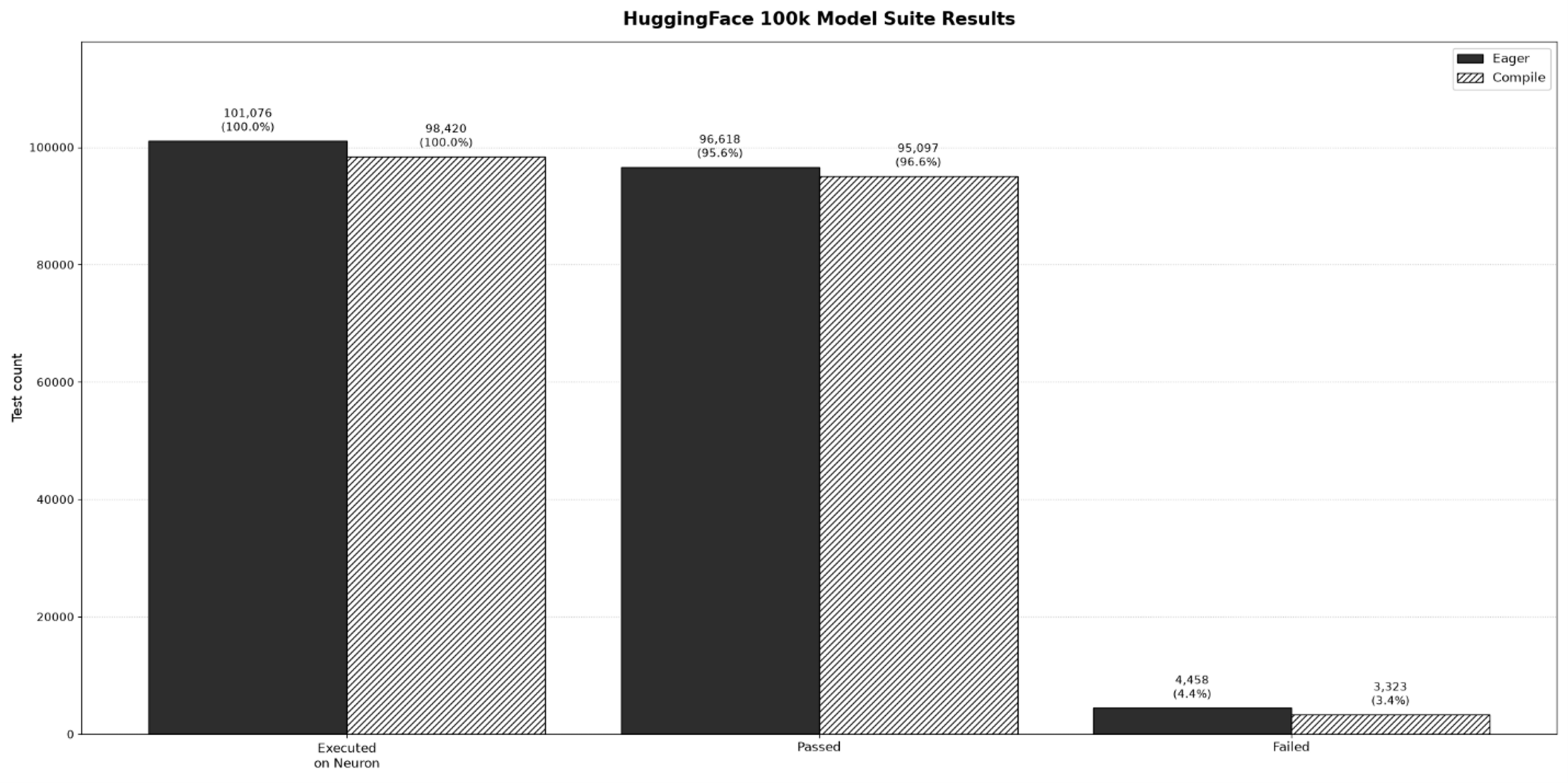
Amazon also reports continuously testing 100,000 Hugging Face models covering 99.9% of usage by download count. That is broad compatibility evidence, but the sweep uses reduced representative configurations and records whether models load, run forward and backward passes, compile, and fall back to the CPU. It is not an independent measure of full-scale throughput, accuracy or production stability.
Where the beta is already useful
TorchNeuron supports common PyTorch interfaces including torch.nn, autograd, autocast, profiler and distributed operations. DDP, FSDP2, SimpleFSDP, tensor parallelism, pipeline parallelism, DTensor and DeviceMesh are part of the supported path. Collective communication uses Trainium’s dedicated collective cores within a node and Elastic Fabric Adapter between nodes.
The surrounding software stack is also moving closer to standard PyTorch. Hugging Face has added Trainium support to Transformers, Diffusers, TRL and its kernels library. The Neuron inference stack includes plugins for vLLM and vLLM Omni, while TorchTitan can run distributed training recipes on Trainium. Developers who need hardware-specific tuning can write custom operators with the Neuron Kernel Interface and use the open-source NKI kernel library for operations such as FlashAttention and mixture-of-experts blocks.
Profiling is essential because compatibility and efficiency are separate questions. TorchNeuron connects torch.profiler to Neuron Explorer, which correlates Python and framework events with runtime and device activity and can trace a stall back to source code. AWS also exposes torch_neuronx.get_fallback_ops() so developers can identify operations that left the accelerator.
Do not generalize one customer’s cost result
Deepgram provides the most concrete performance evidence in the launch material. Its Nova-3 speech-to-text model ran eight replicas on one trn2.3xlarge instance for offline batch transcription. Deepgram and AWS reported 11% to 70% more audio processed per dollar than the compute options Deepgram had been using, based on instance pricing during the evaluation.
That range is promising, but the case study also says the port and tuning took several months with AWS’s Forward Deployed Engineering team. It covered a throughput-oriented batch workload, not latency-sensitive streaming, frontier-model training or a representative set of GPU deployments. The result should be treated as a workload-specific benchmark, not a blanket Trainium discount.
A practical TorchNeuron evaluation plan
- Freeze a representative workload. Use the same model version, dataset, sequence-length distribution, batch policy and quality checks on the current accelerator and Trainium.
- Validate in eager mode first. Move the model and inputs to
neuron, confirm numerical behavior and inventory every CPU fallback before trying to optimize. - Compile stable graph segments. Apply
torch.compileto the steady production path. Pad or bucket variable inputs and measure initial compilation separately from warm execution. - Profile transfers and graph breaks. Use
torch.profiler, Neuron Explorer and the fallback-operator list. A workload that technically runs may still spend too much time crossing between the host and accelerator. - Test real distributed topology. Repeat the benchmark at the intended node count, parallelism scheme and checkpoint cadence. Single-instance results do not establish scaling efficiency.
- Price the full migration. Include engineering time, compile latency, idle capacity, storage, networking, observability and the cost of maintaining any NKI kernels, not only the hourly instance price.
TorchNeuron is part of a wider effort to detach PyTorch workloads from a single accelerator ecosystem. Google’s TorchTPU project is pursuing a similar native PyTorch path for TPUs, including eager execution and torch.compile, and it has identified dynamic shapes and first-run compilation as continuing challenges. The common direction is useful for developers: hardware vendors increasingly have to meet PyTorch where existing code already lives.
For AWS, the public beta turns Trainium portability from a roadmap promise into something teams can measure. The strongest result will not be a model that merely starts after changing cuda to neuron. It will be a workload that stays on the device, passes its quality checks, scales predictably and produces a lower total cost after the migration work is counted.