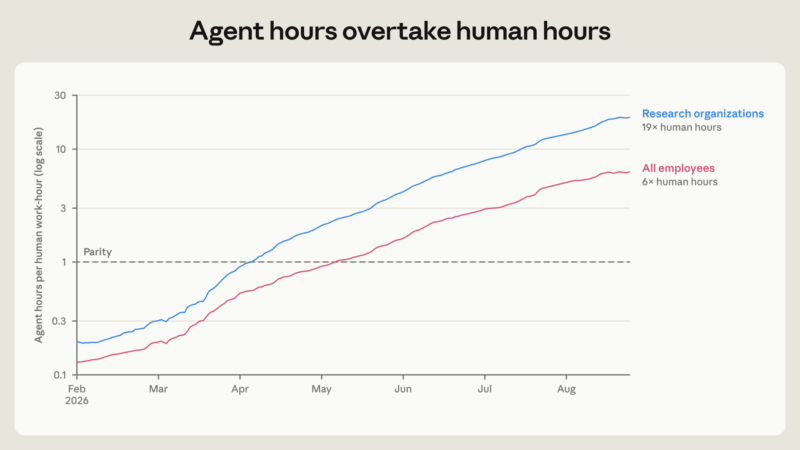
Anthropic’s AI agents now log six hours of active runtime for every assumed hour worked by an employee, while the share of junior technical hires at the company has fallen from 27% to 9% since early 2025.
Those figures come from a new internal employment study published October 16. The report combines agent-session telemetry, hiring records, output measures, calendars, employee surveys and 17 interviews to examine how heavy use of Claude is changing work inside the AI company.
The study does not show that six agent-hours equal six hours of human labor, nor does it establish that Claude caused the hiring shift. Anthropic defines agent work as inference and active tool use, counts a standard 40-hour week for each employee, and acknowledges that the people who adopt agents are not randomly selected. Even with those limits, the data offers an unusually detailed view of what happens when a company makes agents part of everyday operations rather than treating them as an occasional chatbot.
Junior technical hiring fell even as Anthropic kept growing
The junior share of Anthropic’s technical workforce declined from 21% to 14% from early 2025 through 2026. Junior candidates accounted for 27% of technical hires at the start of that period but only 9% by the end, while entry-level job postings dropped particularly sharply after December 2025.
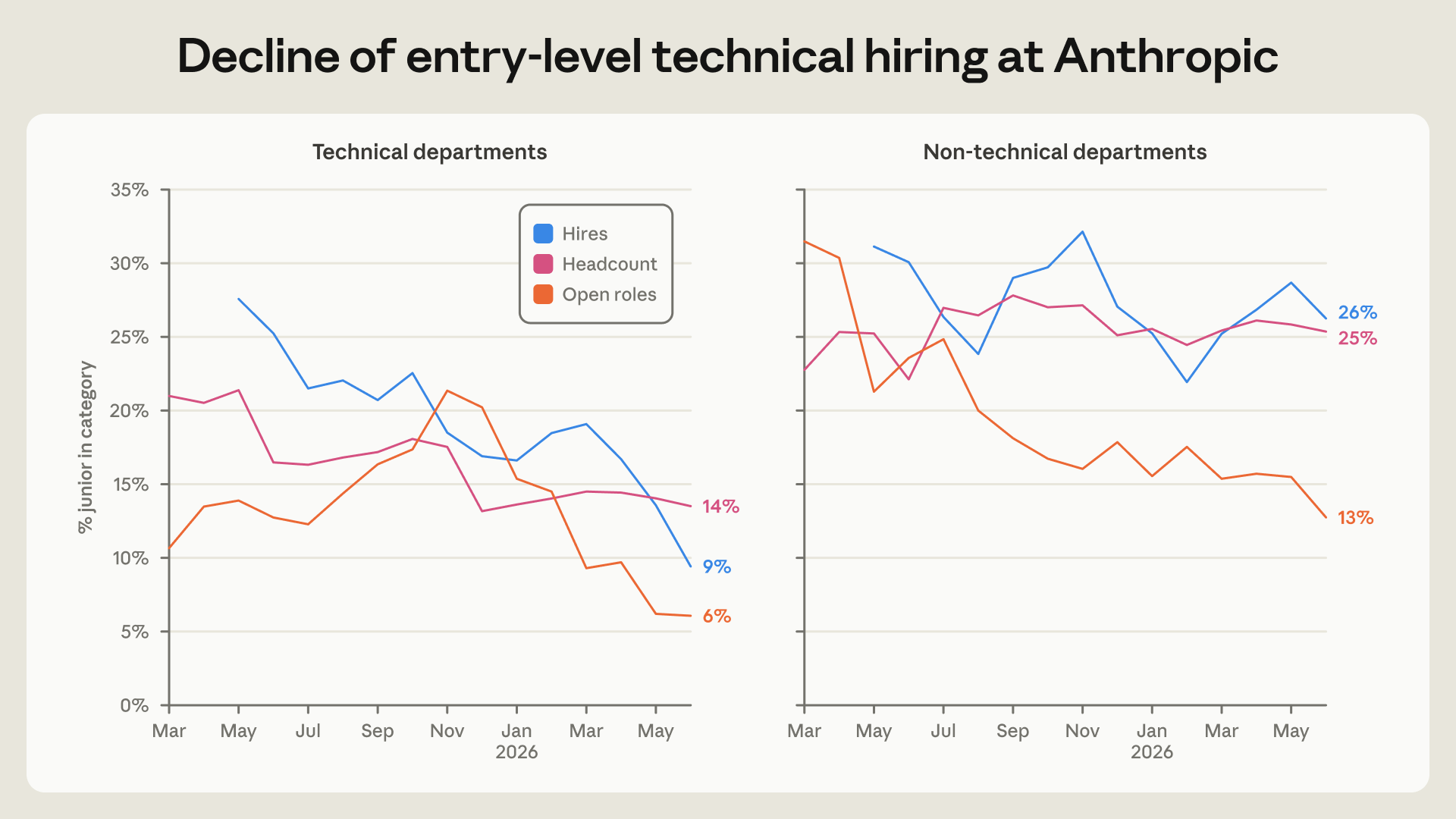
That is a change in composition, not evidence that Anthropic stopped adding technical staff. The report says technical hiring continued to grow in absolute terms. Sales, finance and recruiting expanded faster, reducing technical departments’ share of total employment from 61% to 56% over the past year.
Inside engineering and research, the shift became explicit in early 2026. By April, teams had de-emphasized lower-band technical roles. About one-third of machine-learning managers and one-fifth of software-engineering managers told the company they were hiring less because of AI. Anthropic also found slower junior employment growth in jobs where Claude was already handling more complex work, although that relationship is descriptive rather than proof of causation.
Existing employees have had more room to move than prospective junior hires. Workers with at least a year at Anthropic were 50% more likely to change departments each month in 2026 than in 2025. One content-design team built a system that let agents generate product copy, then moved into model evaluations and prompt work. Redeployment can preserve jobs for people already inside a fast-growing company; it does not recreate the entry-level positions through which new workers learn those jobs.
What six agent-hours actually measures
Combined autonomous and employee-directed agent runtime first exceeded estimated human work hours in March. By August, employee-directed interactive agents alone were running for six times the company’s assumed employee hours.
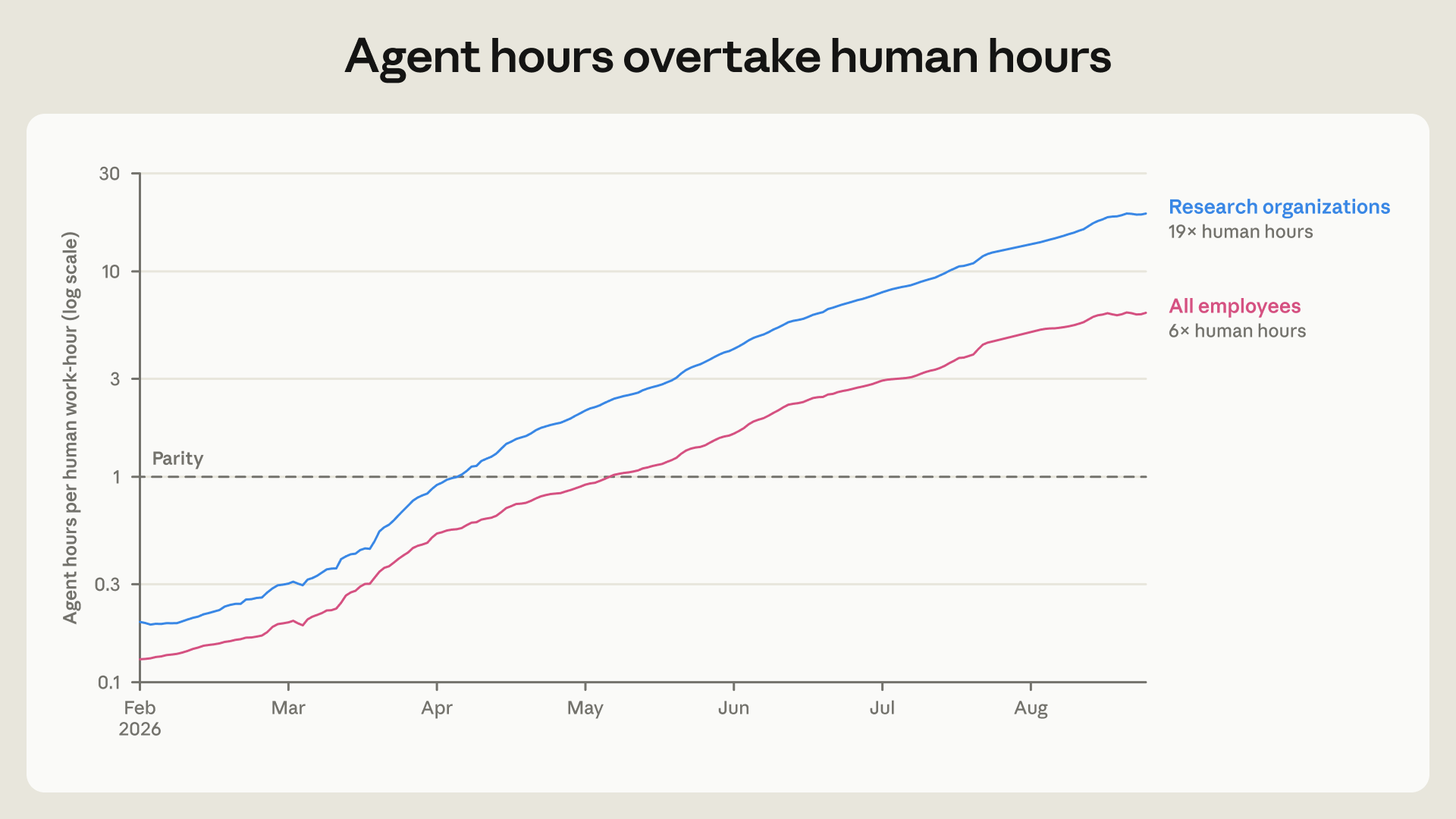
The denominator is headcount multiplied by 40 hours a week. The numerator pools subagents and includes inference and active tool use, but excludes waits longer than 30 minutes. An agent can run in parallel with other agents, repeat low-cost checks or spend time on work that a person would approach differently. The ratio therefore describes the scale of machine activity around employees, not a productivity multiplier or a count of replaced jobs.
Anthropic reports that code commits per engineer rose to five times their pace six months earlier. To look beyond company-wide growth, researchers followed 192 engineers who adopted coding agents and compared them with 74 engineers who had not yet adopted them. Code output increased after adoption, but the adopters were already on a faster trajectory, a selection effect the report openly notes.
The company found no difference between agent-written and human-written commits on several limited quality proxies, including lines later deleted, explicit reverts, lint suppressions and skipped tests. Those measures can catch visible rework, but they cannot establish maintainability, architecture quality, security or business value. Anthropic itself cautions that more code is not necessarily better code.
The pattern extends beyond engineering. Sales representatives closed more deals after adopting agents, lawyers processed more contracts, and accounts-payable staff handled more invoices. Rapid business growth may explain part of those gains. The study cannot fully separate tool effects from rising demand or from ambitious employees choosing automation first.
Faster agents created more review and coordination work
Anthropic’s clearest operational finding may be the pressure placed on human attention. Interactive agent sessions spent about 80% of their wall-clock time waiting for human input. For non-technical teams, simply reading every generated word would consume more than half of a work week, based on the report’s estimate of 0.75 words per token and a reading speed of 250 words a minute.
Employees responded by building another layer of management around the agents. Written standing instructions grew from a few hundred in July 2025 to 8,500 a year later. Work devoted to agent plans, reviews, monitoring and internal tools rose from 10% of interactive Claude sessions in fall 2025 to 22% in spring 2026.
Automation did not eliminate human coordination. Median meeting time increased 20% over the year; even technical individual contributors spent 16% more time in meetings. Agents also appeared in nearly half of active public Slack channels, but mostly in dedicated human-agent threads. The volume of human-to-human discussion remained steady while agent activity was layered on top.
This is a more complicated outcome than a simple hours-saved calculation. Implementation became cheaper, but deciding what to build, reviewing results, resolving cross-team problems and feeding current organizational context back into the system became more prominent parts of the job.
Hiring now favors judgment and AI fluency
Anthropic used an automated classifier to examine thousands of interview scorecards. In 2024, evaluators mentioned a candidate’s AI-tool experience in about 5% of technical assessments and 7% of non-technical assessments. By 2026, the technical rate had tripled and the non-technical rate had quadrupled.
Assessments of technical candidates placed more emphasis on autonomy and judgment, while domain expertise occupied a smaller share of interview feedback. For non-technical candidates, customer and mission orientation gained ground as execution skills received less attention.
That creates a training problem. Judgment is usually developed through implementation, feedback and exposure to failure. If agents absorb more of the lower-risk work traditionally assigned to junior employees, companies will need a deliberate alternative: supervised agent review, controlled production ownership, incident analysis, rotations and clear progression standards. Hiring only experienced workers can postpone that problem, but it cannot supply an experienced workforce indefinitely.
Anthropic is an early signal, not the whole economy
Anthropic is an unusual workplace: it builds the models, has abundant access to them, operates primarily in knowledge work and grew rapidly during the study period. The results should not be projected directly onto manufacturers, hospitals, retailers or even mature software companies with slower growth and older systems.
Still, Anthropic is not the only AI developer reporting a shift toward concurrent agents. A June study of OpenAI Codex usage found active users increased more than fivefold in the first half of 2026. More than 10% of users managed three or more concurrent agents during a typical week, while internal OpenAI output grew sharply in legal and research roles. The two studies use different measures, but both describe work moving from individual prompts toward parallel systems that require supervision.
For employers, the useful lesson is to measure the whole workflow. Agent runtime and generated output should be paired with review time, defects, rework, change-failure rates, customer outcomes and the health of the junior talent pipeline. Otherwise, a dashboard can show more machine activity and more code while hiding the human bottleneck that Anthropic’s own report makes visible.