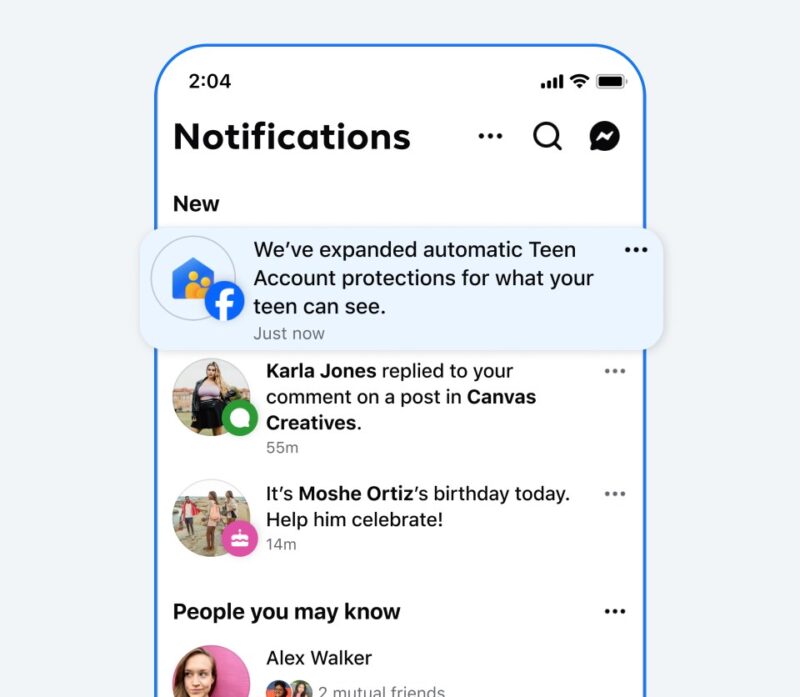
Meta is expanding Teen Account protections across Instagram, Facebook, and Messenger, adding broader 13+ content defaults, AI age-assurance checks, and new parent alerts for repeated suicide or self-harm searches in supervised Instagram accounts.
The company outlined the latest changes in a June 18 newsroom update, framing them as part of a broader move toward age-appropriate defaults. The practical shift is that Meta is trying to make teen safety less dependent on a young user entering the right birthday or a parent finding the correct settings menu. More of the enforcement is moving into the platform itself.
The update arrives as governments are pushing harder on age checks, online safety rules, and social media access for minors. The UK is already moving toward a stricter under-16 social media plan, a policy fight that increasingly reaches into games, AI chatbots, and age-verification systems. Meta’s move is different because it is not a statutory ban. It is a product-level enforcement system built into some of the world’s largest social apps.
What Meta is changing
Meta says 13+ content settings are rolling out globally to Teen Accounts on Instagram, Facebook, and Messenger. On Facebook, the default is designed to reduce teens’ exposure to inappropriate posts in Feed and Reels and to limit interaction with Profiles, Pages, Groups, and Events that mainly share age-inappropriate material. On Messenger, the setting limits teens’ ability to view links to inappropriate Facebook content or chat with accounts that primarily share that kind of content.
The 13+ setting was previously introduced on Instagram in several markets before this broader expansion. In a separate June update, Meta said the system was inspired by movie-rating criteria and parent feedback, while also noting that the Motion Picture Association is not rating or endorsing Instagram content. The company said parents in the US, UK, Australia, and Canada had rated more than 15 million pieces of content as part of its feedback process.
Meta is also consolidating supervision through Family Center, so parents can manage supported teen settings across Instagram, Meta Horizon, Facebook, and Messenger from one place. The company says aggregated time-spent views across apps are planned for the coming months.
How the AI age checks work
The most technically important part of the update is Meta’s age-assurance system. Meta says it uses AI to look for signs that an account may belong to someone underage or to a teen who listed an adult birthday. Those signals can include profile context such as birthday posts, school-grade references, comments, bios, captions, and other account activity.
Meta is also adding visual analysis to some age-detection workflows. The company says the system scans photos and videos for general visual cues, such as height or bone structure, to estimate a broad age range. It describes the method as age estimation rather than facial recognition, saying the system is not trying to identify a specific person.
That distinction matters, but it does not remove the privacy and accuracy questions. Age assurance depends on inference. A system can incorrectly classify an older-looking child, a younger-looking adult, a cosplay account, a family-managed page, or a user whose profile contains misleading context. Meta says suspected under-13 accounts may be deactivated unless the user verifies age, which makes appeals and error handling central to how trustworthy the system feels in practice.
In its May explanation of the age-assurance technology, Meta said visual analysis was available only in select countries while it works toward a broader rollout. It also said it uses ID checks or Yoti facial age-estimation tools in some cases where users try to change a birthday from under 18 to over 18.
Parent alerts are narrower than the headline sounds
The new self-harm-search alert is one of the most sensitive changes. Instagram will notify parents using supervision if their teen repeatedly searches for suicide or self-harm terms within a short period of time. Meta says the feature has rolled out to supervising parents in the EU, Brazil, and India, with parents and teens receiving notifications that the alerts are being introduced.
That means the alert is not a universal monitoring layer across all teen accounts. It depends on supervision being set up, applies to a specific repeated-search pattern, and is currently limited to certain regions. It may still be useful, but parents should not treat it as a complete mental-health safety net or as a substitute for conversations, professional support, and direct attention to a teen’s online experience.
The policy fight is moving toward defaults
Meta’s public framing is that safer defaults should be built into the experience. Natasha Jog, Meta India’s director of public policy, said the changes reflect a commitment to “age-appropriate experiences by default.” That phrase is doing a lot of work. It points to a model where the platform decides, infers, restricts, and escalates before a regulator or parent acts.
Meta also continues to argue that app stores should play a larger role in age verification by giving apps reliable age signals. That position would shift some responsibility away from individual platforms and toward operating-system and app-store providers, a live policy question as lawmakers debate whether age checks should happen at the device, app, platform, or identity-provider level.
For Meta, the benefit of default-on protections is obvious: it can show regulators that it is changing product behavior before more restrictive laws arrive. For users, the tradeoff is more complicated. Stronger defaults may reduce exposure to harmful material, but they also rely on automated judgments about age, content maturity, and risk signals that are hard for outsiders to audit.
What to watch next
The important follow-up will be evidence, not just rollout language. Meta has released some performance claims around its content settings, including external stress-testing by Alice, formerly ActiveFence. But age assurance will need a different kind of scrutiny: how often accounts are misclassified, how quickly appeals work, whether visual analysis expands globally, and how much transparency regulators require from systems that infer a young person’s age from profile and media signals.
Parents using Meta apps should check whether Teen Accounts and supervision are actually enabled, whether the stricter Limited Content setting is available for their teen, and whether Family Center now shows the controls they expect across apps. Policy watchers should treat this update as another sign that age assurance is becoming infrastructure for social platforms, not a side feature buried in parental controls.