OpenAI is moving its models from software work into mechanical and electrical engineering, but its latest hardware tests also show why generated designs are not yet ready to bypass experienced engineers.
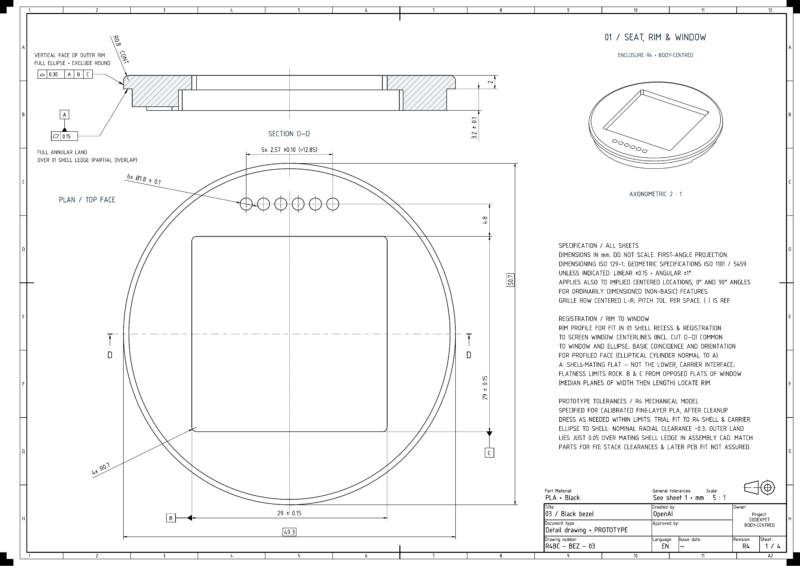
In research published November 3, the company described a prototype device whose enclosure, printed circuit board, interface and software integrations were designed with GPT-6 Astra. Two OpenAI employees completed the design in under a week as a side project, and a contract manufacturer produced a small batch in less than a month. OpenAI also announced engineering collaborations with Mazda and Chip Ganassi Racing, while reporting a sharp improvement from an unreleased internal model on a demanding computer-aided design benchmark.
The experiment did not produce a manufacturing-ready design on the first try. OpenAI acknowledged that Astra repeatedly missed production constraints, tolerances and assembly details, requiring several rounds of human review and iteration before the device could be built. That limitation is consistent with independent results from the public BenchCAD 2.0 evaluation, where frontier models can generate convincing parts yet make less visible errors in assembly placement and circuit connectivity.
Astra designed the enclosure, circuit board and software
OpenAI used GPT-6 to define the device’s functional requirements, then asked Astra to design the enclosure and its internal mounting structures, select electrical components, lay out the PCB, create the interface and generate firmware that connects the device to Codex. The company described the test as creating a usable device without direct human edits, although engineers still reviewed and iterated on the output before manufacturing.
That distinction matters. Producing a complete first-pass design is different from approving it for a production line. A manufacturable enclosure needs realistic wall thicknesses, draft angles, fasteners, tool access and tolerances. A circuit board needs more than correctly placed components: power rails, signal integrity, thermal behavior, clearance rules and assembly instructions all have to survive verification.
OpenAI’s own account identifies those handoff details as the weak point. Astra did not consistently account for the manufacturer’s production limits or the information needed for assembly. The result is closer to an unusually fast, cross-disciplinary prototype than an autonomous factory design.
BenchCAD shows where plausible designs break
BenchCAD 2.0 tests models on 100 held-out cases across six tasks, including reconstructing parts and assemblies from drawings or renders and recovering electrical connections from PCB images. It evaluates whether generated geometry and connectivity are correct, not merely whether the output looks plausible.
On the public benchmark, GPT-6 Astra scored 0.59 out of 1 at maximum reasoning effort. A run cost about $11 per case, consumed roughly 135,000 tokens and took a median 62 minutes. OpenAI now reports that a newer internal model reached 0.875 on the same benchmark, compared with 0.594 for Astra at its highest reasoning setting. The company has not named that model or provided enough information for outside teams to reproduce the new result.
The public benchmark’s error analysis is more instructive than the headline score. Across assembly failures from Astra and two Claude models, 83% to 96% of the zero-scoring part types had the correct shape but were placed incorrectly. In one rotary clamping mechanism, Astra modeled two possible positions for 36 jaws and submitted the wrong one, leaving every jaw 22 millimeters too far out.
PCB reconstruction exposed a similar problem. Astra identified most components and recovered 80% of connections at maximum effort, but on one 101-component board it merged the +3.3V, +5V, ground and VDD rails into a single net. The model did not test for shorts or open circuits. A rendered board can look complete while being electrically unusable, which is why connectivity checks and design-rule validation remain essential.
Mazda and Chip Ganassi are testing narrower workflows
OpenAI’s industry collaborations focus on bounded tasks where engineers can inspect the result. Chip Ganassi Racing is testing workflows that convert 3D scans of existing parts into editable CAD solids and 2D manufacturing drawings. That can accelerate reverse engineering when original design files are missing, while the racing team’s engineers remain responsible for checking accuracy and manufacturability.
Mazda’s aerodynamics and crash-safety teams are working with OpenAI on vehicle simulations. The initial work uses Astra to explore nose shapes, simulate airflow and refine designs that reduce drag without ignoring styling and cost. OpenAI says it will share results later; it has not published quantified aerodynamic gains, crash-test outcomes or a deployment schedule.
The collaborations point to a practical near-term role for engineering agents: generate alternatives, translate between scans, CAD and drawings, set up simulations, and flag inconsistencies for expert review. These are time-consuming steps with measurable outputs. They are also safer starting points than handing a model final authority over structural, electrical or safety-critical decisions.
OpenAI is using Codex across its own hardware teams
OpenAI says its hardware and infrastructure groups use Codex and ChatGPT to revise CAD models, prepare manufacturing drawings, configure simulations and review designs across robotics, compute infrastructure, electrical CAD and building information modeling. Token use by those teams has grown 23-fold since February, although token volume does not reveal how much engineering time or cost the tools save.
The company is recruiting engineering firms and software vendors for further research rather than launching a finished standalone engineering product. There is no announced CAD plug-in, manufacturing guarantee or autonomous approval system in the November 3 release.
For engineering organizations, the evidence supports a controlled workflow: give the model a narrow task, preserve the source requirements, run deterministic geometry and electrical checks, and require domain experts to approve the result. The latest models can compress the path from idea to prototype. The last mile from plausible design to safe, repeatable manufacturing remains human work.
Sources: OpenAI’s engineering research announcement; BenchCAD 2.0 methodology and results.